Fire and sweetness
Brandy in dessert: flambéing, brandy beans, tiramisu
When flambéing, a brandy is ignited over the hot dish, but only part of the alcohol actually burns off. According to measurements by the US Department of Agriculture, roughly 75 percent remains in the food. Brandy beans and many tiramisu recipes likewise contain real alcohol, though the tiramisu from Treviso is made without it.
What happens when you flambé?
In a hot pan, alcohol evaporates faster than water. Hold a flame to these vapors and they burn with a bluish, often barely visible flame, until not enough alcohol remains collected above the pan. Wine won't ignite this way—it's too weak. A brandy at around 40% ABV, by contrast, catches reliably. The heat caramelizes sugar on the surface, creating toasty notes, and the brandy's aroma melds with butter and fruit.
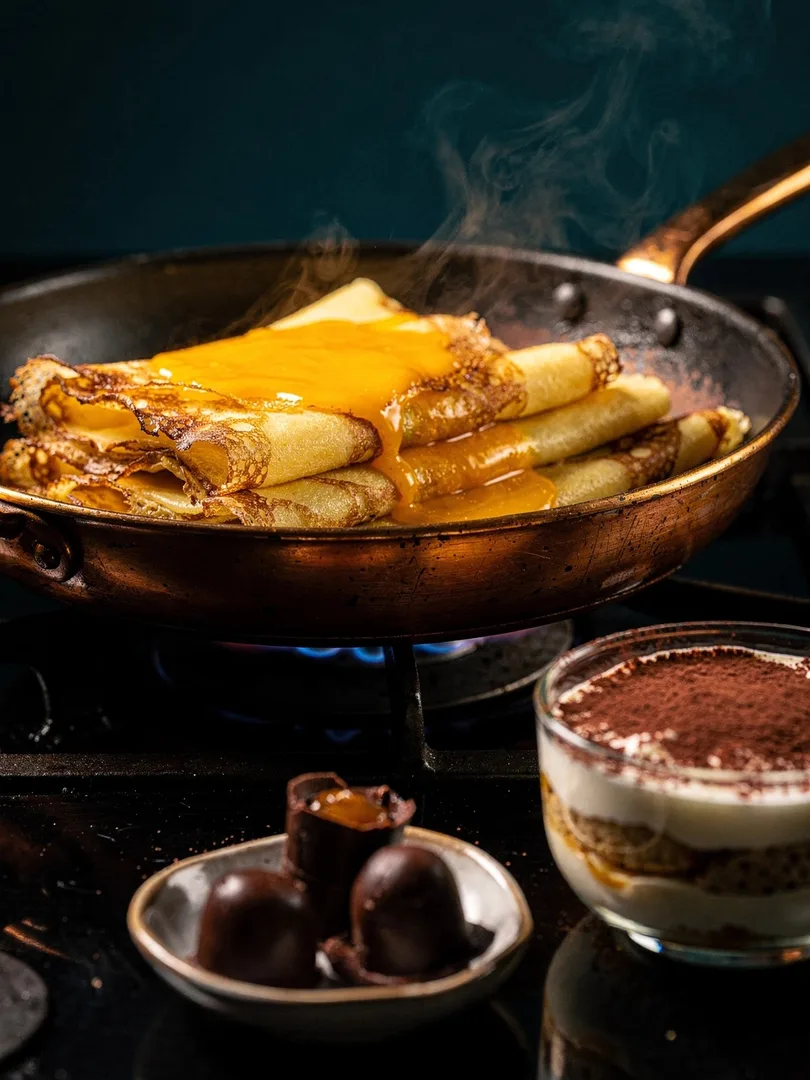
The classics mostly come from French cuisine. For Crêpes Suzette, pancakes are warmed in orange butter and often flambéed with orange liqueur and Cognac. Cherries are flambéed with Kirschwasser, apples with Calvados—each with the brandy of its own fruit. Flambéed bananas, meanwhile, are usually prepared with rum, a distillate made from sugarcane. For the pan, a solid brandy or fruit brandy is sufficient. Old, expensive brandies lose their finesse in the flame and belong in the glass instead.
How much alcohol remains after flambéing and baking?
The widespread assumption that flambéing burns off all the alcohol doesn't hold up under measurement. The US Department of Agriculture (USDA) examined alcohol as part of its table on nutrient losses during cooking. According to its findings, roughly 75 percent remains after flambéing. If alcohol is added to a boiling liquid and the pot is immediately removed from the heat, 85 percent remains. Without heat at all—say, in a cream left to infuse overnight—about 70 percent remains.
Only long cooking times drive off most of the alcohol. Stirred into a batter and baked or braised, about 40 percent remains after 15 minutes, around 25 percent after an hour, and roughly 5 percent after two and a half hours. A briefly baked cake, where the brandy wasn't mixed into the batter, still contains about 45 percent after 25 minutes. For children, pregnant women, people who can't or don't wish to drink alcohol, and anyone who's still driving, a flambéed dessert is therefore not an alcohol-free one.
Flambéing in the kitchen: what to watch for
Burning alcohol poses a real fire hazard, and most accidents share the same cause: someone pouring straight from the bottle into the hot pan. The flame can shoot back into the bottle. It's safer to measure the brandy into a small container beforehand and take the pan off the heat before adding it. An extractor fan should be switched off, so it doesn't draw the flame upward. Long matches or a stick lighter help keep your hand at a safe distance.
If something does go wrong, a well-fitted lid will smother the flame. Water doesn't help with burning fat—it makes things worse. Loose sleeves, hair, and paper towels should stay well clear of the stove. In restaurants, flambéing happens tableside because it looks impressive. At home, it doesn't have to: if you want the flavor without the flame, simply let the brandy simmer gently in the warm sauce for a few minutes. Even then, a large portion of the alcohol stays in the dish.
Brandy beans and tiramisu: alcohol you can't see
Brandy beans are what's known as crusted pralines. A sugar solution containing brandy is poured into molds made of cornstarch powder; the sugar crystallizes into a thin crust on the surface while the filling inside stays liquid. A chocolate coating follows. Because the filling is never heated again once the brandy is added, the alcohol remains fully intact inside. The amount per praline is small, but for children and people who must avoid alcohol, they're still not an innocent sweet.
With tiramisu, alcohol is purely a matter of the recipe. The restaurant Le Beccherie in Treviso had its version notarized with the Accademia Italiana della Cucina in 2010, and it contains no alcohol at all. The dessert's origin is disputed, however, with Friuli also laying claim to it. Many recipes add Marsala, Amaretto, brandy, or rum to the coffee. Of these, only brandy counts as a true spirit in the sense of this journey: Marsala is a Sicilian fortified wine, and Amaretto an almond liqueur.