On the road to brandy
Schnapps fountains, the Brennersteig trail, distillery visits: brandy as an outing
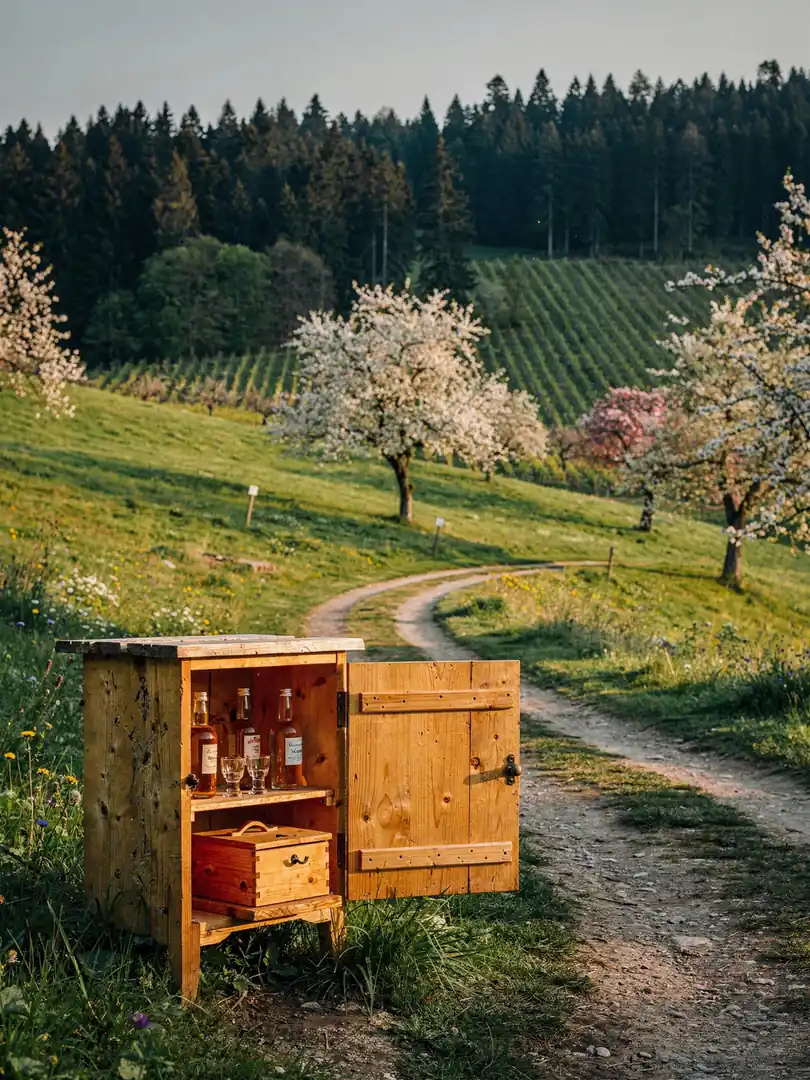
Schnapps fountains are wooden boxes along hiking trails where, for a small fee dropped into an honesty box, you can help yourself to a glass of fruit brandy. They're best known from the Oberkircher Brennersteig in the Black Forest. Add to that distillery tours, fruit blossoms, and farm shops. Anyone traveling this route samples with their nose as much as their palate.
What is a Schnapsbrunnen?
It shares nothing with an actual fountain but the name. A Schnapsbrunnen is a small wooden cabinet or box at the trailside, usually stocked by a nearby farm distillery. Inside sit a few bottles of fruit brandy, some glasses, and a cashbox. Hikers who stop pour their own drink and drop the price into the box—no one checks. The system relies on the distillers' trust and the hikers' honesty. It doubles as advertising: anyone who enjoys a Kirschwasser often finds the farm itself just a few hundred meters further on.
The best known is the Oberkircher Brennersteig in the Renchtal, a circular route of just over 13 kilometers through orchards, vineyards, and woodland, dotted with several such boxes. Other Black Forest communities have set up similar schnapps trails too. A glass as a rest stop is part of the experience—a round at every single stop is not. On steep forest paths, alcohol and elevation gain make a poor combination. Water in the backpack and an eye on the clock belong in the planning alongside the hiking map.
Why are there so many distilleries in the Renchtal?
The answer goes back almost three centuries. In 1726, the Bishop of Strasbourg, Armand Gaston de Rohan, granted farmers around Oberkirch the right to distill surplus fruit. In 2026, this distilling right marked its 300th anniversary. Today, tourism promotion cites roughly 700 farm and household distilleries and the highest density of small distilleries anywhere in Europe—a marketing claim that's hard to verify. What's certain is that hardly anywhere else in Germany are so many stills packed into so little space.
Almost all of them are Abfindungsbrennereien, small distilleries operating under license from the local customs office, producing no more than 300 liters of pure alcohol per year, with tax calculated as a flat rate based on the quantity of fruit used. Since 2018, this license has been tied to the individual rather than the farm. Without a license, distilling alcohol in Germany is illegal, even for personal use. There are also so-called Stoffbesitzer, people who bring their own fruit to be distilled at someone else's licensed distillery, limited to 50 liters of pure alcohol per year.
What can you expect from a distillery tour?
A tour usually begins at the mash vats, where the crushed fruit ferments for weeks. From there it moves to the copper pot still, often topped with a column with several plates that strengthens the alcohol. Good distillers will explain why they separate the heads, with their solvent-like smell, and the tails, with their heavy fusel notes, as well. Only the heart of the run makes it into the glass. At the end come the glass demijohns and stainless steel tanks where the clear brandy rests.
A visit is liveliest during the distilling season, usually between autumn and spring, when the stills are running and the air smells of mash and warm copper. In April, the fruit blossoms draw visitors instead. Brandy is a travel destination beyond Germany too: in Normandy, the Route du Cidre winds through the Pays d'Auge to farms producing cider and Calvados; in the Charente, Cognac houses open their cellars; and the Wachau pairs apricot blossom season with Marillenbrand.
Tasting and driving: what are the rules?
A tasting of six brandies at one centiliter each adds up to more than a large shot of schnapps. In Germany, driving with a blood alcohol level of 0.5 per mille or above is an administrative offense. Even from 0.3 per mille, penalties can apply if driving errors or signs of impairment are present. For new drivers in their probationary period and everyone under 21, the limit is zero. Distilleries know this well and typically offer the option of simply smelling the spirit, or taking only a tiny sip and spitting the rest into a spittoon.
The most relaxed way to travel is not driving at all. Many distillery trails are accessible by bus or train, and in groups it's easy to designate one driver who only sniffs along. With brandy, the nose tells you a great deal anyway: fruit, cleanliness, off-notes. Whatever you like, you can pick up at the farm shop and try properly at home later. Buying directly from the farm is standard practice at Abfindungsbrennereien and often the only way to get hold of small batches of rare single-variety brandies.