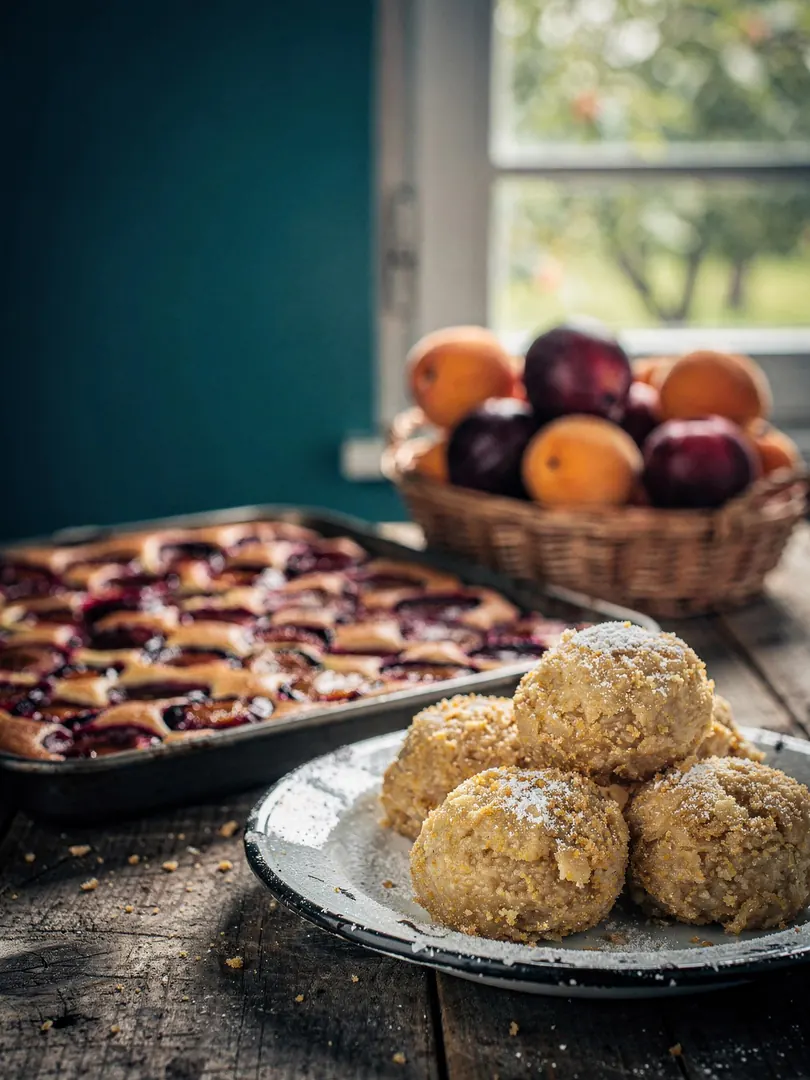
The same fruit
Apricot dumplings, plum cake & co.: the fruit cuisine of distilling regions
Wherever fruit is distilled, it's also cooked and baked: in the Wachau, the same apricot becomes both dumplings and apricot brandy; in Bavaria and Swabia, the same plum becomes Datschi cake and plum brandy. A good brandy doesn't need leftovers for this — it needs fully ripe, healthy fruit.
Why fruit cuisine and distilling share the same map
A large cherry or plum tree bears more fruit in a few weeks than a family can eat fresh. In the past, every fruit-growing region was therefore also a region of preservation: people dried fruit, cooked it into jam, steeped it in syrup, and distilled what couldn't be stored any other way. From this provisioning economy come the pastries and cakes now considered regional classics, as well as the small farm distilleries. Both depend on the same standard-trunk trees and traditional orchard meadows.
This even extends into tax law. In Germany, the legislature justifies the reduced alcohol tax for Abfindungsbrennereien — small farm distilleries with a distilling license — explicitly by citing the preservation of traditional orchard meadows. In 2023, 10,931 such distilleries were still in operation. Where they disappear, the old trees often disappear too, since table fruit today mostly comes from low-growing plantations. Anyone driving through Baden, Franconia or the Mostviertel in autumn will often see cake stands and distillery signs in the very same village.
Apricot dumplings and Wachau apricot brandy
In the Wachau on the Danube, apricots—known as Marillen in Austria—have reportedly been cultivated since 1509. The fruit itself carries the name "Wachauer Marille," a protected designation of origin. It becomes Marillenknödel, a classic of Austrian pastry cuisine: a pitted apricot, often with a sugar cube in place of the stone, is wrapped in curd cheese or potato dough, boiled, and rolled in toasted butter breadcrumbs. The dumplings themselves contain no alcohol—the brandy is served alongside.
That's called "Wachauer Marillenbrand," and it has been a protected geographical indication of the EU since Austria's accession in 1995. It comes from 21 municipalities, predominantly made from the Klosterneuburger Marille variety, with a minimum of 38% ABV and no more than 4 grams of sugar per liter. Continuous column distillation is prohibited. Wachauer Marillenlikör is a different product entirely: sweetened, lower in strength, and simply a liqueur. So anyone asking for "Marille" at a Heuriger should know which of the two they mean.
Zwetschgendatschi, Powidl, and Zwetschgenwasser
The Zwetschge is a subspecies of plum—more elongated, firmer in flesh, and easy to pit. That's why it holds its shape in the oven. Zwetschgendatschi, a sheet cake made from yeast or shortcrust pastry topped densely with plum halves, is so widespread in Bavaria and Swabia that Augsburg is popularly nicknamed "Datschiburg." In Austria and Bohemia, the fruit is slow-cooked for hours into Powidl, a dark fruit butter used in Powidltascherl and Germknödel.
The brandy made from it is called Zwetschgenbrand or Zwetschgenwasser. EU regulations also permit the shorter terms "Zwetschge," "Pflaume," and "Slibowitz," all referring equally to a brandy distilled from plums. Typical notes include a spicy character reminiscent of marzipan and spice, derived from both flesh and pits. "Schwarzwälder Zwetschgenwasser" is a protected geographical indication. Mirabelle plums share this same double life: in Lorraine, they end up as tart filling on the table and as "Mirabelle de Lorraine" in the bottle.
Do you only distill what's left over?
A persistent myth claims that the mash is made from whatever isn't fit for the kitchen or market: windfall fruit, bruised spots, rotten bits. For a good brandy, the opposite is true. Distillation concentrates every aroma, the bad ones included. The specifications for the Swiss designation of origin Zuger Kirsch list typical faults of a spoiled mash, including mustiness, mold, acetic acid, and butyric acid. Distillates from table cherries are explicitly forbidden there; only dedicated distilling cherry varieties are used.
Fruit destined for distilling must be fully ripe, since only then does it have enough sugar for fermentation and full aroma development. Rotten spots are sorted out, stems and leaves removed. With stone fruit, the pits are kept as intact as possible, since crushed pits release hydrocyanic acid. So the kitchen doesn't get the better fruit—usually it's the very same fruit, just destined for a different purpose. Poires Belle Hélène with chocolate sauce and Williams brandy often share the same variety too: the Williams Christ pear, whose brandy alone may bear the name "Williams."