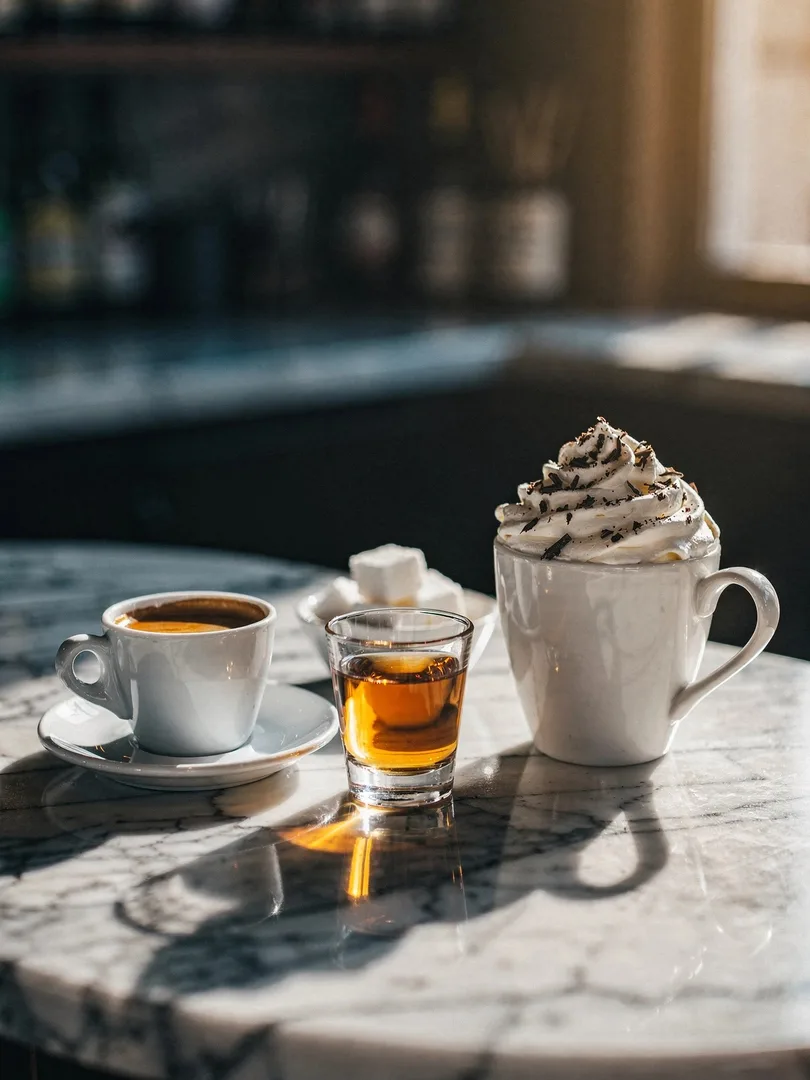
A cup with a kick
Caffè corretto, Rüdesheimer Kaffee, Kafi Luz: spirits in coffee
Spirits in coffee go by their own name in many countries: in Italy, Grappa goes into Caffè corretto; in Rüdesheim, flambéed brandy goes into Rüdesheimer Kaffee; in central Switzerland, Träsch goes into Kafi Luz. Pharisäer and Irish Coffee don't belong to this group, as they contain rum and whiskey.
Caffè corretto: the "corrected" espresso
Corretto means corrected. It refers to an espresso given a small dash of spirit at the bar, most often Grappa in northern Italy. Some bars pour the spirit directly into the cup, others serve it alongside in a small glass so guests can dose it themselves. Sambuca is also common instead of Grappa. However, that's a sweet anise liqueur, not a brandy, and it gives the coffee an entirely different character. Anyone who specifically wants brandy should order a Corretto alla grappa.
In northeastern Italy there's a variant of this custom called Resentin, roughly meaning "rinse." After the espresso, a splash of Grappa goes into the still-warm cup, is swirled around, and drunk along with the remaining coffee and sugar. Both customs call for a young, clear Grappa. A Riserva long-aged in oak, with its vanilla and wood notes, is better enjoyed on its own, since its subtleties would be lost alongside the espresso's roasted aromas.
Rüdesheimer Kaffee: brandy, fire, and cream
Germany's best-known coffee with spirits is an advertising invention. In 1957, TV chef Hans Karl Adam developed a coffee specialty featuring Asbach Uralt on behalf of Asbach. The company is based in Rüdesheim am Rhein, where Hugo Asbach founded his distillery in 1892. Asbach also coined the word Weinbrand (brandy), registered as a trademark in 1907 and, since 1923, the generic term for German wine brandy, after the Treaty of Versailles reserved the term "Cognac" for France.
In the traditional porcelain cup, sugar cubes and brandy are flambéed until the sugar melts. Hot coffee is then added, topped with cream, vanilla sugar, and chocolate shavings. Some of the alcohol burns off in the process, but most of it remains in the drink. Important for classification purposes: there is no protected designation of origin called "Rüdesheimer Weinbrand." In Germany, only "Deutscher Weinbrand" and "Pfälzer Weinbrand" are protected. Rüdesheimer Kaffee is a recipe, not a protected product of origin.
Kafi Luz, Kaffee fertig, Café-calva, and Carajillo
In central Switzerland, coffee with spirits is an everyday drink found in farmhouse kitchens and ski huts. The Kafi fertig, known as Kafi Luz in Lucerne, is served in a glass: sugar cubes, weak coffee, and a generous splash of brandy. Traditionally this is Träsch, a brandy made from pears and apples, or Zwetschgenwasser (plum brandy), less often Kirsch. An old rule of thumb says to pour in enough coffee that the sugar disappears, then add enough brandy until it reappears.
Other regions drink their spirit alongside the cup rather than in it. In Normandy, this is called Café-calva: a glass of Calvados accompanies the coffee after a meal, or is poured into it. In Spain, the Carajillo is common, an espresso with brandy, or depending on the region, with rum or liqueur. What these customs have in common is that a clear or aged regional spirit complements the coffee, rather than being mixed into an elaborate concoction. These traditions have little to do with cocktails in the modern sense.
Pharisäer and Irish Coffee: other spirits in coffee
Two well-known coffee drinks contain no brandy at all. The Pharisäer originates from the North Frisian peninsula of Nordstrand. According to legend, in 1872 farmers there hid rum under a layer of whipped cream at a christening celebration to conceal it from their strict pastor, who, upon discovering the ruse, called them "Pharisees." Rum is a distillate made from sugarcane or molasses. Irish Coffee contains Irish whiskey, a distillate made from malted barley and other grains, aged in oak.
One point applies to all these variations and is often misunderstood: coffee does not sober you up. Caffeine may mask the drowsiness that alcohol brings on, but it doesn't change your blood alcohol level at all. Anyone who feels more alert after a Rüdesheimer Kaffee is only imagining it. If you need to drive, skip the shot and order your coffee plain. You can still enjoy the aroma of a good brandy alongside the cup, without drinking a drop.