Festivals Around the Fire
Queimada, Kazani, Trou Normand: Fire and Distilling Traditions
Many spirits come with their own traditions: on Crete, autumn is celebrated at the Kazani, the copper still used for Tsikoudia; in Galicia, Orujo is set alight as Queimada; and in Normandy, the Trou Normand interrupts the feast. Behind every custom lies a particular spirit and a particular season.
Kazani in Crete: The Festival at the Still
After the grape harvest, Crete is left with pomace, the skins, seeds, and stems from pressed grapes. It ferments for several weeks in barrels before being distilled in October and November in the Kazani, a copper still. The distilling season is called Rakokazano, and it's more of a celebration than a chore. Neighbors, friends, and family gather around the still, cooking and eating by the fire, often with music playing. The freshly distilled spirit is sampled right away.
The spirit is called Tsikoudia, and as 'Tsikoudia of Crete,' it holds a protected geographical indication from the EU. Legally, it's a pomace brandy, related to Grappa and Marc rather than to brandy proper. Colloquially, many Cretans call it 'Raki,' though it contains no anise. In Cretan tavernas, a small carafe often arrives at the table after the meal, accompanied by a bit of fruit or pastry, as a gesture from the house. Anyone who doesn't wish to drink can simply leave it untouched without causing offense.
Queimada: Orujo in Flames
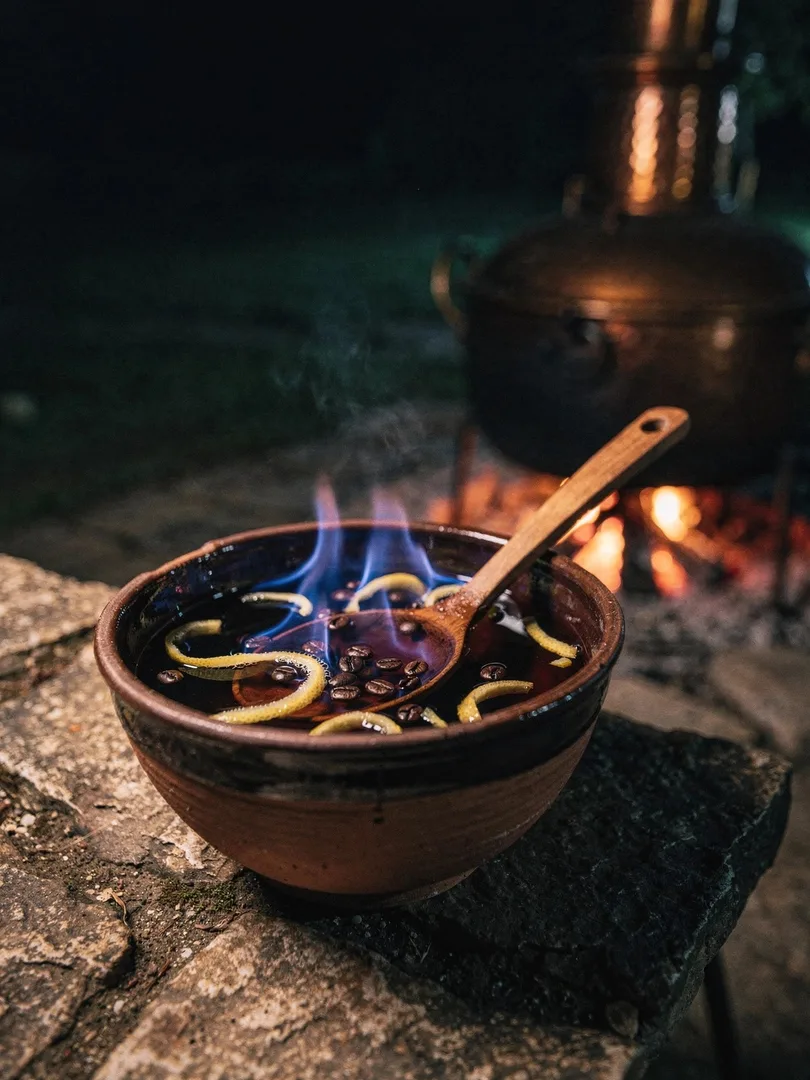
In Galicia, in northwestern Spain, Orujo, the local pomace brandy, gets set on fire. To make a Queimada, Orujo, sugar, lemon or orange peel, and a few coffee beans go into a large clay bowl. The mixture is then ignited and stirred until some of the alcohol burns off and the drink takes on aromas of caramel and citrus. As this happens, someone recites the Conxuro, an incantation meant to ward off evil spirits. Queimada is especially associated with the Night of San Juan in June and with long evenings spent among friends.
The incantation sounds ancient, but according to common accounts, it actually dates back to the 20th century. That doesn't diminish the magic of the evening, but it shouldn't be passed off as Celtic lore either. 'Orujo de Galicia' has held protected geographical indication status in the EU since 1989. Open flame with alcohol at the center of a table remains risky: keep a safe distance, clear away anything flammable, and have a lid ready to smother the flames. Even after the fire dies down, there's still plenty of alcohol left in the cup.
Trou Normand: The Hole in the Feast
Normandy has a tradition of pausing in the middle of a meal. Between two courses of a long feast, a small glass of Calvados is served, these days often poured over a scoop of apple sorbet. The name means 'Norman hole': the spirit is meant to make room in the stomach for what's still to come. Similar pauses exist elsewhere, such as the 'coup du milieu' in western Switzerland, a glass of Kirsch served halfway through a cheese fondue.
Medically speaking, the idea doesn't quite hold up. A Zurich study, published in the British Medical Journal in 2010, found that during cheese fondue, the stomach empties more slowly with alcohol than with tea. So the 'hole' in the stomach is more of a feeling than an actual process. Still, as a tradition, the Trou Normand has its merits. It breaks up a meal that stretches on for hours and brings the region's fruit to the table at least once. The sorbet alone serves that purpose just as well.
Winter Distilling in the Alps, and a Distinction Worth Making
In the Alpine region, distilling season traditionally falls in winter, when work in the fields and meadows comes to a halt. In Fraxern, in Vorarlberg, where cherries have been documented since 1574, the cherry brandies are double-distilled in December. Some families sew little sachets from the cherry pits, which are warmed in the oven and used as heating pads. In Tyrol's Wildschönau valley, eligible farms distill Krautinger from stubble turnips, a right that dates back to a privilege granted in the era of Maria Theresa.
A related fire tradition, strictly speaking, doesn't belong here. In Feuerzangenbowle, burning rum drips from a sugar loaf into hot red wine. Rum is a spirit distilled from sugarcane or molasses, not a brandy made from fruit or wine, and it needs an especially high alcohol content for the sugar loaf ritual to work. Fruit brandy doesn't perform this trick nearly as well. So if you're looking for a winter fire ritual involving spirits, you're better off with Queimada or the Cretan still.