Kirsch for baking
Kirsch in the kitchen: Black Forest and Zug cherry cake
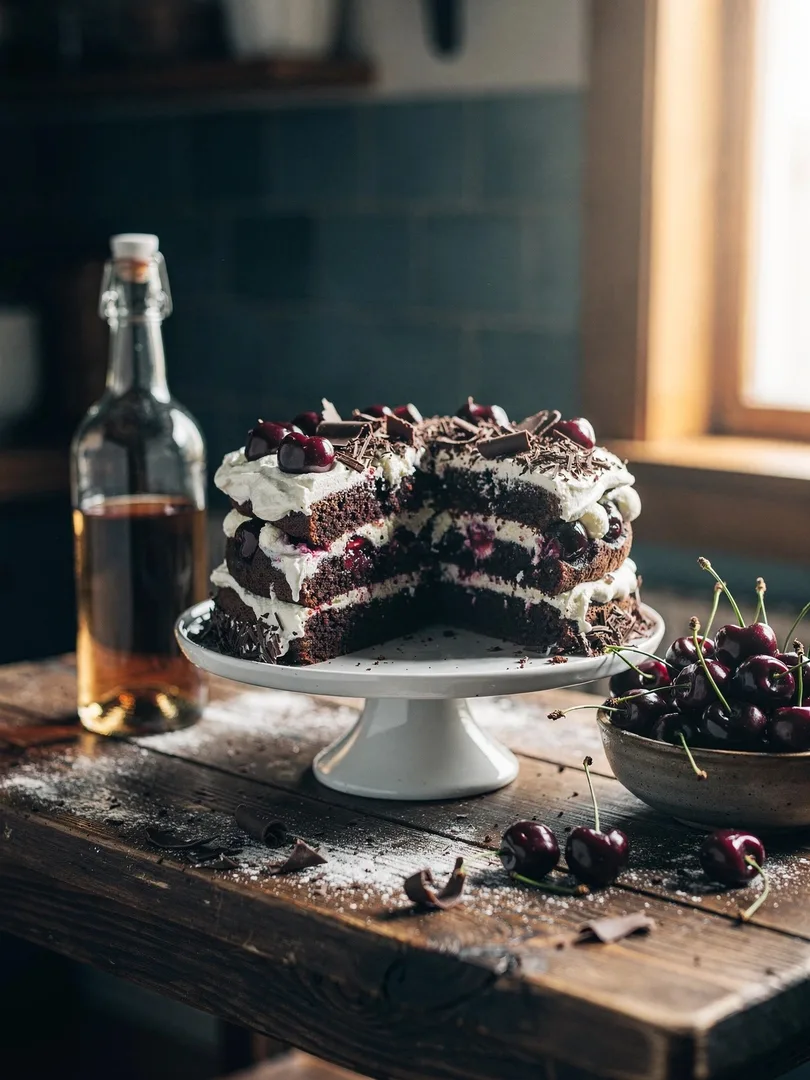
Kirsch is mainly a flavoring agent in the kitchen: it soaks the layers of Black Forest cake and Zug cherry cake, and seasons compote, fruit salad and creams. For Black Forest cherry cake, German guidelines for fine baked goods require that the kirsch be clearly tasted.
Kirsch for baking: a brandy, not a liqueur
In many kitchens along the Upper Rhine, the bottle sits ready next to the flour and sugar. What's inside is regulated by the EU Spirit Drinks Regulation: kirsch is a cherry brandy in the fruit brandy category, made from fermented cherries, with at least 37.5% ABV and no added alcohol or flavoring. The ending "-wasser" is just a permitted second name, as is the short form "Kirsch." A cherry liqueur is something else entirely. It's sweetened, usually colored red by juice, and noticeably weaker.
For pastry chefs, what matters most is that kirsch is clear and almost sugar-free. It adds aroma without coloring the cream or adding extra sweetness. The typical almond and marzipan note comes from the pits, which are kept as intact as possible during mashing. Too much damage here would be a mistake, since crushed pits release hydrocyanic acid, for which an EU maximum applies. Important for children and drivers: kirsch is usually added to the cake layers only after baking. Its alcohol then largely remains in the cake.
Black Forest cherry cake: what do the guidelines require?
Germany's most famous cake has something like an official profile. The guidelines for fine baked goods, part of the German Food Code, describe what buyers may expect under this name. This includes dark layers with cocoa, a filling of cream and sour cherries, and a kirsch flavor that must be clearly perceptible. The guidelines aren't law. But food inspectors and courts refer to them when checking whether a name is misleading.
A cake that tastes only of cherry juice or flavoring therefore carries the name wrongly. Who invented the cake is disputed; several pastry chefs and towns claim the honor. What's undisputed is the connection to the distilling tradition. Old, small-fruited distilling cherries grow in the Black Forest, and "Schwarzwälder Kirschwasser" has been a protected EU geographical indication since 1989. Cherry brandies, however, are at home throughout the Upper Rhine and Alpine region, from Alsace to Zug.
Zug cherry cake: kirsch without cherries
Its Swiss relative looks completely different. Zug cherry cake contains not a single cherry. It consists of two crisp nut meringue layers, a sponge cake soaked generously with kirsch in between, wrapped in buttercream and dusted with powdered sugar. The pastry chef Heinrich Höhn, who settled in Zug in 1913, is credited as its inventor. The first advertisement using the name "Zuger Kirschtorte" appeared in 1915 in the "Zuger Nachrichten." In 1943, Höhn handed his business over to his head pastry chef, Jacques Treichler.
The kirsch used for it has its own designation of origin. "Zuger Kirsch" or "Rigi Kirsch" has been a Swiss AOP, a protected designation of origin, since 2013. The specification requires approved distilling cherry varieties from standard-trunk trees, prohibits byproducts from table cherries, and allows a maximum of 5 grams of sugar per liter. Distillation happens only in a pot still, and it's sold at a minimum of 40% ABV. For the cake, this means its entire cherry flavor comes from the brandy, not the fruit.
Compote, fruit salad, chocolates: kirsch in small amounts
Outside of cakes, kirsch is used sparingly. A splash lifts cherry compote, red berry pudding or a fruit salad with pineapple and berries, since it emphasizes fruit without adding sweetness. In Switzerland, cherry sticks are well known — chocolates with a liquid cherry filling under a sugar crust. In creams and whipped cream, the same rule of thumb applies as with the cake: what isn't heated keeps its alcohol. Anyone baking for children replaces the brandy with cherry juice and accepts that the result tastes different.
For cooking purposes, a solid cherry brandy is enough. Very old or rare single-variety brandies show themselves better in the glass, where their finer points don't get lost next to cream and chocolate. A cherry liqueur is only a limited substitute, since it brings along sugar and color. The English term "Cherry Brandy" is additionally misleading: it usually refers to a cherry liqueur, not a cherry brandy, even though the word "Brandy" suggests otherwise.