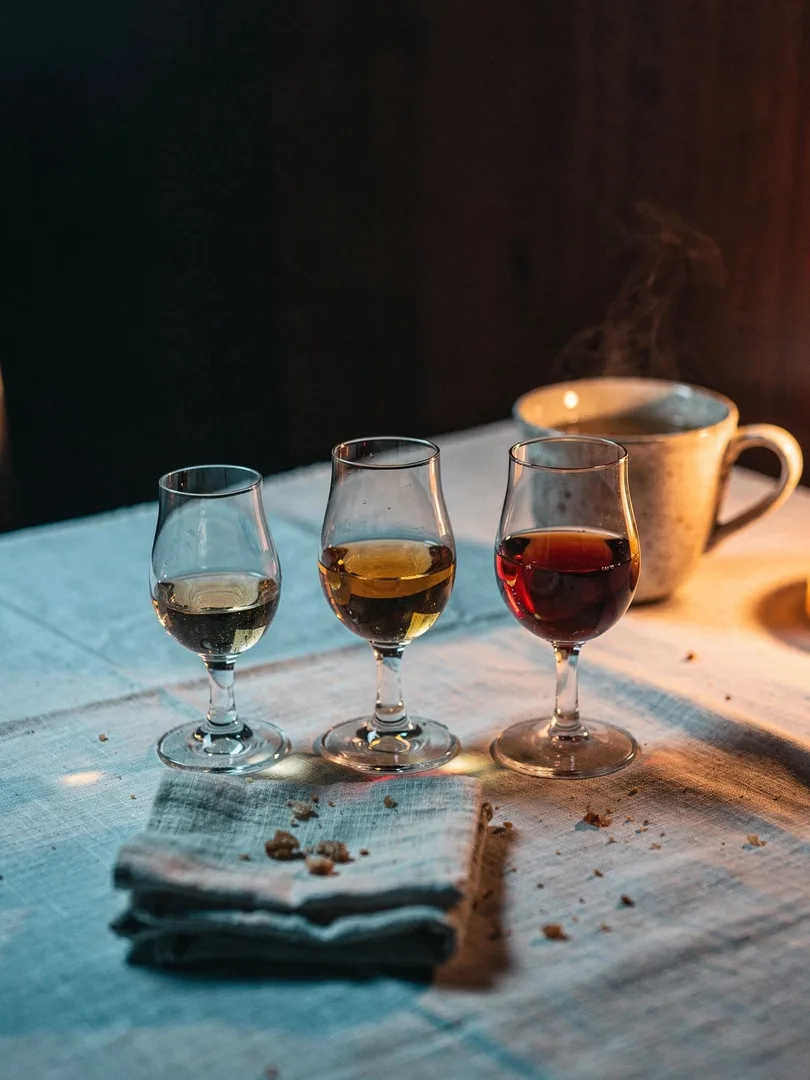
The glass afterwards
Digestif: which spirit after which meal?
A digestif is a small glass after a meal, classically a fruit brandy, grape brandy, Calvados or grappa. The choice depends on the meal: clear fruit brandies after light dishes, cask-aged spirits after roasts and chocolate. Studies show it doesn't actually speed up digestion.
What counts as a digestif?
The name comes from French and refers to something meant to aid digestion. It's a small glass to close out a meal, often served once the plates and cutlery have already been cleared. Legally, a digestif isn't a category. It describes a moment, not a drink. That's why the digestif shelf holds drinks with little in common technically: fruit brandies like kirsch or Williams, grape brandies like Cognac and Armagnac, Calvados made from cider, grappa made from grape pomace, plus herbal liqueurs and sweet fortified wines like Port.
Looking at production helps with the selection. A brandy (Brand) is the distillate of a fermented raw material and barely sweetened: EU Spirit Drinks Regulation 2019/787 allows a maximum of 18 grams of sugar per liter for fruit brandy, and 35 grams for grape brandy. A liqueur, by contrast, is distinctly sweet and usually flavored with herbs or fruit. Italian Amaro, a bitter herbal liqueur, therefore belongs among liqueurs and isn't a brandy. Port, meanwhile, is wine whose fermentation was stopped with grape brandy. It's a fortified wine and roughly half as strong as a brandy.
Which spirit suits which meal?
There are no fixed rules, but there is plenty of experience from restaurants and distilleries. After light dishes with fish, vegetables or white meat, colorless fruit brandies feel fitting. A Williams brings pear aroma, a raspberry eau-de-vie a delicate berry note, a kirsch a faintly almond-like stone-fruit tone. Such brandies usually rest after distillation in glass or stainless steel so the fruit stays front and center. Wood would mask it. A young grappa made from aromatic grape varieties like Moscato also fits this category.
After roasts, game or a hearty braise, heavier spirits are welcome. A plum brandy with its spicy, marzipan-like tone complements a dark sauce. Cask-aged spirits like Calvados, Armagnac or an older Cognac bring vanilla, dried fruit and nut. After a chocolate dessert, they're often the better choice than a clear fruit brandy, whose delicate fruit gets lost next to cocoa. With cheese, region often plays a deciding role — covered in its own chapter of this journey.
Does a drink after a meal help digestion?
Many know the feeling: after fondue, roast pork or goose, the meal sits heavy in the stomach, and a glass of fruit brandy seems to bring relief. "Schnapps" isn't a technical term here, just colloquial speech for spirits of all kinds. Whether that small glass really helps was studied by a research team led by Heinrich and Fox in Zurich. The randomized study appeared in 2010 in the British Medical Journal. Twenty test subjects ate cheese fondue, in different rounds with white wine and kirsch or with black tea.
The result ran counter to folk wisdom. With alcohol, the stomach took considerably longer to empty than with tea. Alcohol slows digestion rather than speeding it up. Experts explain the pleasant feeling after the glass through relaxation, not a harder-working stomach. The study was small, but its direction was clear. Anyone seeking something soothing after a heavy meal is at least as well served by herbal tea, an espresso or a walk.
How is a digestif served?
A digestif is deliberately small, usually two centiliters in restaurants. Clear fruit brandies go into the glass slightly below room temperature, since too much cold locks in the aroma and too much warmth makes the alcohol sting. Aged spirits tolerate normal room temperature. A slim tulip glass concentrates the aroma better than a wide snifter or a stamperl, the small, straight shot glass. Anyone serving several spirits starts with the lightest and ends with the cask-aged one.
No one has to drink alcohol to close a meal, especially not if they're still driving. Alcohol-free distillates with herbal or fruit notes are widespread today. Legally they're not brandies, since a fruit brandy needs at least 37.5% ABV and a grape brandy at least 36% ABV. As a gesture at the end of a meal, though, they serve the same purpose. A good host puts both on the table, the bottle and the alternative, and lets guests choose.