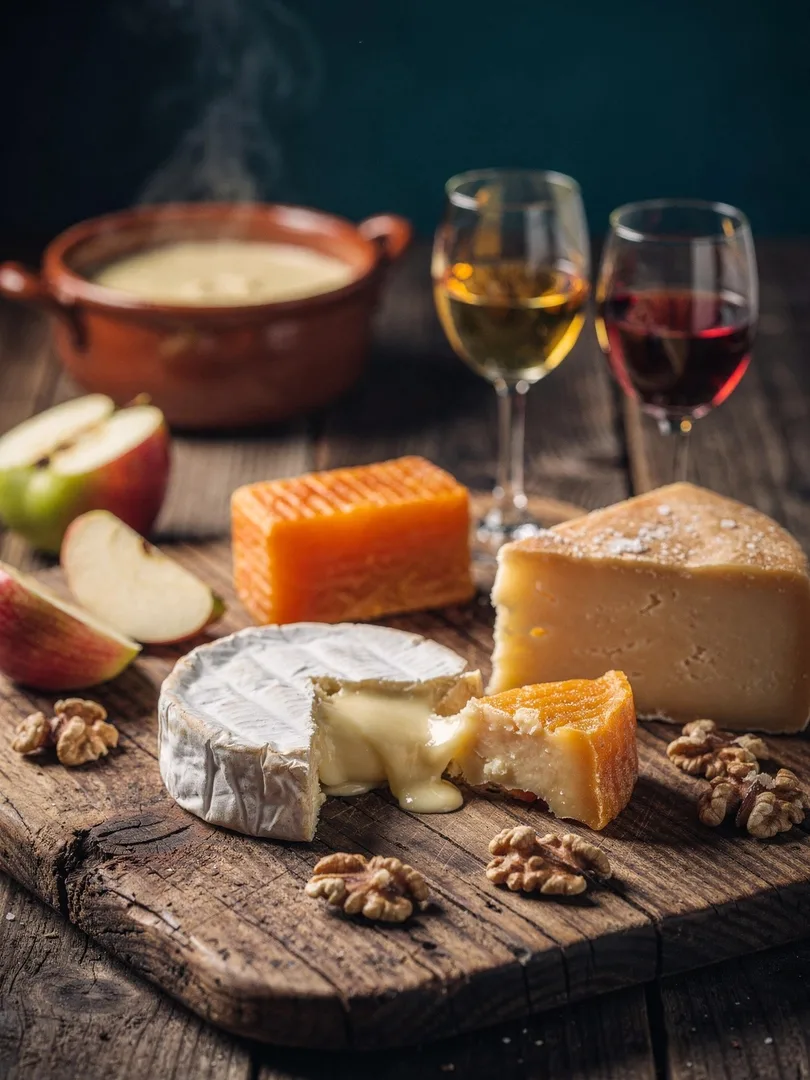
Pairs from the same region
Brandy and cheese: Calvados with Camembert, kirsch with fondue
Brandy and cheese pair best when both come from the same area: Calvados with Camembert and Livarot, kirsch with Swiss cheese fondue, Marc de Bourgogne with Époisses, whose rind is washed with this very pomace brandy. The cheese's fat and salt soften the alcohol's sharpness.
Why do brandy and cheese go together?
Many wines struggle with strong cheese. A ripe washed-rind cheese or an aged hard cheese can easily overpower delicate wines, and the tannins in red wines can taste metallic alongside salt and fat. A brandy hardly has this problem. It brings a concentrated aroma that holds its own next to the cheese, and no tannins from grape skins. Conversely, milk fat coats the tongue with a film that softens the burn of the alcohol.
The most reliable principle is an old one: what grew up together belongs together. In many regions, cheese and brandy came from the same farms, the same agriculture of meadows, cows and orchards. That's no guarantee, but a good starting point. When tasting, a small sip alongside a bite is enough, plus water. Anyone comparing several pairings should start with mild cheese and clear brandy, then work up to strong cheese and cask-aged spirit.
Calvados with Camembert: the Normandy pairing
Normandy delivers both in pure form. Its pastures yield Camembert de Normandie, Livarot and Pont-l'Évêque, all with protected designation of origin. Its orchards yield Calvados, a brandy made from cider — fermented apple and pear wine — aged at least two years in oak. The apple fruit of Calvados meets the fungal, faintly cabbage-scented rind of Camembert, while the wood notes suit the spice of Livarot and Pont-l'Évêque.
In the Pays d'Auge, the hill country east of Caen, cheesemakers and Calvados farms often sit just a few kilometers apart. Some cheesemakers offer Camembert additionally refined with Calvados, though that isn't part of the designation of origin. Pommeau is also often served with cheese, an apple must fortified with Calvados. It's sweeter and weaker and legally not a brandy. The trou normand, a glass of Calvados served mid-feast, is a separate custom and not part of the cheese board.
Kirsch with cheese fondue: ingredient, companion, custom
Kirsch appears twice in Swiss cheese fondue. Many recipes stir a splash of it together with some cornstarch and add it to the melted cheese mixture just before serving, where it provides aroma and binding. At the table, bread is then sometimes dipped in kirsch before being dunked in the fondue. In French-speaking Switzerland, the "coup du milieu" is also known, a small glass of kirsch served halfway through the meal. This is custom, not necessity.
It has little to do with digestion. The 2010 Zurich study published in the British Medical Journal tested exactly this meal: with white wine and kirsch, the stomach emptied more slowly after cheese fondue than with tea. Anyone drinking kirsch with fondue does so for the taste, then. And it fits: the delicate stone-fruit note lifts the savoriness of Gruyère and Vacherin without masking it. Black tea remains the traditional alcohol-free accompaniment.
Époisses, grappa and aged hard cheese: further pairings
In Burgundy, the brandy is even part of the cheese itself. The specification for the Époisses designation of origin requires that the rind be washed during aging with water and then with increasingly concentrated Marc de Bourgogne. Marc is the French word for pomace brandy, a brandy made from the fermented skins and seeds left over from pressing. It contributes to the rind's orange-red color and intense aroma. A glass of the same brandy alongside is a natural choice.
Italy thinks along similar lines. An aged grappa, also a pomace brandy, pairs with long-aged hard cheese like Parmigiano Reggiano or an old Montasio from Friuli, where both traditions live side by side. With blue cheese, many prefer something sweet instead. The English classic Stilton with Port shows why: sugar tames the salt and sharpness of the mold. Port isn't a brandy here but a fortified wine, and rightly belongs on the board in this case.