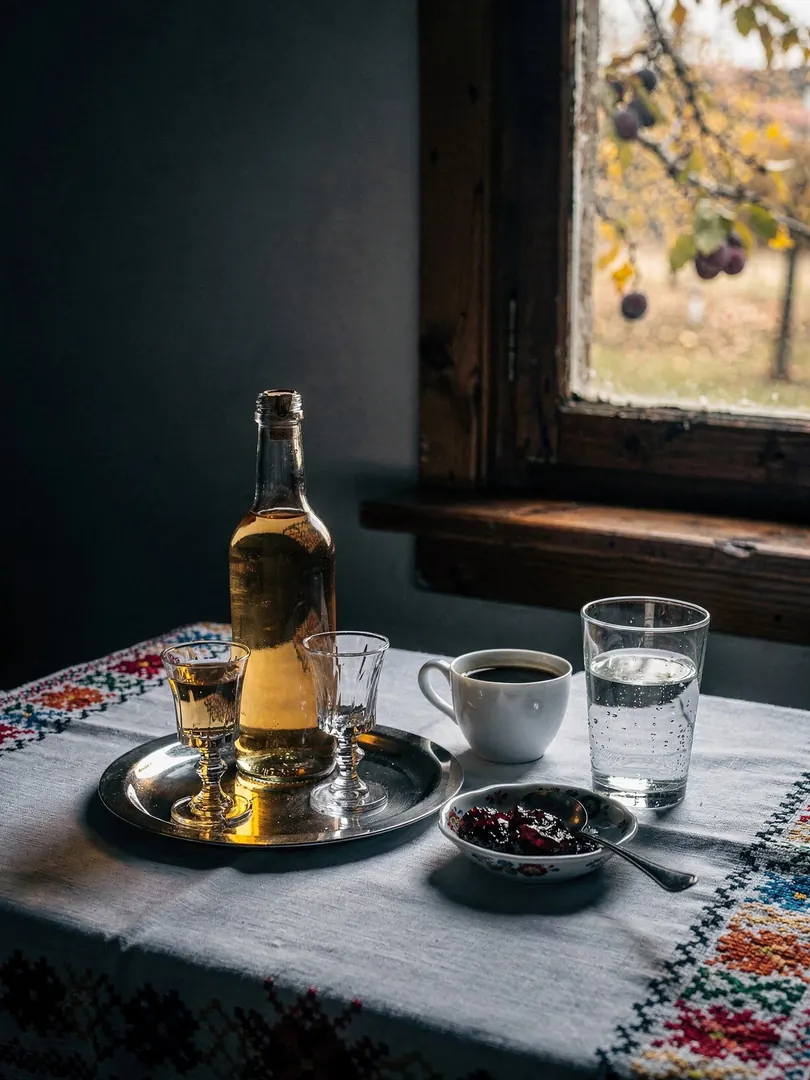
Guest and glass
Rakija, Pálinka, Chacha: brandy as hospitality and ritual
Across the Balkans, in Hungary, and in Georgia, brandy is part of hospitality: Rakija as a welcome, Pálinka for a toast, Chacha at the festive table. Rakija is an umbrella term for fruit and grape brandies, Pálinka a strictly protected Hungarian fruit brandy, and Chacha a Georgian pomace brandy.
What is Rakija, and what isn't it?
Between Slovenia and Bulgaria, nearly the same word applies everywhere to fruit brandy. Rakija isn't a single drink but an umbrella term for brandies made from fruit or grapes. Šljivovica is distilled from plums, Loza from grapes, Kajsija from apricots, Dunja from quinces, and Viljamovka from Williams pears. Within the EU, several of these enjoy protected status as geographical indications, including Hrvatska stara šljivovica and Slavonska šljivovica from Croatia, as well as several Bulgarian grape brandies registered under the name Grozdova rakya.
Rakija is easily confused with two namesakes. Turkish Rakı is an anise-flavored spirit based on grape distillate—an entirely different drink that turns milky-cloudy when mixed with water. And what tourists in Crete order as "Raki" is actually called Tsikoudia there, a pomace brandy made without anise. Serbia, which isn't an EU member, found a different path to recognition in 2022: UNESCO added the social customs and knowledge surrounding Šljivovica to its list of intangible cultural heritage.
Rakija as welcome and gift
Guests visiting a family in Serbia, Bosnia, or Croatia are often offered a small glass of Rakija first, sometimes even in the morning. It comes alongside coffee, water, and something sweet. Rakija appears on the table at weddings, christenings, and church family celebrations, and a bottle from a home distillery makes a popular gift. Folk medicine attributes numerous uses to it, from rubbing it on the skin to compresses. That's tradition speaking, not proven medicinal effect.
No one is obliged to drink along. A polite no with thanks is generally understood, especially if you're driving or abstaining for other reasons. Anyone bringing a bottle home should know the customs rules. Travelers from countries outside the EU such as Serbia or Bosnia and Herzegovina may bring in one liter of spirits above 22% ABV duty-free. Homemade, unlabeled bottles are often excellent. But their origin and quality can't be verified, and dangerous methanol poisonings generally stem from adulterated alcohol, not from carefully distilled fruit brandy.
Pálinka: what defines Hungarian fruit brandy
Hungary has regulated its fruit brandy especially strictly by law. Since the Pálinka Act of 2008, only spirits made entirely from fruit grown in Hungary, and mashed, distilled, and bottled there as well, may carry the name. Sugar, flavorings, and outside alcohol are forbidden, and the minimum strength is 37.5% ABV. That makes Pálinka more tightly regulated than an ordinary fruit brandy under EU law, which may contain up to 18 grams of sugar per liter.
Within the EU, Pálinka is a protected geographical indication that Hungary shares with Austria: Marillenbrand from certain Austrian federal states is also permitted to carry this name. Törkölypálinka is the Hungarian version of pomace brandy. Pálinka is drunk at family celebrations, as a welcome, and at pig-slaughter feasts, usually with the toast "Egészségedre," meaning "to your health." As with Rakija, the glass is a gesture—declining it won't seriously offend anyone.
Chacha and Tsipouro: brandy at the festive table
In Georgia, wine is part of the Supra, the great feast table where a Tamada, a toastmaster, guides the toasts. Chacha joins in too, usually served in small glasses. It's a pomace brandy made from grape marc, meaning the leftovers of winemaking, and on December 13, 2011, it became Georgia's first registered geographical indication. Chacha has nothing in common with Armenian or Georgian brandy, which is distilled from wine and aged in barrels. It's typically clear and potent.
In Greece, Tsipouro plays a similar role. Especially in Thessaly and Macedonia, you'll find Tsipouradika, small taverns where every carafe of Tsipouro comes with a round of meze, small plates of olives, fish, or vegetables. Tsipouro is also a pomace brandy, available both with and without anise. In Cyprus, the local pomace brandy is called Zivania. What all three share is that the spirit accompanies the meal rather than replacing it. Food is always served, and the spirit is sipped in small amounts.