Variety, name, origin
Williams Christ: why this pear in particular?
Williams brandy is considered the archetypal pear brandy because the Williams Christ variety carries an unusually intense, juicy aroma all the way into the distillate. But a brandy may only be called "Williams" if it is distilled exclusively from pears of this one variety.
What kind of pear is the Williams Christ?
The variety originates in England. Around 1770 it was known in the county of Berkshire; a schoolteacher is said to have found it as a chance seedling in Aldermaston. A London nursery owner named Williams popularized it, and it has carried his name ever since. The "Christ" goes back to the French epithet Bon Chrétien. In North America, the same pear is called Bartlett, after a man from Massachusetts who sold it under his own name.
As a table pear it is soft, very juicy, and gives off a fragrance when ripe that you notice even in the fruit bowl. This very fragrance is what makes it valuable to distillers. Many pears taste pleasant fresh but lose their character during fermentation and distillation. The Williams keeps it. A good brandy smells unmistakably of freshly cut, fully ripe pear, often with a slightly floral note.
Why may only Williams be called Williams?
Regulation (EU) 2019/787 is unusually strict here. The designation "Williams" is permitted only for a pear brandy obtained exclusively from pears of the Williams variety. A blend with any other pears, however small the proportion, must be called pear brandy. In this way, the law protects a varietal designation that buyers have long associated with a particular flavor.
Other pears yield their own, often more rustic brandies. In Styria, Hirschbirnenbrand is registered as a traditional foodstuff; in the Mostviertel, perry pears like Speckbirne or Dorschbirne shape the local fruit-growing culture. In Hohenlohe, Hohenloher Birnenbrand has been protected as a geographical indication since 2019. Such brandies often show more tannin and spice, while the Williams shines through pure fruit.
Williams brandy and methanol: a special limit
The variety has one further legal peculiarity. For Williams brandy, the regulation permits up to 1,350 grams of methanol per hectoliter of pure alcohol, compared with 1,200 grams for other pears. The reason lies in the fruit itself. Methanol forms from the pectin in cell walls, already while the mash stands, and the soft, juicy Williams pear brings plenty of it along.
For distilleries this means: clean fruit, swift processing and careful fermentation matter more than any trick at the still. Separating the heads, the first, highly volatile fraction, only partially lowers the methanol content. Legally produced Williams brandy stays below the maximum limits. Dangerous methanol poisonings come from adulterated alcohol, not from a properly made fruit brandy.
Williams from Valais, the Black Forest and South Tyrol
In the Swiss canton of Valais, pear brandy carries a designation of origin: Eau-de-vie de poire du Valais AOP, registered since December 21, 2001. The word Williamine is often heard for it. This, however, is a brand of the Distillerie Louis Morand in Martigny, founded in 1889, and not a generic term. Anyone seeking a Valais Williams should look for the AOP, not a brand name.
In the EU, several Williams brandies are protected as geographical indications: Schwarzwälder Williamsbirne since 1989, along with Südtiroler Williams, Williams friulano and Williams trentino. All share the same variety. Differences arise from climate, ripeness at harvest, and the distillery's own style, which may emphasize either the juicy fruit or its floral side.
The pear in the bottle: tradition rather than a mark of quality
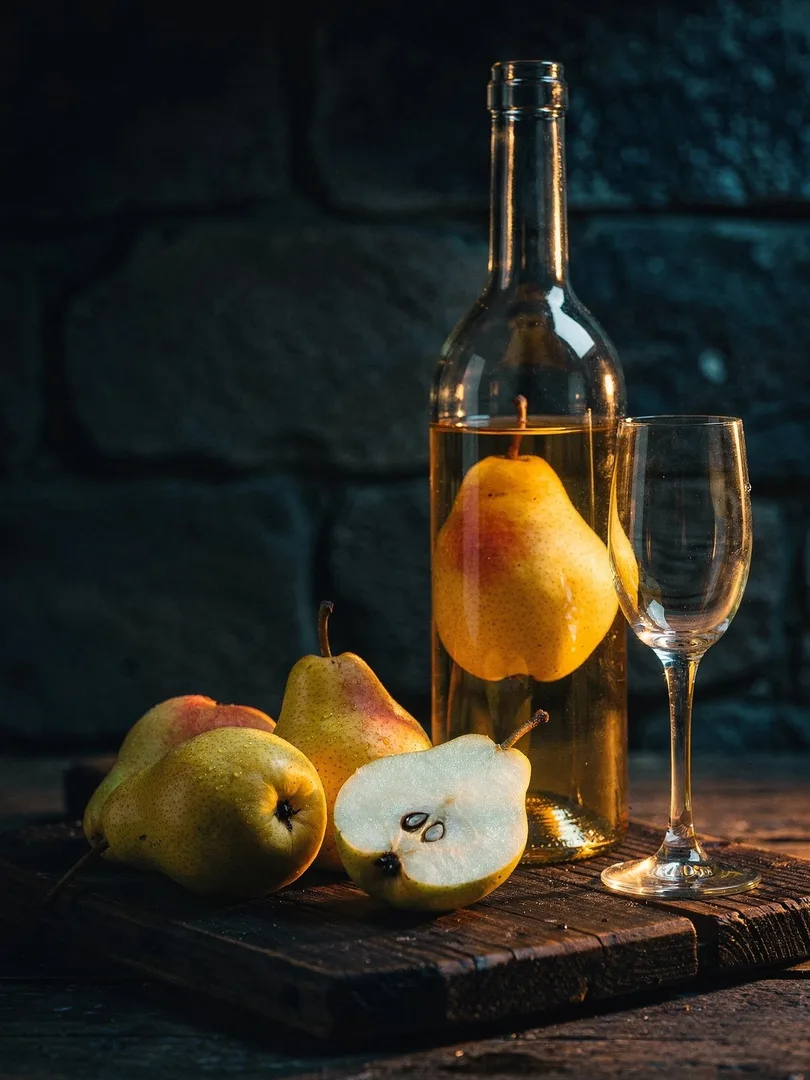
Some bottles hold a whole pear inside. It is not inserted afterward. In spring, the empty bottle is slipped over the young developing fruit on the tree, and the pear grows inside it. After harvest, the bottle is cleaned and filled with brandy. This is craft and custom, and it takes much patience, since far from every fruit succeeds.
The fruit in the bottle says nothing about the brandy's quality. It is a showpiece. What matters remains what is stated on the label: Williams only for a pure single-variety brandy, pear brandy for other or mixed pears. Whoever gives away a bottle with fruit inside is, above all, giving away a story.