Small fruits, big aroma
Mirabelle, Zibärtle, Kriecherl, Damassine: the small plums
Mirabelle, Zibärtle, Kriecherl, and Damassine are small relatives of the Zwetschge, and their brandies often have a more concentrated aroma than those made from large plums. Well known are Mirabelle de Lorraine, Baden's Zibärtle, Styria's Kriacherl, and the Damassine from the Swiss Jura.
What are Mirabelles, Kriecherl, and Zibarten?
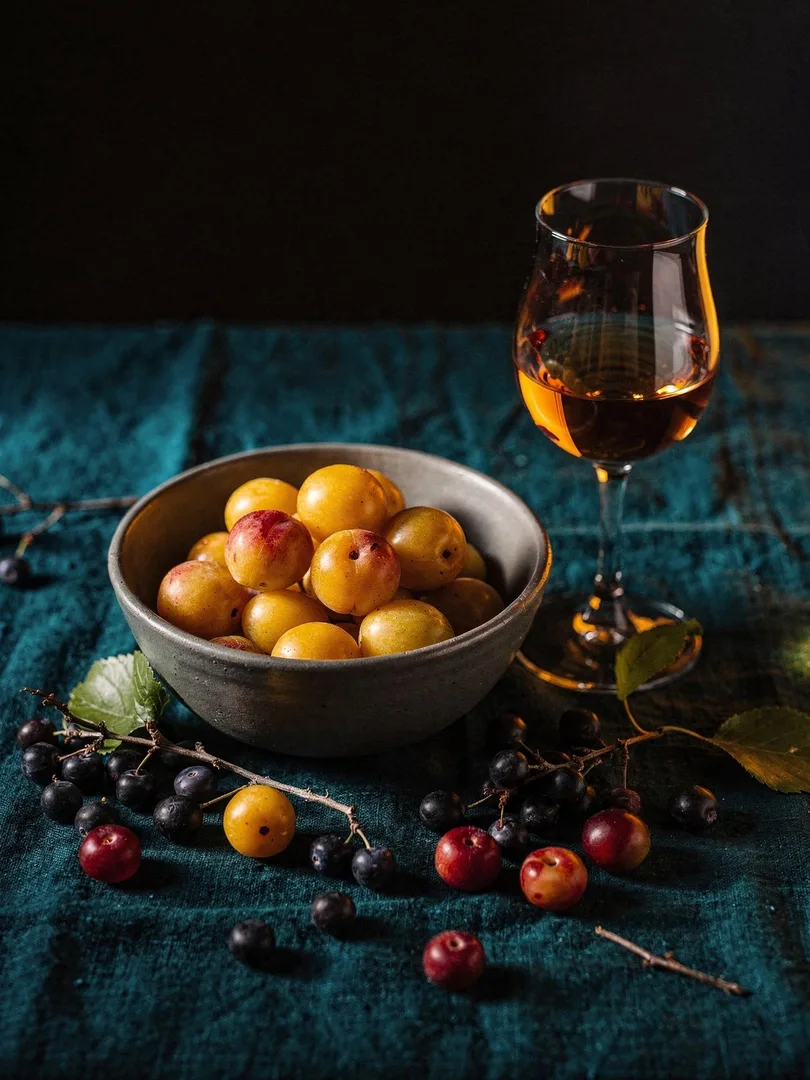
Alongside the large Zwetschge plum, there's an entire family of small-fruited plums. Mirabelles are yellow, round, and barely bigger than a cherry, with sweet, honey-like flesh. Kriecherl, also called Haferpflaumen, are small, often semi-wild fruits found in hedges and farm gardens. The Zibärtle is a rare wild plum from the southern Black Forest and southern Baden. The Damassine, finally, is a small red plum from the Swiss Jura.
For distillers, these fruits have much in common. They're small, carry a high ratio of pit and skin to flesh, and bring a concentrated aroma. Harvesting is laborious, and yield is modest, since small fruits give little juice. Anyone making these brandies is deliberately choosing aroma over volume. Accordingly, they're rare finds on store shelves.
Mirabelle brandy from Lorraine, Alsace, and the Black Forest
The Mirabelle is the best known of these small plums. Its brandy smells of ripe, yellow fruit, of honey, and sometimes of blossom. Lorraine is considered its stronghold, and Mirabelle de Lorraine has been protected as a geographical indication for the brandy since 1989. Also registered with the EU since 1989 are Mirabelle d'Alsace and Schwarzwälder Mirabellenwasser.
Legally, Mirabelle brandy is a Category 9 fruit spirit with a methanol limit of 1,200 grams per hectoliter of pure alcohol. Regulation (EU) 2019/787 permits the word "Mirabellen" as a legal name. Anyone buying a Mirabelle liqueur, by contrast, gets a sweetened drink with lower alcohol content. As always, the legal designation on the label is the reliable guide, not the picture of the fruit.
Zibärtle: the wild plum from Baden
The Zibärtle, also called Zibarte, is one of the rarest brandies in Germany. The small fruits come from old trees in the southern Black Forest and southern Baden. As a Baden specialty, it's distilled among others by Scheibel in Kappelrodeck and Schladerer in Staufen im Breisgau. The Zibärtle has no protected geographical indication of its own; it survives through the tradition of individual distilleries.
In the glass, Zibärtle is often described as tart and spicy, with a pronounced pit note, wilder than any Mirabelle. That pit note in particular demands care. With small fruits carrying a high proportion of pit, the hydrogen cyanide limit of 7 grams per hectoliter of pure alcohol becomes relevant faster than with larger fruit. Unbroken pits and dark storage of the finished brandy help prevent this.
Kriecherl from Styria
In Austria, the small Haferpflaumen are called Kriecherl, or Kriacherl in Styria. Steirisches Kriacherl is listed in Austria's register of traditional foods. The fruits often grow in hedges, along roadsides, and in old gardens. Its brandy is usually fruity and slightly tart, with a wildness that can recall sloe.
For many distilleries, Kriecherl is an off-season fruit. You gather what the trees provide and distill small batches. That's exactly where its appeal lies. No vintage is like another, and the brandy tells more about a particular place than about any standardized variety.
Damassine: the AOP plum from the Jura
The Damassine has been registered as a Swiss AOP since March 9, 2010, and is restricted to the canton of Jura. It's based on the small red plum of the same name. As with every Swiss AOP, the fruit comes from the region and is also processed there. That makes the Damassine, alongside Zuger Kirsch, Walliser Williams, and Abricotine, one of Switzerland's four brandy AOPs.
What all these small plums have in common is how clearly they show just how much a single fruit can shape a brandy. A Mirabelle brandy and a Zwetschgenwasser come from close relatives yet taste completely different. Anyone wanting to learn the differences is best off tasting them side by side, in small amounts, with water on hand to cleanse the palate.