Europe's plum
Zwetschgenwasser, Slivovitz, Šljivovica: one spirit, many names
Zwetschgenwasser, Slibowitz, Slivovitz, and Šljivovica all essentially describe the same thing: a fruit brandy made from fermented plums. The names reveal the language, not the method. Only certain origins are protected, such as Schwarzwälder Zwetschgenwasser or Slavonska šljivovica.
Zwetschge or Pflaume: what's the difference?
Botanically, both belong to the species Prunus domestica. The Zwetschge (damson-type plum) is elongated, has firm flesh, and separates easily from the pit; the round Pflaume is softer and juicier. For the brandy, the law makes no distinction. Regulation (EU) 2019/787 explicitly permits "Pflaume," "Zwetschge," and "Slibowitz" as legal names. The methanol limit stands at 1,200 grams per hectoliter of pure alcohol.
In flavor, the Zwetschge gives the brandy notes of plum jam, marzipan, and a light spice reminiscent of cinnamon. Because the pit is large, distilleries take special care not to crush it during mashing. A well-made plum brandy smells fruity and warm, without the pit-derived note overpowering the fruit.
Why is plum brandy called Slivovitz?
The word comes from the Slavic languages, where plum is šljiva, slivka, or śliwka. The regulation allows several member states — including Bulgaria, Czechia, Croatia, Poland, Romania, Slovakia, and Slovenia — to turn the fruit name itself into the designation by adding a suffix. That's how slivovice, šljivovica, or slivova rakija come about. "Slibowitz," meanwhile, is a permitted generic term for plum brandy in German and protects no particular origin.
In the Balkans, Šljivovica is the best-known form of Rakija, the umbrella term for the region's fruit and grape brandies. There's a risk of confusing it with Turkish Rakı, which is an anise spirit based on grape distillate and has nothing to do with plums. In Romania, plum brandy is called Țuică; in Hungary, Szilvapálinka.
Which Slivovitz origins are protected?
Fewer than many people think. In the EU, Hrvatska stara šljivovica and Slavonska šljivovica from Croatia are protected, both since 2012. Bulgaria has registered two plum rakias from Troyan and Lovech, and Italy has registered Sliwovitz from Friuli-Venezia Giulia and from Trentino. Romania protects several Țuică origins, such as Țuică de Argeș. Poland applied for Śliwowica łącka only in 2026; as of October 2026, it had not yet been protected.
Czechia and Slovakia, often cited as the homeland of Slivovitz, have not a single brandy designation in the EU register. In Vizovice, Moravia, stands the Rudolf Jelínek distillery, founded in 1894; on the same estate, a distilling operation is documented as early as 1585. Serbia lies outside the EU and isn't represented in the register. There, the social customs surrounding Šljivovica were added to the UNESCO list of intangible cultural heritage in 2022.
Țuică and Szilvapálinka: plum brandy in Romania and Hungary
In Romania, the plum is the most important distilling fruit, and its brandy is called Țuică. Two origins have been protected as geographical indications since 2005: Țuică Zetea de Medieșu Aurit and Țuică de Argeș. An application for a further origin from Horezu has been pending since 2024. In the country's north, the names Horincă and Pălincă are also used for fruit brandies, and both are likewise in the register.
In Hungary, plum brandy is called Szilvapálinka. It's subject to the strict Pálinka rules: fruit 100 percent from Hungary, no added sugar, no flavoring, no neutral alcohol. Three origins are additionally protected: Szatmári and Békési Szilvapálinka since 2003, and Nagykunsági szilvapálinka since 2016. Each country thus shows how the same spirit lives on under its own name and its own rules.
Zwetschgenwasser from Germany, Alsace, and South Tyrol
In German-speaking regions, this brandy is usually called Zwetschgenwasser or Zwetschgenbrand. Protected since 1989 are Schwarzwälder Zwetschgenwasser and Fränkisches Zwetschgenwasser. Across the Rhine, Quetsch d'Alsace is in the register, and in South Tyrol, Südtiroler Zwetschgeler. All these names describe fruit brandy made from Zwetschgen, differing only in origin and specification.
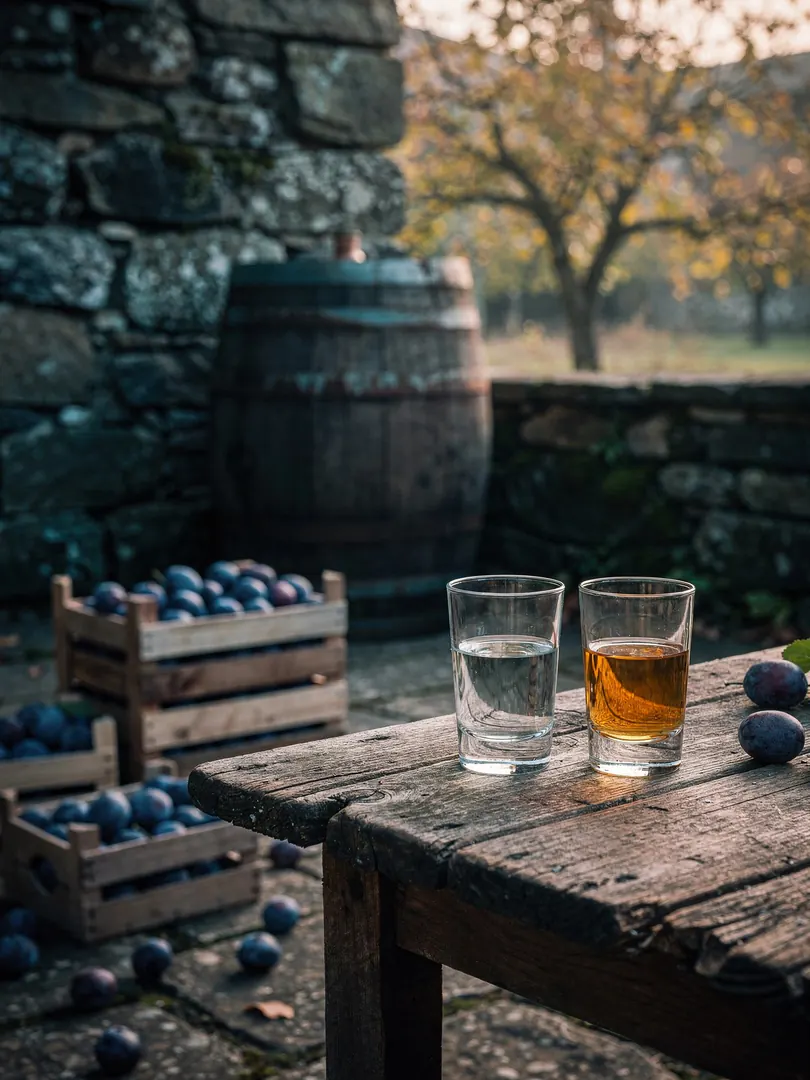
Between these origins, there are often stylistic worlds apart. Many distilleries in southern Germany and the Alps bottle their plum brandy clear, after a resting period in glass or stainless steel. In the Balkans, Šljivovica often ages in wooden casks, turning golden yellow in the process; the Croatian name stara šljivovica literally means "old Šljivovica." A fruit brandy may not be colored, by the way. Only after at least one year of contact with wood is caramel coloring permitted, to even out the color.