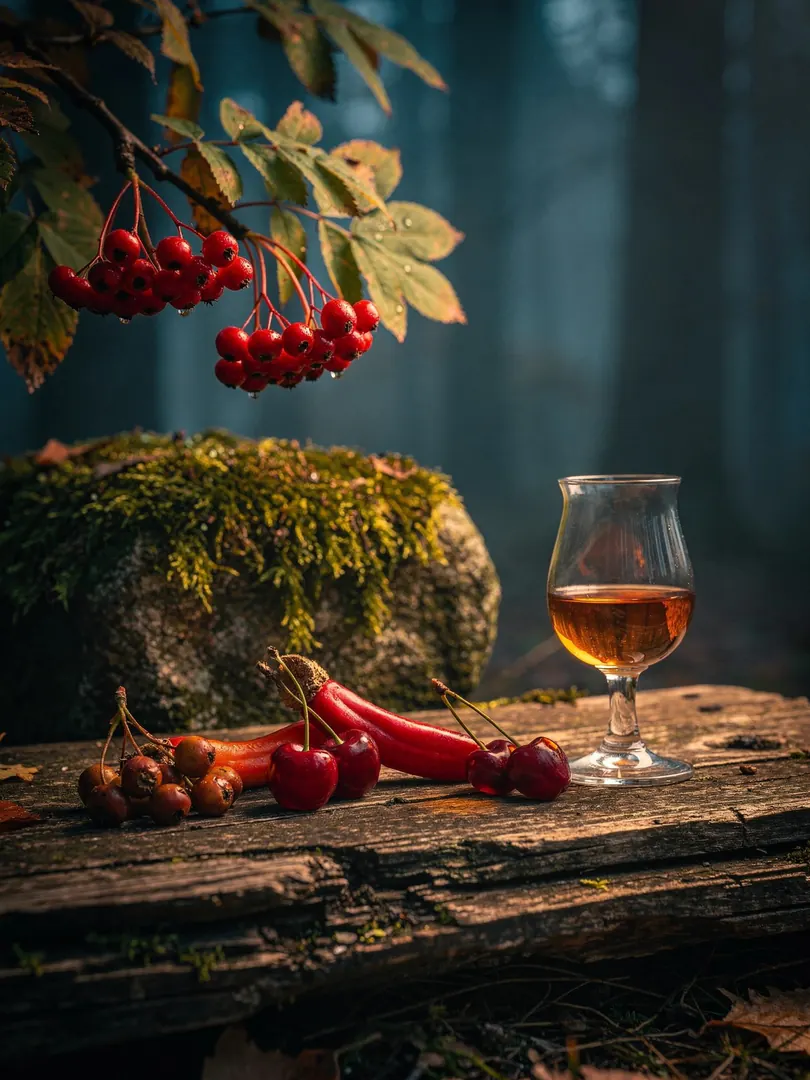
Wild fruit in a glass
Vogelbeere, Elsbeere, Speierling, Dirndl: the rare brandies
Vogelbeerbrand, Elsbeerbrand, Speierling, and Dirndlbrand are among the rarest fruit brandies, because their small wild fruits are laborious to harvest and yield little spirit. For Vogelbeere, Elsbeere, and Speierling, EU law permits the highest methanol limit of any fruit brandy.
Why are wild fruit brandies so rare?
Wild fruit doesn't grow in rows. Rowanberries (Vogelbeeren), wild service berries (Elsbeeren), service tree fruit (Speierling), and cornelian cherries hang from individual trees and shrubs, often at forest edges, in hedges, or on mountain meadows. The fruits are small, ripen unevenly, and often have to be hand-picked and stripped from their stems. Many have little juice and little sugar, but an intense, distinctive aroma.
The simple math follows from this: a lot of work meets very little yield. How much brandy comes from a given amount of wild fruit varies greatly by year, ripeness, and fruit, and there are no reliable figures for it. What's certain is only that the yield falls far below that of apples or plums. That's why these brandies are rare and, at many distilleries, available only in small batches.
Vogelbeerbrand: marzipan from the mountains
The Vogelbeere is the fruit of the rowan tree, a species that grows high into the mountains. Raw, the red berries taste bitter and tart. Distilled, they show a distinct character often described in terms of marzipan, bitter almond, and an earthy spice. Vogelbeere is traditionally distilled in Tyrol, Styria, and Salzburg, where the brandy is listed in Austria's register of traditional foods.
Because rowanberries contain little sugar, the brandy is also made "by maceration and distillation." In that case, the berries are extracted using a limited amount of alcohol, and the label must state this on the front. A Vogelbeerbrand without this note, by contrast, is made entirely from fermented berries. It's worth a close look for buyers, since the two methods differ markedly.
Elsbeere and Speierling: relatives of the Vogelbeere
Elsbeere (wild service tree) and Speierling (service tree) belong, like the rowan, to the genus Sorbus. Both have become rare forest trees in Central Europe. The Elsbeere bears small, brown fruits that turn soft and sweetish only when overripe. Elsbeerenbrand is registered as a traditional food in Lower Austria. The tiny fruits make it one of the most labor-intensive brandies of all.
The Speierling forms small pear- or apple-shaped fruits rich in tannins. In Hesse, they're traditionally added to apple wine to clarify it and give it a more tart edge. As a brandy, Speierling shows a tart, spicy fruit character. Both tree species are now being deliberately replanted in many places, since they've become rare and are considered ecologically valuable.
Methanol limits: why wild fruit brandies get more leeway
Regulation (EU) 2019/787 sets a base limit for fruit brandy of 1,000 grams of methanol per hectoliter of pure alcohol. For Vogelbeere, Elsbeere, and Speierling, the limit is 1,350 grams, as it is for quince, Williams pear, rosehip, elderberry, and currants. These fruits naturally contain a lot of pectin — the very substance that makes jam set.
From this pectin, methanol forms already in the mash, without anyone making a mistake. The higher limits reflect the nature of the fruit, not any laxity on the lawmaker's part. Legally produced brandies stay below these values. Methanol becomes dangerous with adulterated alcohol that's been mixed with industrial methanol — not with a proper fruit brandy.
Dirndl: the cornelian cherry from the Pielach Valley
The Dirndl isn't a cherry, even though its German name includes the word. Botanically, it's Cornus mas, a dogwood species whose elongated red fruits only soften late in summer. In Lower Austria's Pielach Valley, the fruit is so deeply rooted that the Original Pielachtaler Dirndlbrand is listed in Austria's register of traditional foods.
The brandy combines tart, red fruit with a slightly bitter edge. Legally, like all the brandies covered here, it's a Category 9 fruit spirit: fermented, distilled, with no neutral alcohol added. Such rarities exist beyond the Alps, too. In Portugal, Medronho do Algarve is protected as a geographical indication, a brandy made from the fruit of the strawberry tree.