Distilled from the Earth
Enzian, Topinambur, Meisterwurz, Krautinger: Spirits from Roots and Root Vegetables
Enzian, Topinambur, Meisterwurz and Krautinger are spirits distilled from roots, tubers and root vegetables, not fruit brandies. Enzian and Topinambur have their own categories under EU law, and Krautinger, made from stubble turnips, may only be distilled in the Tyrolean Wildschönau valley.
Why Root Spirits Aren't Fruit Brandies
According to Regulation (EU) 2019/787, fruit spirit is made from fleshy fruits, berries or vegetables. Roots and tubers only partly fit this scheme, so lawmakers created separate categories for the most important ones. Enzian forms Category 18, Topinambur Category 14. Other root spirits like Meisterwurz have no category of their own; they survive on regional tradition.
In terms of flavor, they inhabit a different world from fruit spirits. Instead of fruitiness and sweetness, earthiness, bitterness, spice and sometimes a powerful sharpness define the spirit. In the Alps, people like to drink such spirits after a heavy meal. That they aid digestion, however, is folk belief rather than a proven effect.
Enzian: A Root Spirit from the Alps
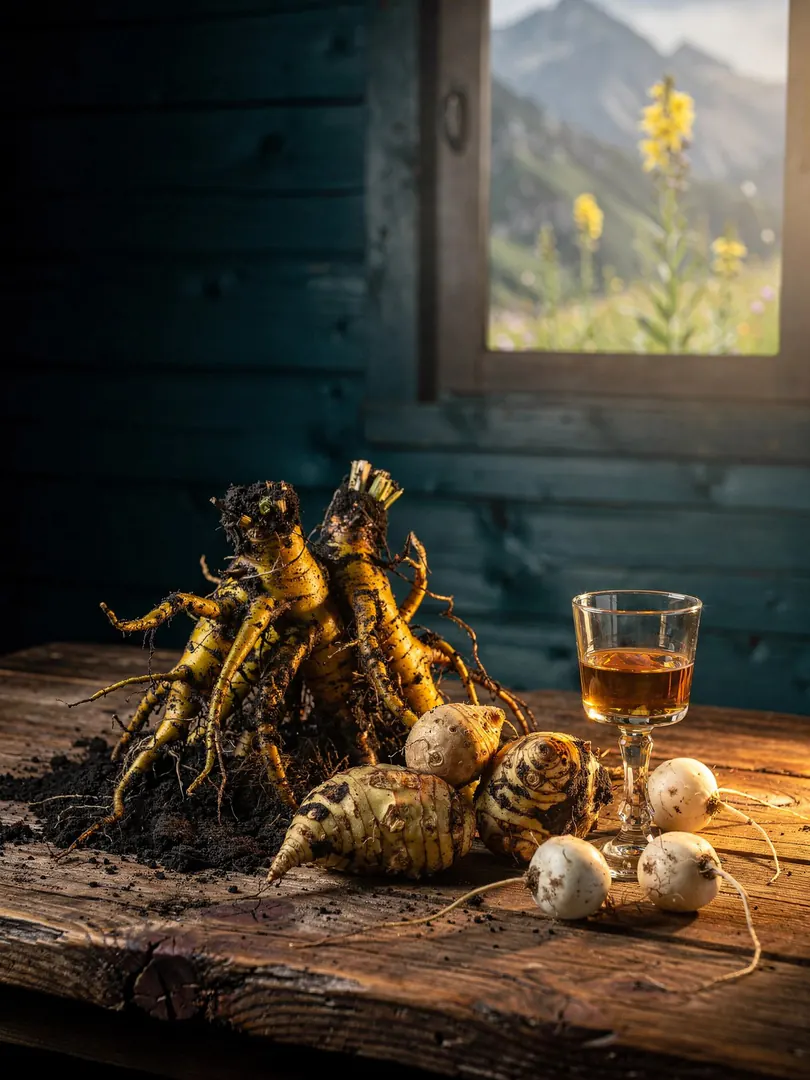
Enzian brandy comes from the root of the yellow gentian, a tall-growing plant found on mountain meadows. The roots are dug up, chopped, fermented and distilled. The spirit smells earthy, rooty and bitter-spicy, a scent you either love right away or take a long time to warm to. Under the regulation, Enzian may be produced with or without the addition of ethyl alcohol; flavorings are not permitted.
Wild-growing yellow gentian is a protected species in the Alpine region. Distilleries need the landowner's consent and a permit from the nature conservation authority to dig up the roots. Protected within the EU are Bayerischer Gebirgsenzian, Südtiroler Enzian and Genziana trentina. The Grassl distillery in Berchtesgaden claims, with a founding date of 1692, to be Germany's oldest Enzian distillery; this is the producer's own claim.
Topinambur: Baden's Rossler
Topinambur is a type of sunflower whose tubers grow underground. The tubers store inulin, a complex sugar that must first be broken down into simple sugars before fermentation can take place. In Baden, the resulting spirit is called Rossler; elsewhere it's known as Erdbirne or simply Topinambur. The regulation lists it under its own Category 14, as Topinambur or Jerusalem artichoke spirit.
A Topinambur spirit must have at least 38 percent alcohol by volume, slightly more than a fruit spirit at 37.5 percent. Its flavor is earthy, nutty and slightly sweet, sometimes with a hint of artichoke. It has remained a specialty of Baden, rarely found outside the region.
Meisterwurz: Folk Medicine and Spirit from Tyrol
Meisterwurz is an umbellifer found in the Alps, whose rootstock has a sharp, spicy aroma. In North and East Tyrol, it is distilled into a spirit listed in Austria's register of traditional foods. In folk medicine, the plant was long considered a remedy for all manner of ailments, and tradition holds this is where its German name ("master root") comes from. This is folklore, not a medical claim.
In the glass, Meisterwurz comes across as bold, spicy and slightly bitter, with a sharpness reminiscent of celery and pepper. This spirit has no EU category of its own. Anyone wanting to know how a particular bottle was made will find the answer in the legal designation on the label.
Krautinger: The Turnip Spirit from Wildschönau
Wildschönauer Krautinger may be the most unusual spirit in the Alps. It's made from stubble turnips, white autumn turnips sown into fields after the grain harvest. The distilling privilege dates back to the reign of Maria Theresa, so the years 1740 to 1780, and originally applied to 51 farms, exclusively in the Wildschönau valley. It was reconfirmed from Berlin in 1942.
The turnip juice is boiled down, briefly fermented and distilled twice. The finished Krautinger has between 39 and 49 percent alcohol by volume. Austria's Ministry of Agriculture describes its flavor in its register as highly distinctive. In folk medicine it was used both externally and internally; today that's regarded as tradition, not advice.