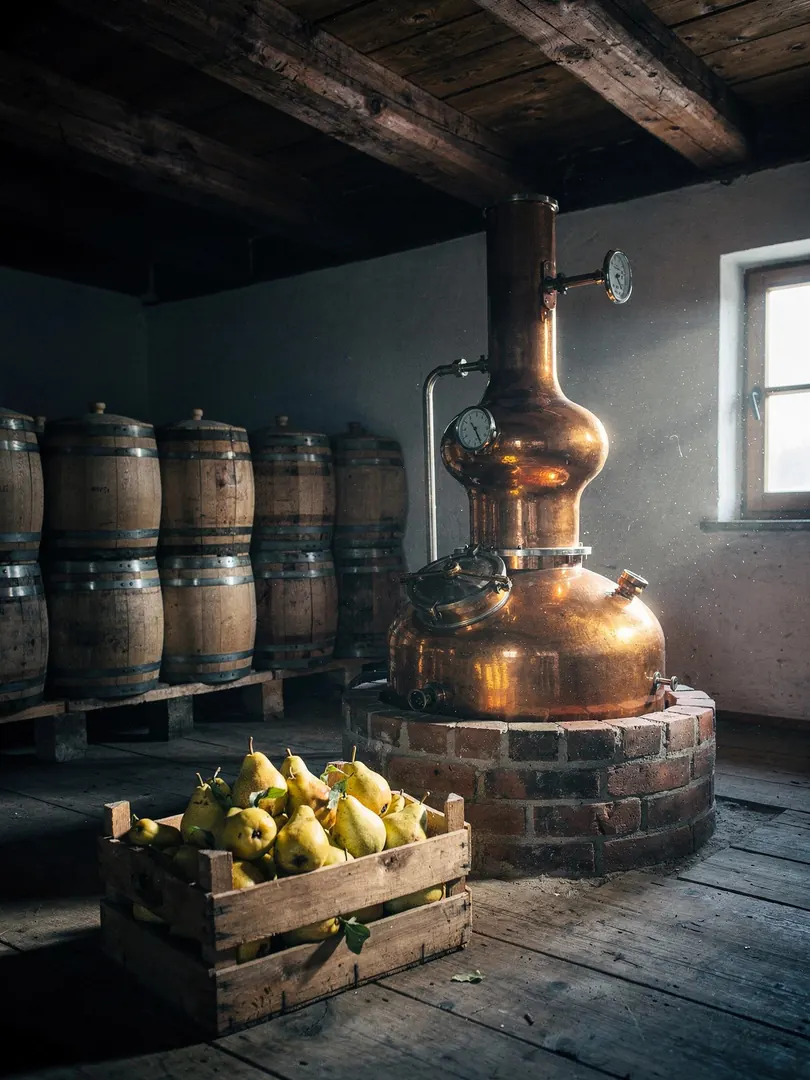
Distilling on the farm
What is a flat-rate distillery? 300 liters and the flat-rate system
A flat-rate distillery is a small, usually farm-based distillery permitted to operate without a customs seal. Tax isn't measured on the distillate itself but calculated at a flat rate from the amount of raw material used. A maximum of 300 liters of pure alcohol per year is allowed.
Flat-rate assessment: why customs calculates by the lump sum
Here, the word Abfindung essentially means a flat rate or lump sum. At a flat-rate distillery, customs doesn't measure how much alcohol actually flows from the condenser. Instead, they calculate: raw material quantity multiplied by the official yield rate. The yield rate sets out how much alcohol can be expected from a given amount of a particular raw material, say, cherry mash or apple mash. That gives the quantity on which tax is charged.
For this to work, the distiller must register every distilling run in advance: which raw material, how much, and when. The still itself isn't sealed; control happens through these declarations. That's precisely the difference from a bonded distillery, where a meter under customs seal records every single liter.
The flat-rate system has a side effect many distillers appreciate. If you distill cleanly fermented, ripe fruit and extract more alcohol than the yield rate assumes, you don't have to pay tax on that surplus. As a counterbalance, small bonded distilleries producing up to 4 hectoliters of pure alcohol get their own reduced tax rate.
Who is allowed to operate a flat-rate distillery?
The permit is issued by the main customs office. It requires what's known as a demonstrated need, which is defined in agricultural terms. Under Section 19 of the Alcohol Tax Ordinance, you need a farming operation of at least 3.0 hectares. For intensive fruit growing or viticulture, 1.5 hectares suffices. A hobby garden or a leased patch of meadow isn't enough.
Since January 1, 2018, this permit has been tied to the individual, no longer to the farm. Anyone taking over an operation with a flat-rate distillery must therefore apply for a new permit of their own. For family businesses, this is a noticeable change, since the distilling right used to pass with the farm to the next generation. How the handover works today, and what deadline applies, is explained in the section on distilling rights.
The raw materials are also limited. Permitted are fruit including must and pomace, berries, wine including lees and pomace, roots and tubers, Jerusalem artichokes, grain, beer, and potatoes. So a flat-rate distillery can produce Kirschwasser, Williams pear brandy, pomace brandy, lees brandy, or gentian spirit. A fruit spirit made by macerating unfermented fruit in neutral alcohol, by contrast, doesn't fall within this list.
300 liters of pure alcohol: how much spirit is that?
The upper limit is 3 hectoliters of pure alcohol per calendar year. Calculated over a three-year period, that's 9 hectoliters. Pure alcohol is a calculation unit: alcohol expressed at 100% ABV. Diluted to drinking strength of 40% ABV, 300 liters of pure alcohol becomes 750 liters of finished spirit, a good thousand 0.7-liter bottles.
In everyday speech, this limit is still called the '300-liter distilling right.' That sounds like a piece of property you could trade. But since 2018 it has been a personal permit. A further restriction applies to sales: flat-rate distilleries may not ship their alcohol commercially to other EU states or to non-EU countries. Their market is the farm shop, the restaurant trade, and domestic retail.
Besides their own fruit, many flat-rate distillers also distill for raw-material owners, meaning people without a still of their own who bring in their home-grown fruit. This often turns the small farm distillery into the village distillery, where neighbors have their plums, pears, and cherries turned into brandy.
Flat-rate distilleries in numbers: fewer, but not gone
Official alcohol tax statistics show a clear decline. In the 2014/15 distilling year, 18,186 flat-rate distilleries were operating in Germany; by 2023, only 10,931 remained. Counting methods changed in 2018, so the figures before and after aren't directly comparable. Even so, the trend is clear: many farms are giving up distilling, often when the next generation takes over.
Small distilleries are especially concentrated in southwestern Germany. The area around Oberkirch in the Renchtal advertises around 700 home and farm distilleries and bills itself, per tourism marketing, as the region with the highest density of small distilleries in Europe. Lawmakers justify the tax reduction for flat-rate distillers as a way of preserving traditional orchard meadows, since without distilling, much of the fruit from old standard-trunk trees would find no buyer.