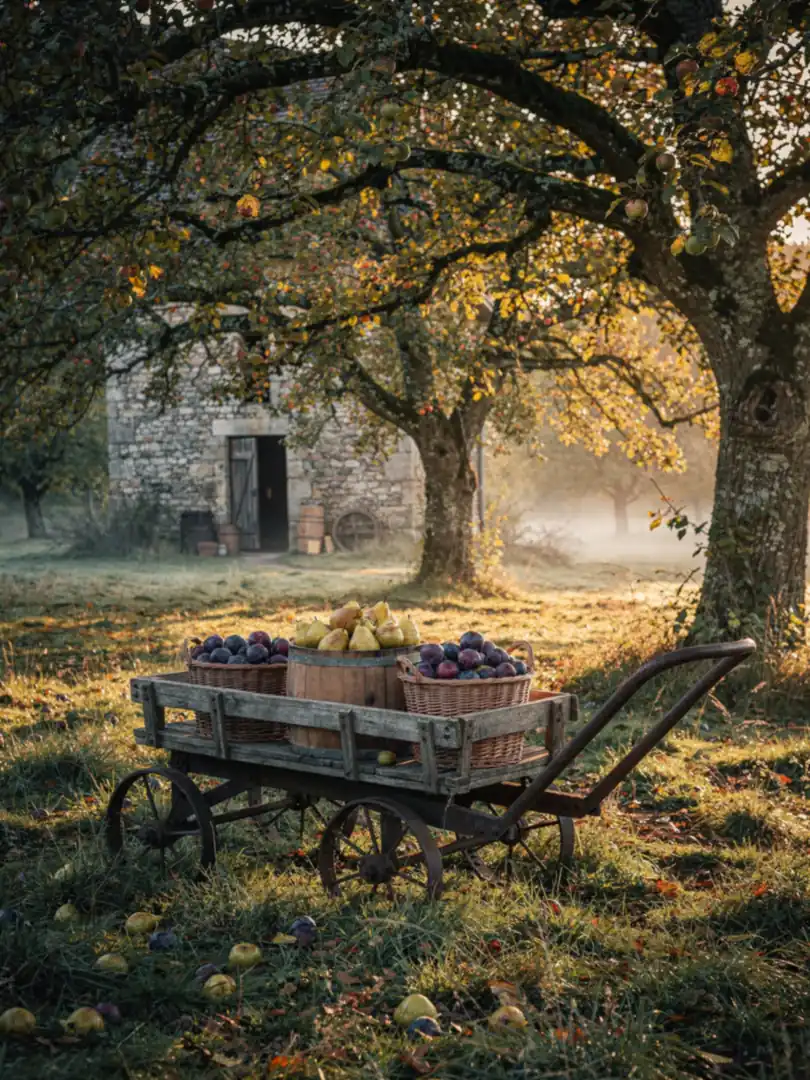
Your own fruit, someone else's still
Raw-material owner: having your own fruit distilled legally
A raw-material owner is anyone who has home-grown fruit, their own berries, or their own wine distilled at a flat-rate distillery without owning a still themselves. A maximum of 50 liters of pure alcohol per year is allowed, and only one person per household may act as a raw-material owner.
What is a raw-material owner?
The name sounds like bureaucratic German, and that's exactly where it comes from. Stoff here means the raw material, that is, fruit, berries, wine, roots, or Jerusalem artichokes. The raw-material owner is whoever owns that raw material. It gets distilled by someone else, specifically at an approved flat-rate distillery. Professionals call this custom distilling, or Lohnbrennen: the distiller provides the equipment and expertise, while the raw-material owner brings their fruit and ends up with their own brandy.
This is regulated under Section 11 of the Alcohol Tax Act. For private individuals, it's the most important legal path to a brandy made from their own harvest. Typical raw-material owners have a few plum trees, an inherited orchard meadow, or a home garden with old pear trees. Instead of letting the windfall fruit rot, it becomes plum brandy, Williams pear brandy, or a mixed fruit brandy.
Once distilled, the brandy belongs to the raw-material owner. Legally, it's a fruit brandy like any other. To be labeled as such, it must meet the rules of the EU Spirit Drinks Regulation, including a minimum of 37.5% ABV and no addition of outside alcohol. A Williams must come exclusively from Williams pears, while a mixed fruit brandy (Obstler) must be made of at least 85% apples or pears.
Who can be a raw-material owner? The conditions
Only a natural person can be a raw-material owner, never a club or a company. The raw material must be self-produced, specifically within German tax territory. Fruit from a wholesale market or grapes from a holiday abroad don't qualify. Permitted are fruit and berries, wine, roots, and Jerusalem artichokes. Grain and potatoes, which a flat-rate distillery is allowed to process itself, are missing from the raw-material owner's list.
Two further rules prevent the quantities from being artificially multiplied. Only one person per household may have spirits distilled as a raw-material owner. So a family can't register four separate lots of 50 liters. Furthermore, flat-rate distillers themselves and the people in their household are excluded. Anyone who runs their own flat-rate distillery already distills under their own permit.
The most important condition is built into the term itself: a raw-material owner has no still of their own. Anyone who has a still at home and produces alcohol with it isn't a raw-material owner, they're distilling without a permit.
50 liters of pure alcohol: what that means in the glass
The maximum quantity is half a hectoliter of pure alcohol per year, meaning 50 liters. Diluted to drinking strength of 40% ABV, that's 125 liters of brandy, around 178 bottles of 0.7 liters each. That's plenty for a household but far too little for a farm shop. That's exactly how the rule is designed to work.
The quantity is calculated the same way as for a flat-rate distillery, via the declared amount of raw material and the official yield rate. Within the permitted quantity, a reduced tax rate of €1,022 per hectoliter of pure alcohol applies, or €10.22 per liter. For comparison, the standard rate is €13.03. How much brandy actually ends up in the glass depends heavily on the fruit. Sugar-rich plums yield more than tart apples.
Many raw-material owners distill far less than the permitted amount. A few crates of plums yield only a few liters of brandy, and that's often enough for a household to last for years. The upper limit is a cap, not a target.
Raw-material owner and distillery: who does what?
In practice, the division of labor is a matter of arrangement. Often the raw-material owner prepares the mash themselves and brings it already fermented to the distillery. Some distillers also handle the mashing. Registration with customs goes through the flat-rate distillery, since it knows the forms and deadlines.
Quality depends on both sides here. Even the best equipment can't turn rotten or unripe fruit into a fine brandy, and an inexperienced distiller can ruin good fruit. Anyone wanting to become a raw-material owner should therefore look for a nearby distillery and ask about their terms. In Switzerland, the same principle is called Lohnbrennen (custom distilling); in Austria, farms know it as the tax-free Hausbrand (home distilling allowance).