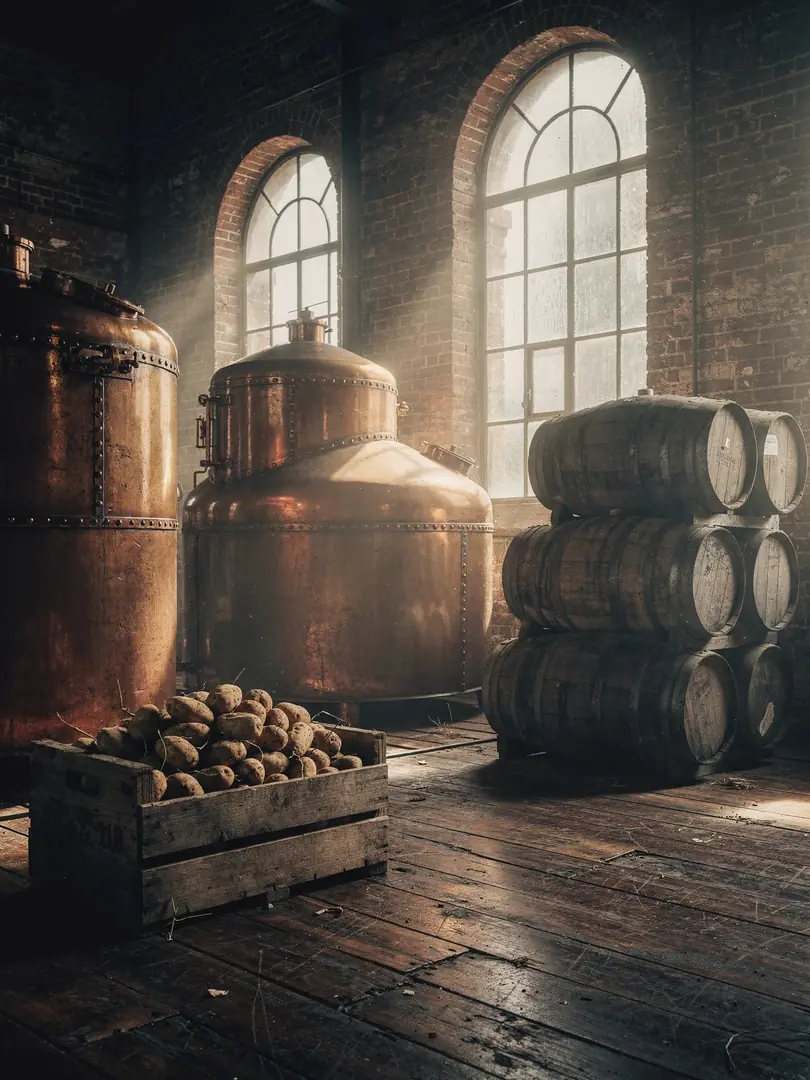
1919 to 2017
The Spirits Monopoly: What It Was and Why It Ended in 2017
Germany's spirits monopoly existed from 1919 and ended in two stages: for potato and grain distilleries on September 30, 2013, and for fruit distilleries, licensed small-scale distillers, and raw-material owners on December 31, 2017. Since January 1, 2018, the Alcohol Tax Act (Alkoholsteuergesetz) has applied.
What Was the Spirits Monopoly?
A monopoly means only one party is allowed to trade. In the case of the spirits monopoly, that party was the state. Many distilleries weren't allowed to sell their alcohol freely but had to deliver it to the monopoly administration. This body purchased it at fixed prices, purified it, and resold it, for example as neutral alcohol to industry or to spirits producers. The last body responsible for this was the Bundesmonopolverwaltung für Branntwein (Federal Spirits Monopoly Administration).
How much a distillery was allowed to deliver was set by its Brennrecht, a quota in hectoliters of pure alcohol. This mainly affected agricultural distilleries that distilled from potatoes or grain. A special rule applied to small fruit distillers: they could either market their own brandy or hand it over to the monopoly. This choice shaped the image of the farm distillery that sells its own kirsch and Williams pear brandy in its own shop.
What Was the Purpose of the Monopoly?
The monopoly arose after World War I and, according to the Scientific Services of the German Bundestag, existed from 1919. It secured income for the state and a guaranteed buyer for many agricultural operations. Especially on poor soils, potato distilling was a part of the farm that paid off, since the monopoly guaranteed to buy the alcohol.
This security came at a price. The federal government paid distilleries more than the alcohol was worth on the world market. Until 2013, the subsidy amounted to around 80 million euros a year. That made the monopoly a form of subsidy, and that is precisely what sealed its fate.
For potato distilleries, the system had a second dimension as well. The leftover mash from distilling, the stillage, went into the barn as feed, closely linking distilling and livestock farming. When the delivery system ended, many of these operations lost their foundation. For fruit distillers in the south, the impact was smaller, since they often sold their brandy themselves anyway.
Why Did the Spirits Monopoly End?
The reason was European Union state aid law. State subsidies that favor individual producers are only permitted there within narrow limits. Germany therefore passed the Branntweinmonopolabschaffungsgesetz (Spirits Monopoly Abolition Act) in 2013, published in the Federal Law Gazette Part I 2013, page 1650. It provided for a staggered phase-out so businesses would have time to adjust.
The first step affected agricultural bonded distilleries, meaning mainly potato and grain distillers. They were only permitted to deliver to the monopoly administration until September 30, 2013. Between 2013 and 2017, 525 distilleries received compensation of 51.50 euros per hectoliter of distilling quota. The second step followed on December 31, 2017, for communal fruit distilleries, licensed small-scale distillers, and raw-material owners. So anyone who reads that the monopoly ended as early as 2013 only knows half the story.
What Remains of the Monopoly
Since January 1, 2018, the Alcohol Tax Act has governed distilling. It has carried over many terms from the monopoly era. The licensed small-scale distillery, the raw-material owner, and the bonded distillery still exist, and the old distilling rights continue to apply as licenses. What's new is that the state no longer buys alcohol. Every distillery markets its own alcohol and pays alcohol tax on it.
The reduced tax rates for small distilleries have also remained. The legislature justifies them with the preservation of traditional orchard meadows. These meadows with old standard fruit trees are considered a species-rich cultural landscape, and their fruit can often only be put to use through distilling. Whether this is enough to keep small distilleries going remains an open question: the number of operating licensed small-scale distilleries fell from 18,186 in the 2014/15 distilling year to 10,931 in 2023.
For enthusiasts, the end of the monopoly has a pleasant side effect. Many fruit distillers who used to supply the state now bottle their own spirits and proudly state their provenance on the label.