Home distillers and contract distillers
Distilling in Switzerland: home distillers and contract distillers
In Switzerland, only those under the supervision of the Federal Office for Customs and Border Security may distill. Home distillers (Hausbrenner) are farmers with their own distilling equipment who use only domestically grown or gathered raw materials of their own. Anyone without equipment has their spirits made by a contract distiller (Lohnbrenner).
Who is allowed to distill spirits in Switzerland?
In Switzerland, responsibility for taxation and oversight lies with the Federal Office for Customs and Border Security, known as BAZG. This task was previously handled by the Swiss Alcohol Board, the EAV, a name still familiar to many older distillers. As in Germany and Austria, producing alcohol without a permit and without supervision counts as illicit distilling. This too is prohibited in Switzerland.
Swiss law distinguishes mainly two roles. Commercial distilleries produce spirits for sale and pay tax on them. Alongside them are home distillers, that is, farmers who distill their own harvest. Anyone who is neither can have their fruit distilled on a contract basis. The terms sound similar to those in Germany, but the rules behind them are distinct.
Home distillers: farmers with their own still
Under the Alcohol Ordinance, a home distiller is a farmer with their own distilling equipment who processes exclusively domestically grown raw materials of their own or wild plants they have gathered domestically. In Switzerland, the equipment is often called a Brennhafen. Hafen is an old word for pot, referring to the kettle in which the mash is heated. A home distiller may not process purchased fruit or fruit from abroad.
A limited quantity remains tax-free for personal use. The exact amount and the conditions attached are set out in alcohol law; the BAZG provides binding information. Figures found in forums or older guides should be treated with caution, as many date back to the era of the Alcohol Board. Anything beyond personal use that is sold must be taxed.
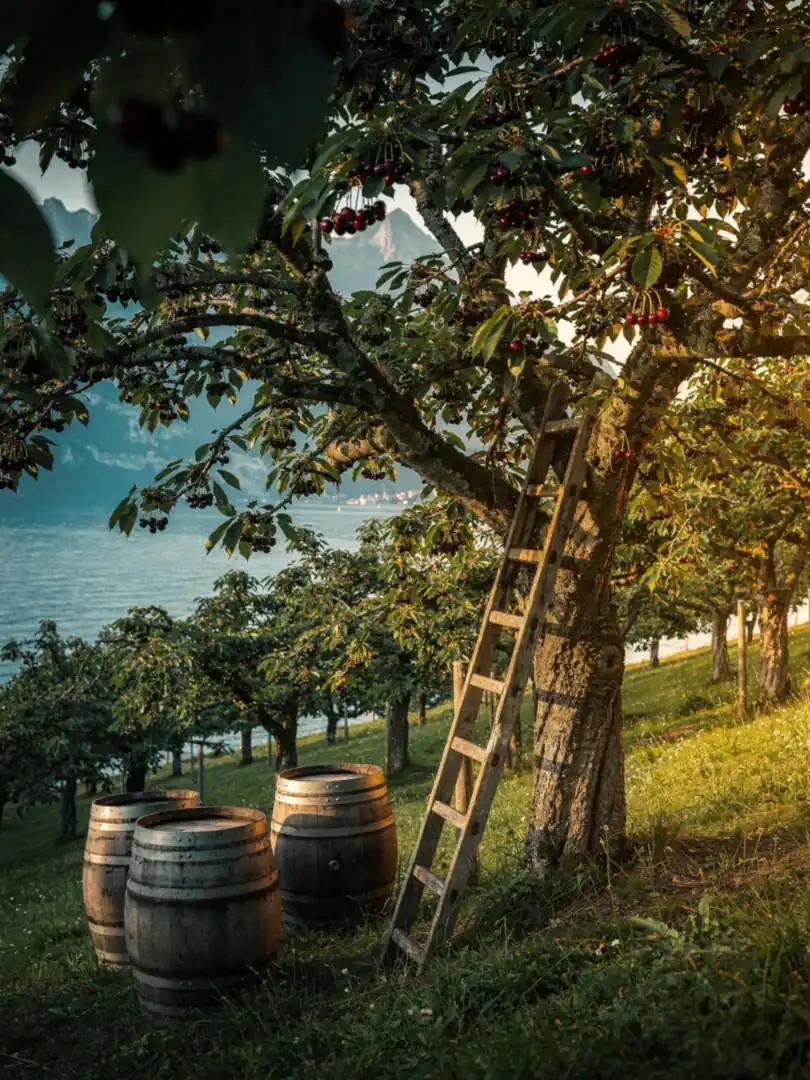
Home distillers are typical in fruit-growing regions, for instance around Zug and the Rigi, in Valais or the Jura. Many distill cherries, plums, pears, or apples from their own standard orchard trees and sell some of it through their farm shop.
Contract distillers: having spirits made rather than distilling yourself
Anyone with fruit but no equipment of their own brings their mash to a contract distiller. This is a distillery that, for a fee, distills raw materials belonging to someone else. The finished spirit belongs to the customer, and distilling takes place under BAZG supervision at a facility licensed for the purpose.
The principle resembles that of the German raw-material owner (Stoffbesitzer). In both countries, the aim is to give people with their own fruit a legal route to their own spirit without the need for a still on every farm. However, the quantities and tax rules differ. The same rule applies to quality in both places: a spirit can only be as good as the fruit and mash that go into the kettle. Good contract distillers therefore don't accept just any mash and advise their customers even before the harvest. Anyone in Switzerland who wants spirits distilled is best off asking a local contract distiller directly how intake, distilling dates, and billing are handled.
Swiss spirits with protected origin: the four AOPs
Switzerland maintains its own register of designations of origin, the AOP, from the French appellation d'origine protégée. Four spirits are listed there. Eau-de-vie de poire du Valais is a pear brandy made from Williams pears from Valais, registered on 21 December 2001. Abricotine, also known as Eau-de-vie d'abricot du Valais, is an apricot brandy from Valais, registered on 6 January 2003.
There is also Damassine from the canton of Jura, a brandy made from a small red plum, registered on 9 March 2010. The most recent spirit AOP is Zuger Kirsch or Rigi Kirsch, decreed in 2013. Its specification requires, among other things, distilling cherries from standard orchard trees grown in the area, distillation in pot stills (Hafenbrennapparate), at least six months of aging, and a minimum of 40% ABV at sale. A bottle is labeled either Zuger Kirsch or Rigi Kirsch, never both.
Not every well-known name is an AOP. Williamine, for instance, is a brand of Distillerie Morand in Martigny, founded in 1889. The protected designation of origin is Eau-de-vie de poire du Valais.