Where the Color Comes From
Why Is Cognac Brown? Color, Caramel Coloring, and Obscuration
Cognac is brown because it matures for at least two years in oak casks, absorbing color compounds from the wood along the way. Houses are also permitted to adjust the color with caramel coloring. A measure called obscuration limits how much such additives may contribute: no more than 4% ABV.
Why Is Cognac Brown? The Color Comes from the Cask
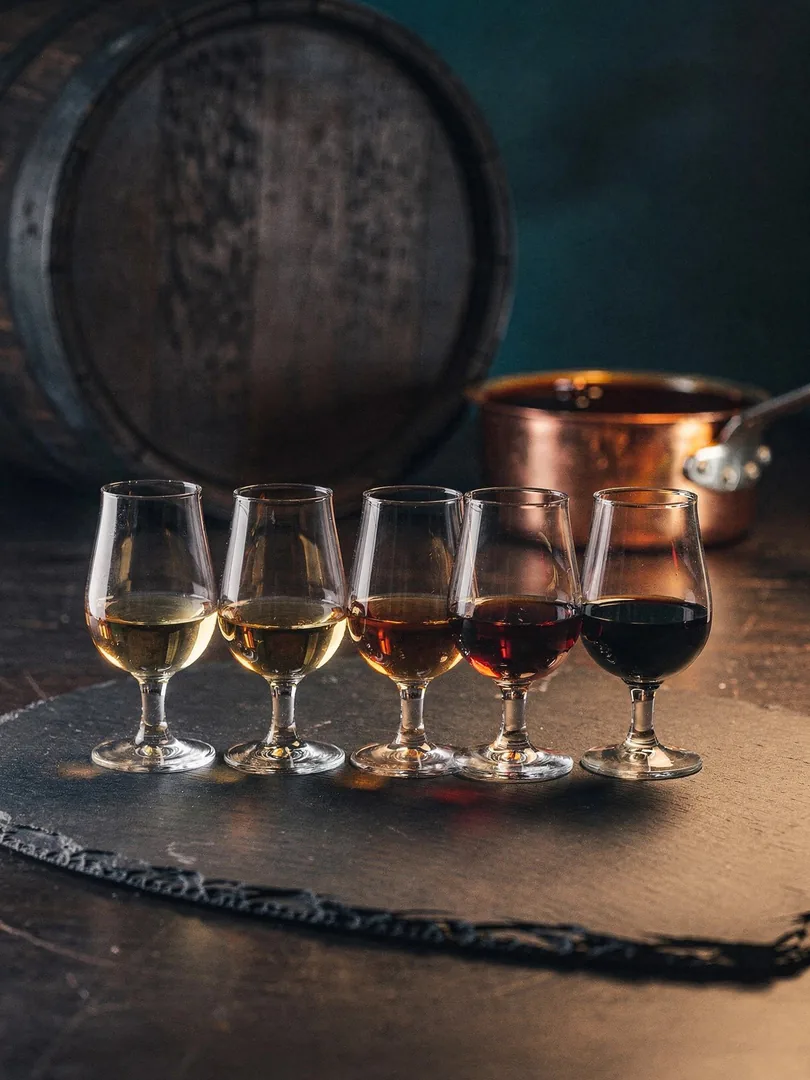
Fresh off the still, every Cognac runs water-clear. Only in the oak cask does it begin to take on color. There, the alcohol draws substances out of the wood: tannins, breakdown products of lignin, the woody substance in the cell walls, and caramelized wood sugar from the toasted inside of the cask. The spirit first turns straw-yellow, then golden, and after many years, amber to mahogany in color.
How quickly this happens depends mainly on the cask. A new, small cask imparts strong color within a few months. An old cask that's already held several spirits gives up barely any color at all. That's why color is an unreliable indicator of age. A young spirit from fresh wood can look darker than a considerably older one from a large, frequently used cask.
The same holds true for Armagnac, Calvados, Brandy, and wood-aged Grappa. For fruit brandy from a glass demijohn, however, everything stays clear, since glass releases nothing.
What Is Caramel Coloring, and Why Is It Allowed in Spirits?
Caramel coloring is sugar that's been browned through heating. As a food additive, its simplest form carries the number E150a. Even very small amounts color noticeably, which is why it's used sparingly in spirits. Its purpose is consistency: large houses blend together hundreds of casks, and each cask has a slightly different color. To make sure every bottle of a given product looks the same, they even out these differences with coloring.
The EU Spirit Drinks Regulation (EU) 2019/787 permits caramel coloring to adjust color in Spirit Drink, meaning wine distillate, in Brandy, and in pomace brandy. For fruit brandy, the rules are stricter. Coloring is generally prohibited there, and caramel coloring is only permitted if the spirit has matured in contact with wood for at least one year. A fruit spirit made by maceration may not be colored at all.
Some appellation rules forbid any additives whatsoever. Pálinka from Hungary may contain no sugar, no flavoring, and no coloring, and neither may Pisco from Peru. Colorless Blanche Armagnac likewise may not be colored.
What does obscuration mean? The 4 percent limit
For Cognac, Armagnac, and Calvados, the specifications of the French appellations regulate additives through a measured value. It's called obscuration, and it has to do with the way alcohol content is determined. A hydrometer, a floating measuring device, indicates alcohol through the density of the liquid. Alcohol is lighter than water, while dissolved substances such as sugar, coloring, or oak extract make the liquid heavier.
The more that's dissolved in the liquid, the less alcohol the hydrometer shows than is actually present. The true content is only obtained by re-distilling the spirit and then measuring it. The gap between apparent and true alcohol content is the obscuration, expressed as a percentage by volume.
For Cognac, caramel coloring, sugar, and an infusion of oak chips together may cause at most 4% vol of obscuration. This infusion, called "boisé" in the Cognac region, intensifies the oak character. The same upper limit applies to Armagnac and to all three Calvados appellations. So the rule doesn't specify a gram amount but limits the combined effect of all additives.
Can you spot added coloring on the label?
Only to a limited extent. Under EU law, beverages above 1.2% vol are not required to carry an ingredients list, as set out in the Food Information Regulation (EU) No. 1169/2011. In Germany, the Food Additives Implementing Regulation requires the notice "with coloring" when a colored spirit is sold without an ingredients list. In other countries, such a notice is often absent.
Some producers explicitly advertise spirits without added coloring, in France for instance with the term "non coloré." This is a voluntary producer statement. It says nothing about quality, but it does show that the color comes from the wood alone.
In the glass, the nose helps more than the eye. Wood reveals itself through vanilla, spice, nut, or dried-fruit notes, while caramel coloring in small amounts has hardly any aroma of its own. For fruit brandy, there's a simple test: if it's golden, it must have spent at least a year in wood, otherwise the color wouldn't be permitted.
Caramel coloring isn't fraud, it's a regulated tool. Anyone looking for natural color should check for the notice "with coloring" or its absence, provided the spirit is labeled for the German market.