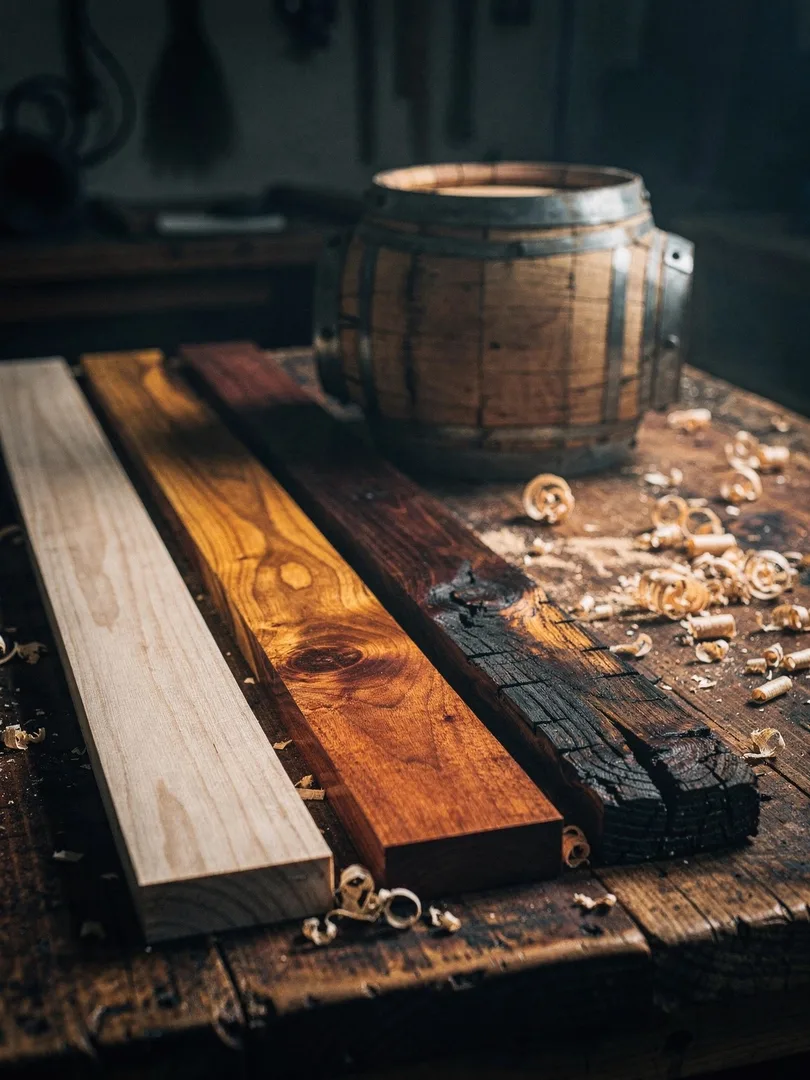
Comparing Woods
Oak, Ash, Acacia: Which Wood for Which Spirit?
Oak is required for Brandy, Cognac, Armagnac, and Calvados because it's dense and imparts vanilla, spice, and tannin. Fruit brandy and Grappa may also mature in ash, acacia, cherry, or mulberry wood, which impart lighter color and mask the fruit less.
Why Oak? What the Wood Gives to the Spirit
Oak is dense enough to hold liquid and can be bent into staves, the curved planks that form a cask. In Europe, pedunculate oak and sessile oak, also called Traubeneiche, are the main species used for spirits. France is known for sources like Limousin and the Tronçais forest. Limousin oak is considered coarser-grained and more tannin-rich, while Tronçais is finer.
What the wood contributes can be roughly grouped. Tannins add structure and a touch of dryness. Lignin, a component of the cell walls, breaks down into vanillin and spicy notes. Lactones recall coconut and fresh wood. A tiny amount of oxygen also passes through the pores to reach the spirit, which slowly oxidizes and softens as a result.
New Cask, Old Cask, Large Cask: What Determines the Effect
A new cask releases a lot in a short time, while a cask that's been used several times gives up far less. Cellar masters therefore often place young distillates briefly in new wood first, then continue aging them in older casks. This way, the spirit gains color and structure without the wood dominating the flavor.
Size matters too. In a small cask, each liter touches more wood surface than in a large one. The EU rule for Brandy accounts for this explicitly: a minimum of one year's maturation in containers of 1,000 liters or more, but six months in smaller casks.
During construction, the inside of a cask is heated over fire so the staves can be bent into shape. This process, called toasting, caramelizes wood sugars and produces notes of toast, caramel, and coffee. How heavily a cask is toasted plays a major role in shaping its later character.
Some casks previously held wine. Brandy de Jerez, by its rules, matures in casks that previously held Sherry. Other distillers use Port or wine casks for a brief finishing period, known as a finish, much as in whisky.
Ash, Acacia, Cherry, Mulberry: Woods for Fruit Brandy and Grappa
Where the law doesn't require oak, distillers have free choice. Ash is light-colored and low in tannin. It imparts little color and lets the fruit stay front and center, which is why it suits fruit brandies meant to receive only a hint of wood.
Acacia, botanically usually black locust, colors golden-yellow and brings floral, honey-like notes. Cherry wood reacts faster, colors reddish, and recalls marzipan and almond. Mulberry wood is known mainly from Italy, where Grappa is traditionally aged not just in oak but also in cherry, ash, acacia, or mulberry. Some distilleries showcase this deliberately by aging the same Grappa in different woods.
Which Wood Suits Which Spirit?
For Brandy, Cognac, Armagnac, and Calvados, this question doesn't even arise, oak is a given. A wine distillate aged in an acacia cask couldn't be called Brandy. Here, differences come down to the oak's origin, age, and toasting level.
For fruit brandy, it pays to consider the fruit itself. Robust, spicy fruits like quetsch plum, apple, or firm-structured pears handle oak well. Delicate aromas like raspberry, Williams pear, or apricot can easily get lost in wood. If distillers use wood at all here, they tend to reach for ash or older casks.
With Grappa, the choice depends on style. An aromatic Grappa made from Muscat grapes handles little wood well, while a robust one from red varieties can take more. The wood type isn't always listed on the label, the age categories "invecchiata" and "riserva" only require wood aging, not any particular species.
For newcomers, a simple rule of thumb applies. If you want to taste the fruit, choose the clear spirit. If you're after warmth, spice, and roundness, reach for the wood-aged one. Done well, both can shine.