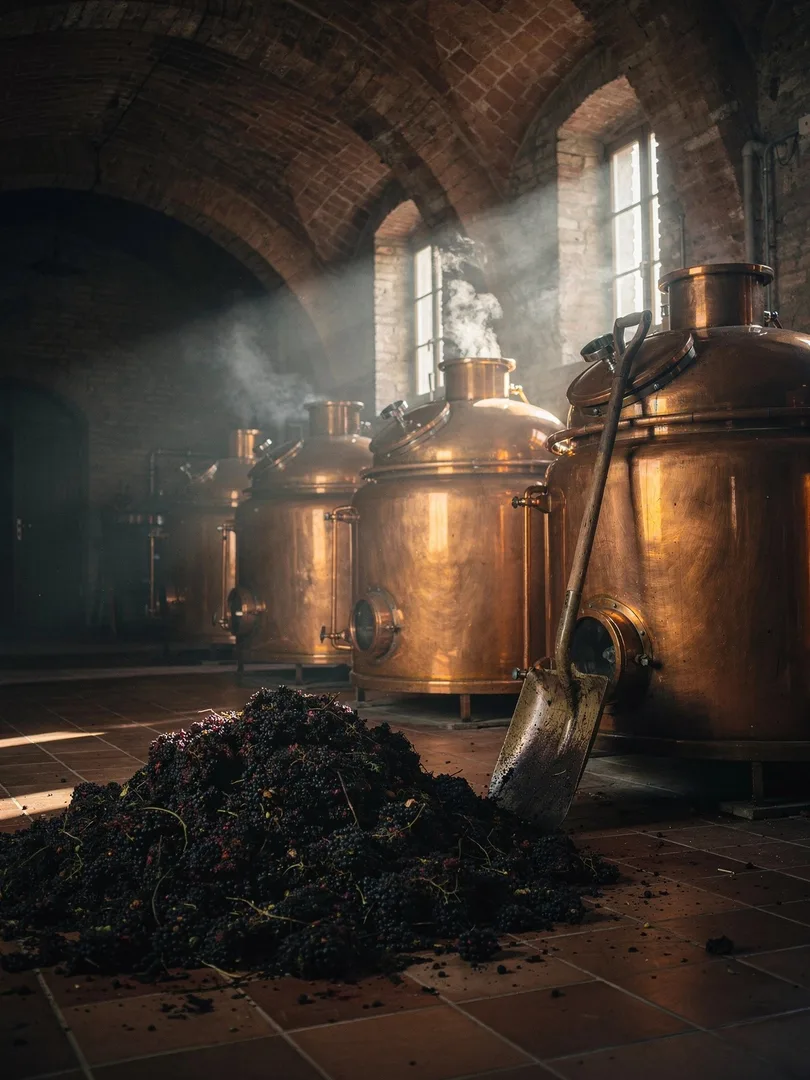
Pomace in the Still
How Is Grappa Distilled? From Pomace to Distillate
Grappa is distilled from fresh, fermented pomace, which goes into the still itself. Since solid skins would scorch over direct heat, they're heated instead with steam or after water is added. What matters most is the freshness of the pomace, a clean separation of heads and tails, and a resting period afterward.
Fresh Pomace: Why Grappa Begins at Harvest Time
A Grappa distillery works to the rhythm of the grape harvest. As soon as pressing begins in the cellars, pomace arrives, and time becomes critical. Damp pomace spoils quickly in open air: acetic bacteria and mold take hold and leave off-flavors that end up in the distillate later. Good producers therefore distill as fresh as possible, or store the pomace airtight until distilling time.
Red pomace usually arrives already fermented, since red wine ferments on the skins. White pomace, on the other hand, is still sweet and must ferment first before it can be distilled, as EU rules explicitly require fermented pomace. With aromatic varieties like Moscato or Traminer, distilleries pay particularly close attention, since their fragrance is fleeting.
Why the Pomace Must Go Into the Still
The heart of the process is written into law: the first distillation must take place in the presence of the pomace. That's precisely where the aromas that define a pomace brandy reside. But solid pomace in a directly fired still would scorch at the bottom, producing bitter, smoky notes. The regulation therefore allows two approaches: either steam is passed directly through the pomace, or water is added to create a kind of mash.
In Italy, stills are common in which pomace is loaded in batches and steam is passed through it. The steam draws alcohol and aromatic compounds out of the skins and carries them upward. Heating in a water bath, known in Italian as bagnomaria, is also cited as a traditional method; which approach a particular distillery uses is often detailed only in producer information. Large operations also distill in continuous systems, while smaller houses favor batches because they can manage each lot individually.
This isn't meant as a distilling guide, and that's intentional. Producing alcohol without a license is a criminal offense in Germany, even on a small scale. The technique is explained here solely to make clear why a pomace brandy tastes the way it does.
Heads, Heart, Tails: What Gets Separated from the Pomace
What flows out of the still isn't uniform from start to finish. First come the highly volatile compounds—the heads, or foreshots—with a sharp, solvent-like smell. Then follows the heart, the main run, which is destined for the bottle. At the end, the tails trickle out with heavy, oily notes. The distiller recognizes the right moment to switch cuts by smell, taste, and alcohol content.
With pomace, this cut is especially tricky. Skins bring a great deal of methanol with them, and the limit for pomace brandy stands at 1,000 grams per hectoliter of pure alcohol. Separating out the heads only partially reduces the methanol content, since methanol spreads throughout the entire run. What matters more is clean, fresh pomace that doesn't generate excessive methanol in the first place.
After Distillation: Resting, Water, Bottle
Freshly distilled Grappa is too strong and still unsettled. Young Grappa therefore rests for a while in glass or stainless steel before being brought down to drinking strength with water. Adding water isn't a trick—it's standard practice for nearly all spirits; most Grappa on the market falls between 40 and 45% ABV.
If it's meant to age, it goes into wood. How long determines the designation on the label, since Italy mandates fixed minimum periods for each one. These stages, from giovane to riserva, are the subject of the next stop.