Copper and the Cut
Distilling
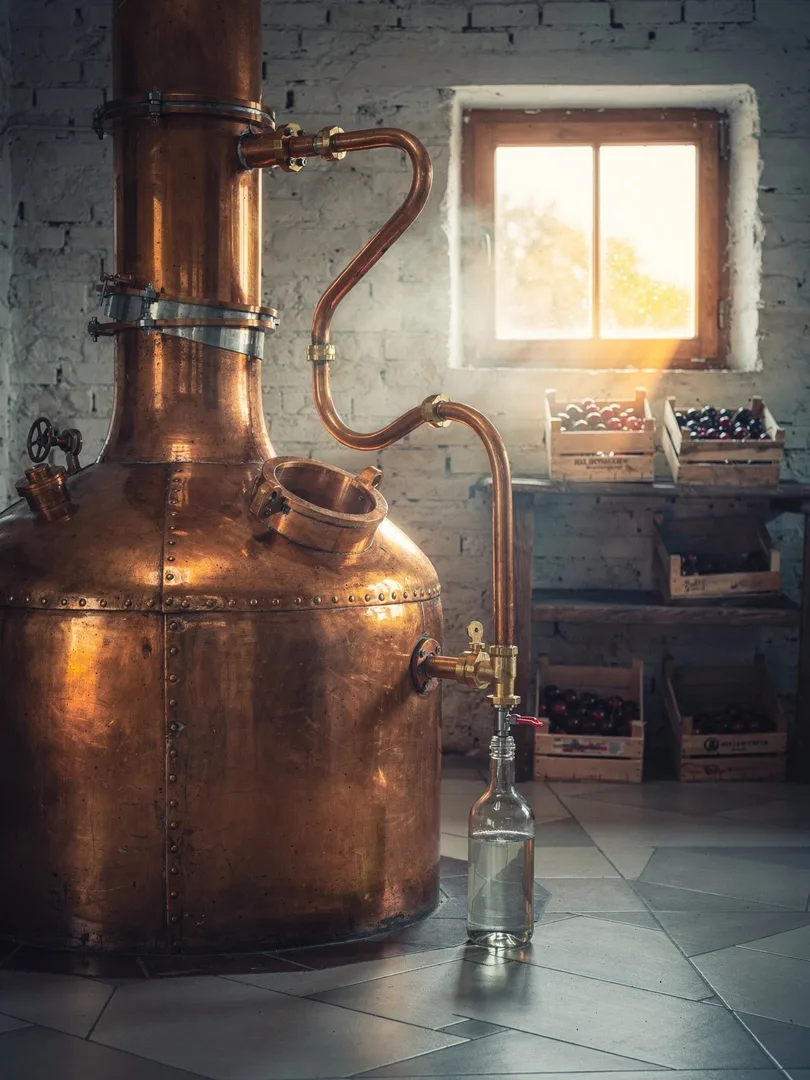
The heart of every Pálinka distillery is the pot still, a bulbous copper kettle with a long neck. Copper conducts heat well and binds sulfur compounds that would otherwise give the spirit an unpleasant smell. That's why polished copper stills still stand in the region's distilleries, and the distiller makes sure they're thoroughly cleaned after every run. A dirty still passes its odor on to the next batch.
The fermented mash is heated, the alcohol rises as vapor, cools again in a coil, and drips out as distillate. Because alcohol evaporates earlier than water, the distillate is stronger than the mash. It must stay below 86% ABV so that the fruit's aroma is preserved and it doesn't turn into neutral alcohol.
The distillate comes in three parts. The foreshots, containing the most volatile substances including methanol and harsh aromas, are separated off. The middle run, the "heart," is the actual spirit. The feints, with heavy, fusel-smelling components, are likewise discarded. Where the distiller makes the cuts shapes the character of the spirit.
If distilled twice, a weak low wine is produced first, which is refined in the second pass. Stills with a column or a reflux enhancer, an attachment that purifies the distillate again as it rises, can achieve this in a single pass. For Újfehértói meggypálinka, the specification allows two types of stills, so both methods are considered standard.
A single pass requires patience, and the distiller stays at the still the entire time. Anyone without their own equipment can have their fruit processed in Hungary by a contract distiller for a fee. In Germany, too, the rule applies: distilling is only permitted with a license or distilling right; anything else is prohibited.