Softened by Sandstone
Water & Climate
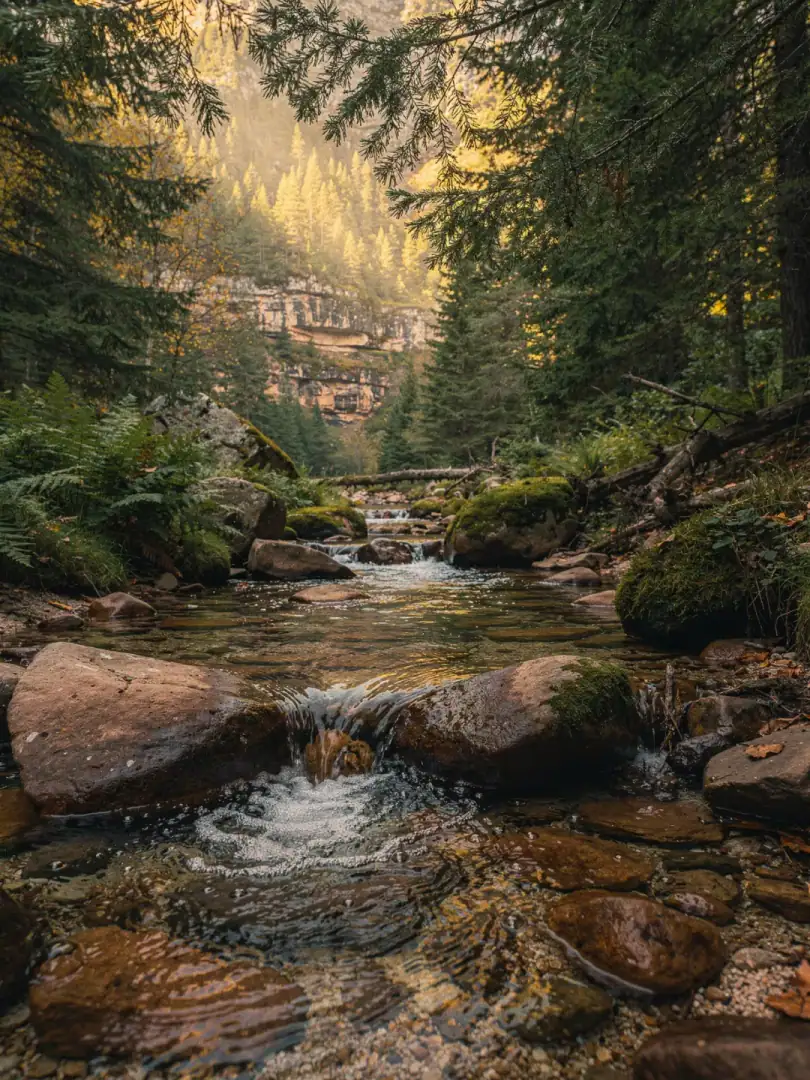
Anyone hiking in the Black Forest constantly crosses small streams. They emerge cold and clear from the forest before gathering into rivers like the Kinzig or the Murg. On its way through the mountain, this water usually seeps through thick layers of granite, gneiss, or Buntsandstein.
It's the Buntsandstein in particular that underlies large parts of the central and northern Black Forest. It formed around 250 million years ago from sediment deposited by long-vanished rivers in a hot, dry plain. Rainwater seeps through this stone like a coarse filter, losing nearly all its hard minerals along the way.
The result is remarkably soft spring water with very little lime. For distilleries, this is more than a pleasant side note. When a distillate is cut down from bottling strength to 40 or 47% ABV, hard, lime-rich water can react with the essential oils of the botanicals, clouding the gin or altering its flavor.
Soft Buntsandstein water, by contrast, leaves the delicate aromas of spruce shoots or lingonberries largely undisturbed. That's why Black Forest distilleries prefer their own springs for dilution rather than just any tap water. The difference is rarely easy to quantify, but it's noticeable nonetheless.
The harsh upland climate, with cool nights and wet winters, keeps the springs cool and consistent year-round. Distilleries that want the same water quality in every season value exactly this consistency. Even in dry summers, the deep springs from the Buntsandstein rarely run low.