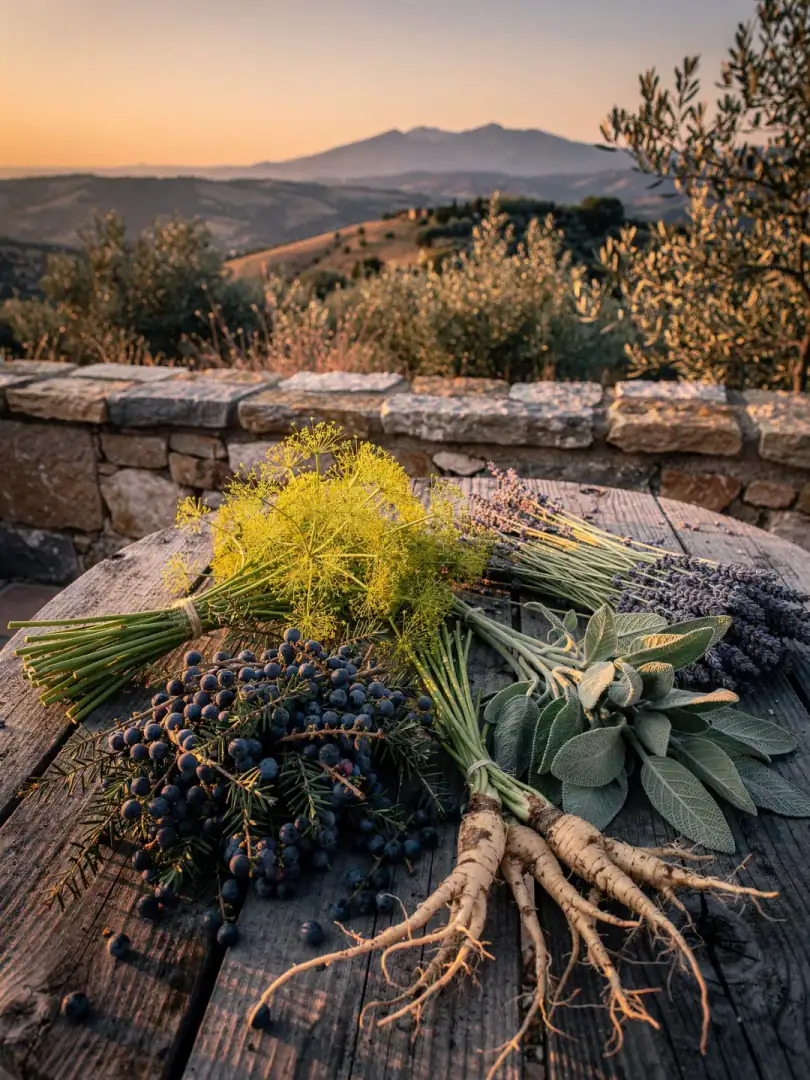
Iris and Apennine Juniper
Botanicals
The juniper (Juniperus communis) of this region grows wild on the stony slopes of the Apennines, often where little else will thrive. That very scarcity is what makes it interesting. Shrubs on lean limestone soil produce more essential oils to cope with little water, yielding berries with a bold, resinous aroma. Traditional harvesting involves beating the branches over a spread cloth, a method faster than picking individual berries but one that demands a careful touch so only ripe fruit falls.
Sabatini Gin from Teccognano near Cortona pairs its juniper with eight other Tuscan botanicals, including coriander, Florentine iris, wild fennel, lavender, olive leaves, thyme, lemon verbena, and sage. Most of these the family gathers wild on their own hillside. Only the juniper comes from various parts of the region, since their own harvest alone isn't enough.
At Peter in Florence in Pelago, Florentine iris takes center stage. Its root, known as orris root, has served for centuries as a fixative and flavoring agent in perfumery. The iris is also Florence's heraldic symbol, since the lily on the city's coat of arms is botanically actually an iris. Alongside it come Tuscan juniper, rosemary, bergamot peel, rose, and lavender, fourteen botanicals in total.
What each herb contributes in the glass mirrors this landscape. Wild fennel and sage bring the dry, resinous scrubland straight to the tongue. Olive leaves add a faintly bitter, green note reminiscent of the season's first-pressed oil. The iris root, by contrast, feels soft and powdery, almost like wet stone after rain. It holds the bolder herbs together rather than letting them overpower the blend.
brittle, flaky shale marl of the Tuscan hills, typical of the slopes around Cortona
The root: shallow roots force the juniper to make do with little water, concentrating more essential oil in the berry