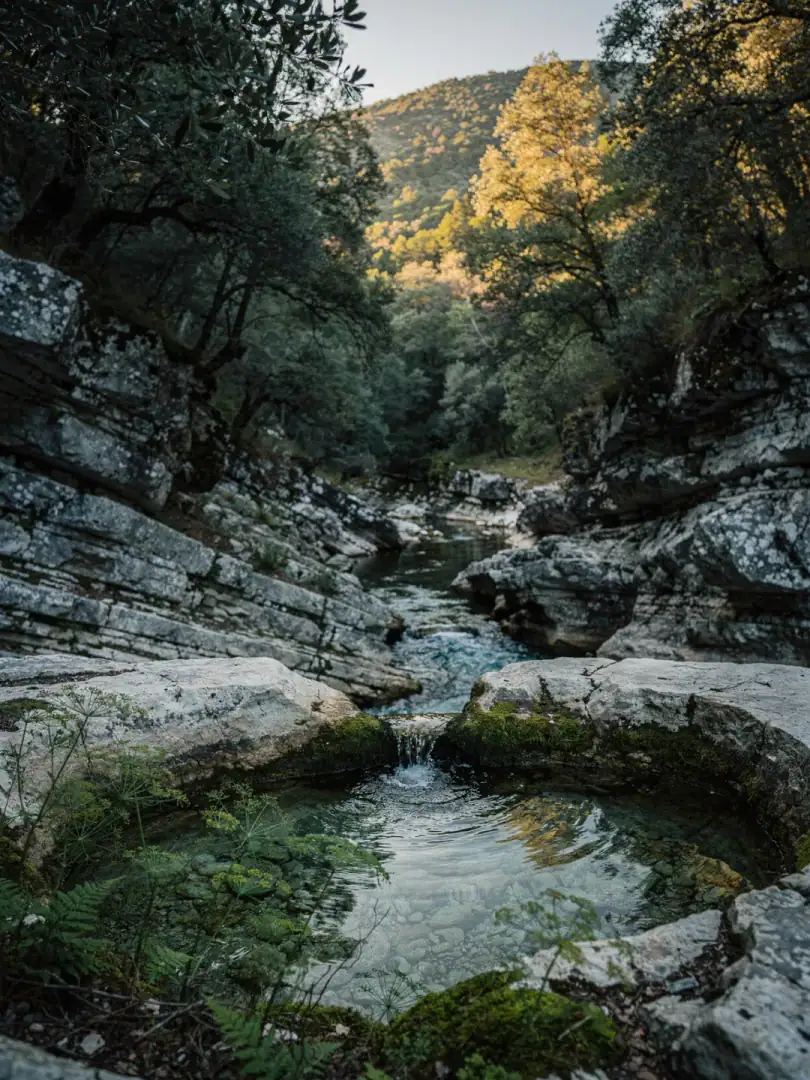
Apennine Springs
Water & Climate
Tuscany and Umbria lie along the spine of the Apennines, the mountain chain that runs through Italy like a backbone. Rainwater seeps through its limestone over years, filtering through fissures and caves before emerging again as a spring, filtered and usually cooler than water down in the valleys. Springs just like these lie within reach of the distilleries near Cortona and Pelago. Both operations sit on hillsides above four hundred meters.
The climate is classically Mediterranean, with hot, dry summers and cool, often frosty winters at altitude. This contrast puts stress on the plants and forces them to concentrate their aromas. Wild fennel and juniper don't grow here despite the dryness, but because of it. Where water is scarce, plants lignify early and store more essential oil.
When cutting the distillate down to drinking strength, water quality determines the outcome. Hard, lime-rich water carries minerals with it, sometimes a faintly chalky undertone. Soft Apennine spring water, by contrast, stays more neutral and lets the botanicals shine through more clearly. Both Tuscan distilleries therefore rely on local spring or well water rather than city tap water, to avoid diluting the botanicals' character.
Diluting with water that's too cold can also cause essential oils to temporarily cloud during proofing, an effect distillers call louche. In unfiltered, naturally presented gins, this is accepted as part of the character. In the hills around Cortona and Pelago, day and night temperatures swing sharply in summer. This behavior of the water is treated there as part of the craft, not a flaw to be filtered away.