Molasses Instead of Grain
Distilling & Production
The big difference from European gin begins even before the still. Ginebra San Miguel doesn't rely on grain but on sugarcane molasses as the base for its alcohol. The molasses comes from sugar mills in the Philippines, India, and Indonesia. It's fermented and distilled into raw alcohol at the company's own Distileria Bago.
This is a matter of history. Sugarcane was, and still is, abundant in the Philippines, while grain had to be imported. Even the old distilleries in Manila therefore turned to what grew locally. A stopgap solution became a style tradition all its own, one that still holds today.
The finished neutral alcohol is then infused with the botanicals. Depending on the recipe, it's distilled a second time or recombined with flavorings. Ginebra San Miguel then hits the market at a classic 40% ABV. A milder version, Ginebra San Miguel Premium, comes in at 35% ABV.
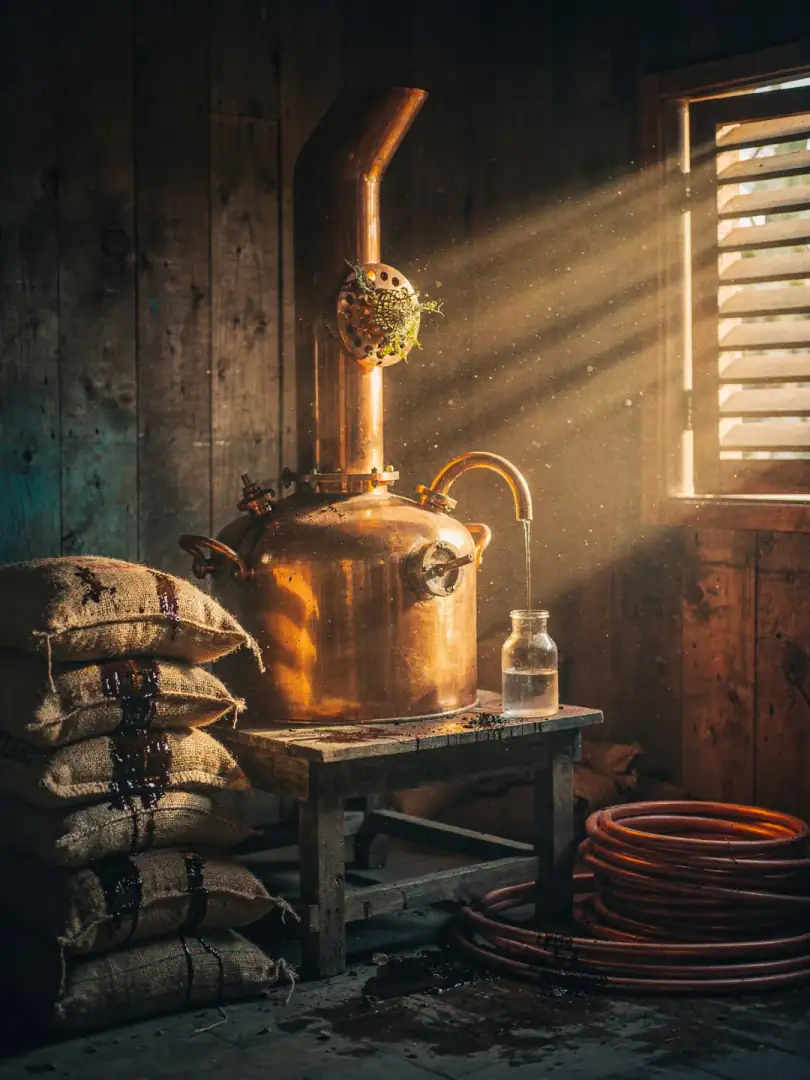
The young craft distillery Full Circle Craft Distillers in Calamba City works differently. For its Archipelago Botanical Gin, it uses a copper pot still. The gathered botanicals, from Calamansi to Benguet pine, are macerated directly in the alcohol. Only after that does distillation happen, rather than simply adding flavorings afterward.
So in Manila, two distilling philosophies exist side by side. The industrial one turns cheap molasses into a drink for millions, bottle after bottle, case after case. The small copper one sends the archipelago through the still, botanical by botanical. And in the end, both carry the same Spanish name: Ginebra.