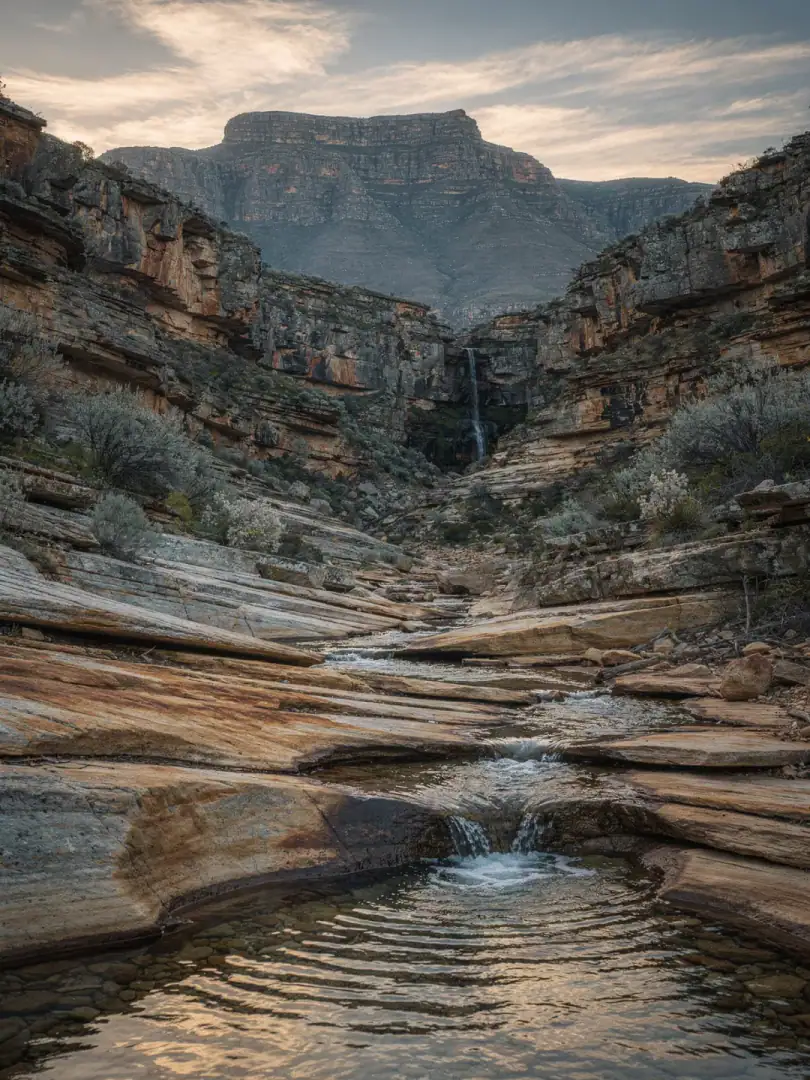
Winter Rain from Table Mountain
Water & Climate
Table Mountain is made of sandstone, compacted from sand at the bottom of an ancient sea more than 500 million years ago. Rainwater seeps through this stone, gets mechanically filtered, and stays almost mineral-free, since sandstone releases hardly any soluble salts. This very soft water flows into the streams that supply Cape Town and Stellenbosch.
Unusual for South Africa is the timing of the rain. While the country as a whole mostly receives rainfall in summer, on the Cape West it falls in winter—a Mediterranean climate with dry, hot summers and damp, mild winters. It's precisely this winter rain that keeps the fynbos alive and fills the reservoirs from which distilleries draw their water.
During proofing, the final step before bottling, distilled or heavily filtered water dilutes the high-proof spirit down to typically 40 to 43 percent ABV. If the water contained a lot of lime or iron, the gin would easily turn cloudy when diluted or pick up a metallic off-taste.
Soft, sandstone-filtered water avoids exactly that. It blends cleanly with the alcohol without displacing the fine oils from buchu or honeybush, which can otherwise bind to hard water ions and cause haze. Distilleries at the Cape therefore actively market their proximity to Table Mountain as a water source.
Stellenbosch also sits at the foot of granite mountains, whose weathered soils already support the region's vineyards. Here too, winter rain feeds the rivers running through the wine country, before distilleries on the edge of town tap them for their own production.