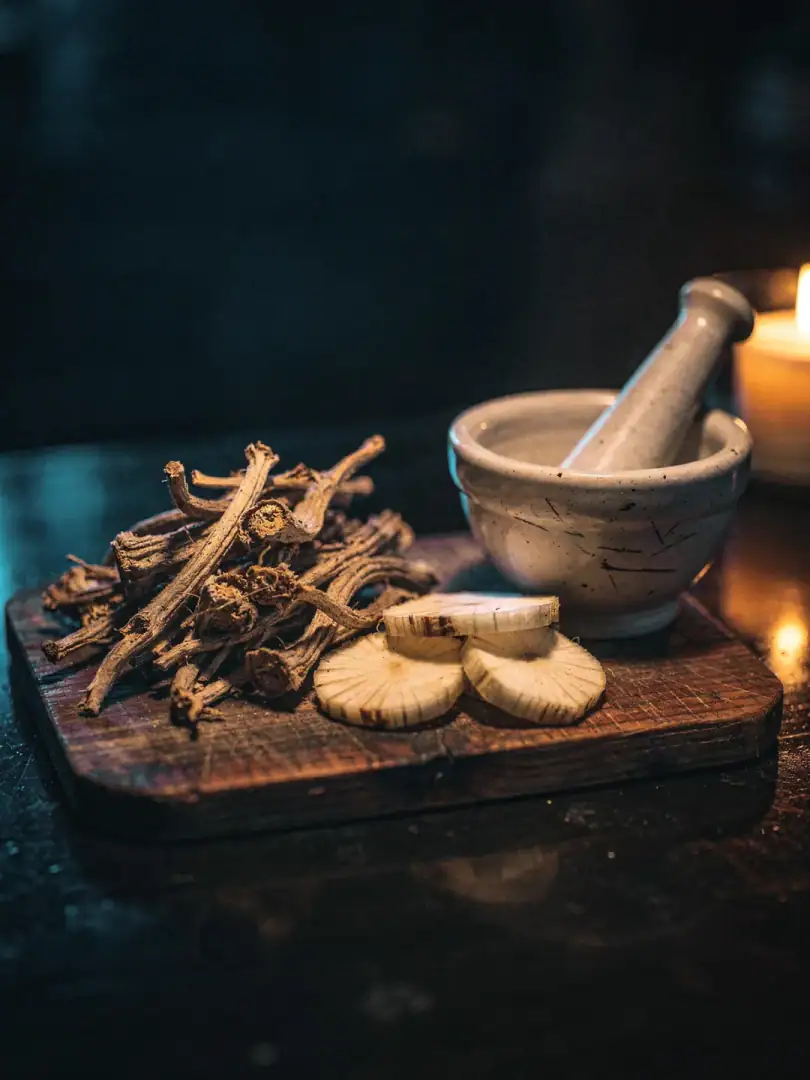
Roots as fixatives
Angelica and orris
Two unassuming roots hold many gin recipes together: angelica root and orris root. On their own, neither smells much like gin, yet without them, the volatile aromas of citrus and florals would fade away much faster. Distillers call this job fixation, a term borrowed from perfumery.
What does angelica root do in gin?
Angelica, botanically Angelica archangelica, is a tall-growing plant from cooler regions of Northern Europe, whose root is dried, cut and added to the still. It smells earthy, musky and slightly bitter, with a hint of celery and forest. On its own, this note would hardly be pleasant, yet in small amounts it transforms the entire recipe, giving it an earthy depth that pure citrus or floral notes would otherwise lack.
The real effect lies not in its own flavor but in its impact on other botanicals. Angelica root contains compounds that prevent lightly volatile citrus and floral aromas from evaporating too quickly and disappearing. A gin containing angelica holds its aroma in the glass longer and more evenly, rather than turning flat after just a few minutes — something especially noticeable when tasting over the course of a long evening.
What does orris root do in gin?
Orris root, also known as iris root, comes from certain iris species such as Iris germanica or Iris pallida. It's not the fresh root that's used, but a rhizome dried and matured over years, which develops a delicate, violet-like scent in the process. Freshly harvested, the root barely smells at all — its aroma only emerges through long storage, which is why well-aged orris root fetches a much higher price than freshly dug root.
Like angelica, orris root works mainly as a connector. It lengthens a gin's finish and ensures that the individual botanicals merge into a rounded overall impression rather than fading away one after another. Some distillers describe its role figuratively as a kind of glue for aromas, holding the recipe together, much like a quiet undertone that carries a piece of music.
Why is this role called fixation?
The term fixative comes from perfume-making, where certain raw materials ensure a scent lasts for hours on the skin instead of fading within minutes. Gin distillers borrowed this idea because their spirit faces a similar challenge: light aromas like citrus oil or floral scent evaporate in the glass faster than heavier, resinous notes like juniper.
Angelica and orris root balance out this imbalance. Without them, a gin would smell intensely of lemon or rose the moment the bottle is opened, only to taste almost purely of alcohol shortly after. With fixatives, the overall impression stays more stable throughout the entire time in the glass, from the very first sniff to the last sip.
How do distillers dose these roots?
Both roots are usually used in very small amounts, often well under one percent of the total botanical mix. Even slight overdosing becomes noticeable: too much angelica pushes a bitter, earthy undertone to the front, while too much orris root quickly turns soapy and powdery, almost like an overly perfumed laundry detergent.
The exact amount depends on the rest of the recipe. A citrus-heavy gin needs more fixative than a gin that already contains heavy, resinous botanicals like cinnamon or cubeb. This fine-tuning is one of the steps distilleries spend the longest testing before considering a recipe finished, often through many small trial batches.
A large share of the orris root traded worldwide comes from Tuscany, around Florence. There, Iris pallida has grown in the same fields for centuries. After harvest, the rhizomes are stored for two to three years in dry warehouses. Only this long resting period releases the violet-like scent. Freshly harvested, the root barely smells at all, almost like raw potato. Angelica root has a similarly long history. In the Middle Ages, monks used it as a medicinal plant against fever and plague. Only much later did distillers discover its usefulness for gin. Both roots show just how much hand labor and patience lie behind what seems like a small ingredient.