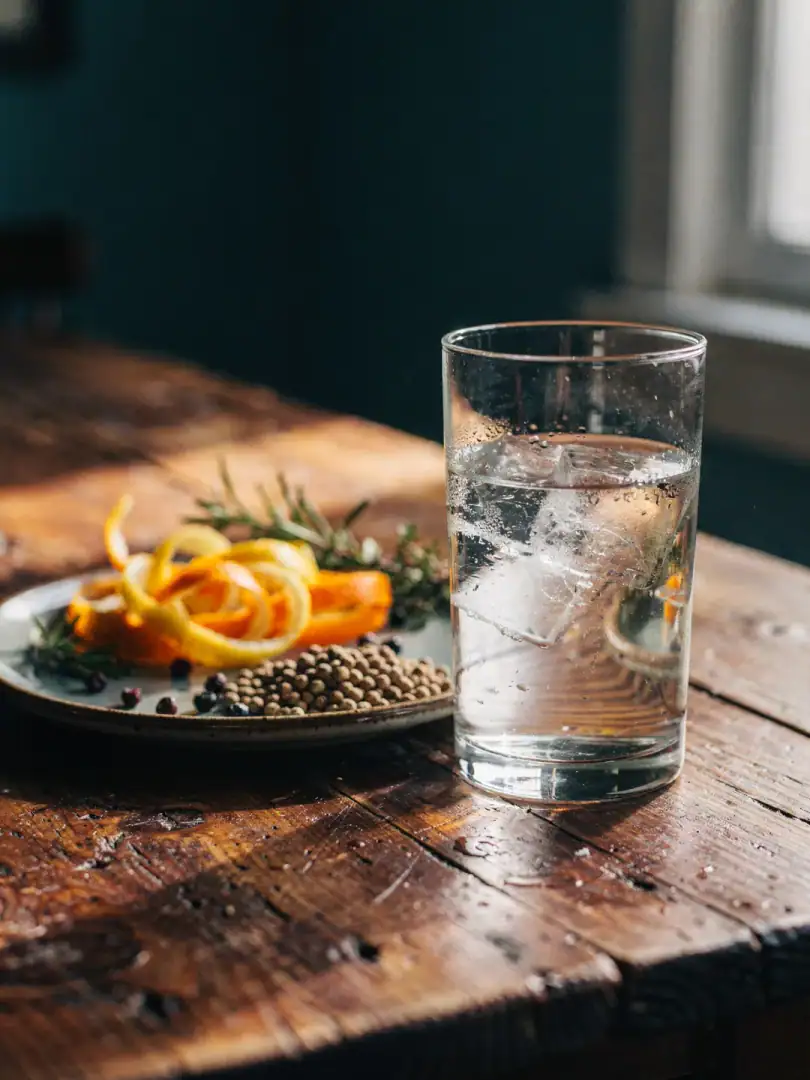
Gin as a Food Companion
Ground Rules
Why does gin pair with food at all? The answer lies in its botanicals: herbs, peels and spices that also appear on the plate, building a bridge between glass and dish.
What Makes Gin a Food Companion?
Gin is a juniper spirit: under EU Spirit Drinks Regulation 2019/787, it must contain at least 37.5 percent alcohol and derive its flavour predominantly from juniper berries. This basic rule makes it a bold partner at the table, quite unlike lighter wine. Anyone drinking gin with food isn't looking for a gentle accompaniment, but a counterpart that can hold its own.
Unlike wine, there's no centuries-old tradition of serving gin deliberately with food. That's exactly what makes it exciting at the table: those who work out the rules for themselves often find more surprising pairings than with well-worn wine recommendations. The foundation for this lies in the botanicals in the glass – the herbs, peels and roots that flavour the gin.
Gin styles differ enormously around the world: a classic London Gin tastes nothing like a floral, modern gin or an earthy gin distilled with local herbs at a small distillery. Anyone pairing food with gin should therefore pay less attention to category and more to the actual flavour profile in the bottle – two gins of the same style can behave completely differently at the table.
Botanicals as a Bridge to the Plate
Every gin carries its own signature of botanicals. Citrus peel, coriander, angelica root or cardamom appear in many cuisines in almost identical form. A gin heavy on lemon naturally seeks out dishes that themselves work with lemon, while a gin built around juniper and pine leans towards game and smoky food.
This overlap is called a bridge aroma: a scent or flavour compound that appears equally in the drink and the dish, connecting the two. Anyone who knows their gin's ingredient list, or at least can taste its dominant aromas, can deliberately build a dish from it rather than guessing by feel.
Anyone wanting to experiment at home should put together a short list of their own gins along with their key botanicals. Just three or four bottles with different emphases, one citrus-forward, one herb-driven, one built on warm spices, are enough to have a suitable candidate ready for most dishes, without having to guess afresh at every meal.
Balancing Sweetness, Acidity and Bitterness
On the palate, three forces decide whether a pairing succeeds: sweetness, acidity and bitterness. A bitter, herbal gin often tastes sharper next to a sweet dessert than it does on its own, because the dessert's sweetness draws out the bitter compounds. A very acidic starter, on the other hand, can make a mild gin taste almost flat.
The simplest rule: similarities amplify each other, contrasts balance each other out. A citrus-forward gin alongside a tart ceviche, a raw fish dish 'cooked' in citrus juice, doubles the sense of freshness. A sweet sloe gin, made with sloes and at least 25 percent alcohol, instead offsets the sharpness of a salty cheese.
Quantity matters too: a single sip of gin changes the next bite differently than a large glass drunk just before the meal. Anyone wanting to use the three forces deliberately is best off tasting sip by sip between courses rather than draining the drink in one go, making it much easier to observe the effect on sweetness, acidity and bitterness.
Dilution and Temperature at the Table
How a gin is served with food changes its effect at least as much as the botanicals themselves. Neat and at room temperature, it tastes intense and alcohol-forward, which suits a hearty dish well. Well chilled and diluted with tonic, it becomes quieter and gives the food more room.
For most pairings at the table, a ratio that doesn't steal the show from the food works best: plenty of ice, a modest amount of gin, a restrained tonic. Anyone wanting to drink gin neat with food instead should lean towards dishes rich in fat or roasted flavours, which cushion the sharpness of the alcohol.
The glass matters too: a rounded glass with plenty of air above the liquid releases the delicate botanicals more strongly than a narrow glass. With an intense dish that already brings plenty of its own flavours, a narrower glass can make more sense, so the gin doesn't compete too forcefully with the food.