Juniper as Medicine
The Origin: Juniper as Medicine
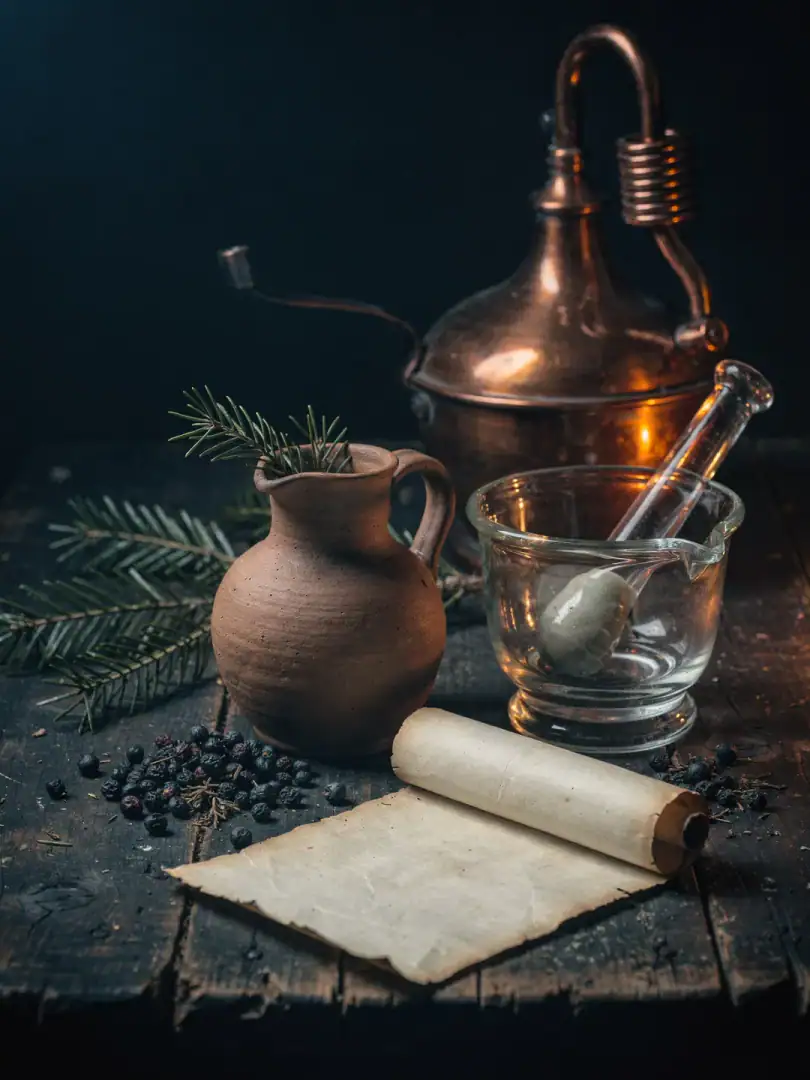
Before gin became a pleasure to drink, it was a medicine. Monks and apothecaries in the Netherlands distilled juniper berries to treat kidney ailments and fever, and over the centuries this bitter medicine evolved into Genever, the grandfather of all gins.
Juniper as a Remedy in the Middle Ages
Long before the first sip of gin, juniper berries were regarded as medicine. Monastery apothecaries boiled them with alcohol, hoping for relief from kidney stones, gout and fever. In many accounts, the Dutch physician and professor Franciscus Sylvius of Leiden is credited with prescribing a juniper tincture for kidney flushing in the 16th century. Whether he actually invented Genever or simply made it more widely known remains disputed among historians. What is certain is that grain spirit flavored with juniper had long been known in the Netherlands and was sold freely in apothecaries at that time.
The name reveals its origin. Genever comes from the French word for juniper, genièvre, which in turn traces back to the Latin juniperus. In English, genever quickly became gin, a shorter word for the spirit that traders and soldiers carried home with them. Important for understanding today's gin: Genever tastes different. It is distilled from a grain mash much like malt wine and often remains heavy and slightly sweet, whereas modern gin relies on a neutral, almost flavorless alcohol in which juniper and other botanicals — the aromatic plants used for flavoring — stand out clearly.
Genever itself is not a single, uniform spirit. To this day it comes in two main styles defined under EU law. Oude, the old style, must by regulation contain at least 15 percent malt wine. Malt wine is that malty grain spirit which gives Genever its robust, almost whisky-like texture. Jonge, the young style, only emerged in the 20th century as a response to lighter drinking habits. It contains at most 15 percent malt wine and hardly any residual sugar. This distinction is no marketing invention — it is enshrined in EU Spirit Drinks Regulation 2019/787, just like the protection of the names Genever and Jenever themselves. Anyone who finds an old stoneware bottle labeled Oude Genever is holding a drink that still comes fairly close to its 17th-century ancestor.
Schiedam and the Rise of Genever
In the 17th century, the town of Schiedam near Rotterdam grew into the center of Genever production. Windmills ground the grain, dozens of distilleries lined the harbor, and the finished Genever was shipped out in stoneware jugs to destinations across the world. The Dutch East India Company ensured that the juniper spirit became known well beyond the country's borders. At the same time, a culture of small tasting houses flourished in Amsterdam and Rotterdam, where Genever was served from earthenware jugs into tiny glasses, filled right to the brim, so that drinkers had to bend down to take their first sip without spilling.
This way of drinking had its own name: kopstootje, a little headbutt. To this day, Genever has remained a distinct, protected drink. The names Genever and Jenever are protected as geographical indications under the EU Spirit Drinks Regulation and may only come from certain regions of the Netherlands, Belgium, and parts of France and Germany. Anyone tasting Genever today is tasting a piece of an era in which juniper spirit was not yet a clear, clean spirit but rather a malty, often oak-aged brandy with a distinct grain character.
Dutch Courage: How Genever's Reputation Was Born
The phrase Dutch Courage dates back to a time when English soldiers fought alongside Dutch troops during the Eighty Years' War. Before battle, Genever was passed around, and English observers marveled at the Dutch soldiers' fighting spirit. The link between alcohol and bravery became a popular saying that, to this day, stands for courage poured from a bottle. English soldiers brought a taste for Genever back home with them, where it met a market ripe for change.
At the time, England had mainly been drinking French brandy. Political tensions with France and the accession to the throne of the Dutchman William of Orange in 1688 suddenly turned Genever into a patriotic alternative. Trade barriers against French imports opened the market to domestic grain spirits, and juniper became a cheap, state-favored ingredient. What had once been a niche medicinal product of the monasteries had become a commercial commodity — one that found fertile political ground in England. What became of it in London is the subject of the next stop on this journey.