Today's global market
Gin today: a global market with many faces
Today, gin is no longer distilled only in London or Schiedam, but simultaneously in Manila, Madrid, and the Black Forest. The history of gin has finally become a truly global story.
The Philippines: the world's biggest gin market
Ask about the best-selling gin in the world, and you'll almost always land on Ginebra San Miguel from the Philippines. The brand traces back to a distillery founded in Manila as early as 1834, long before anyone could have imagined a craft movement. The Philippines remains by far the world's largest gin market by volume sold. There, gin is traditionally seen as an affordable everyday drink, not a premium product.
This Philippine mass market reveals a side of gin's history that's often missing from European craft narratives. For millions of people, gin isn't a refined botanical experience but simply the most accessible spirit on the shelf. Both worlds, the cheap everyday bottle and the elaborately crafted premium release, now exist side by side under the same name: gin.
Industry estimates for 2026 show just how large the global gin market has become. Depending on the calculation method, global gin revenue is projected to reach a double-digit billion-dollar figure in US dollars, with further growth expected in the years ahead. In Britain alone, industry associations recently counted well over eight hundred registered gin distilleries. In the US, estimates put the number of craft distilleries producing gin alongside other spirits in the thousands. The boundaries between categories are also increasingly blurring. Alcohol-free gin alternatives, flavored with the same botanicals, now serve a growing audience that wants to skip the alcohol without giving up the ritual of a gin and tonic.
Spain and the culture of the big glass
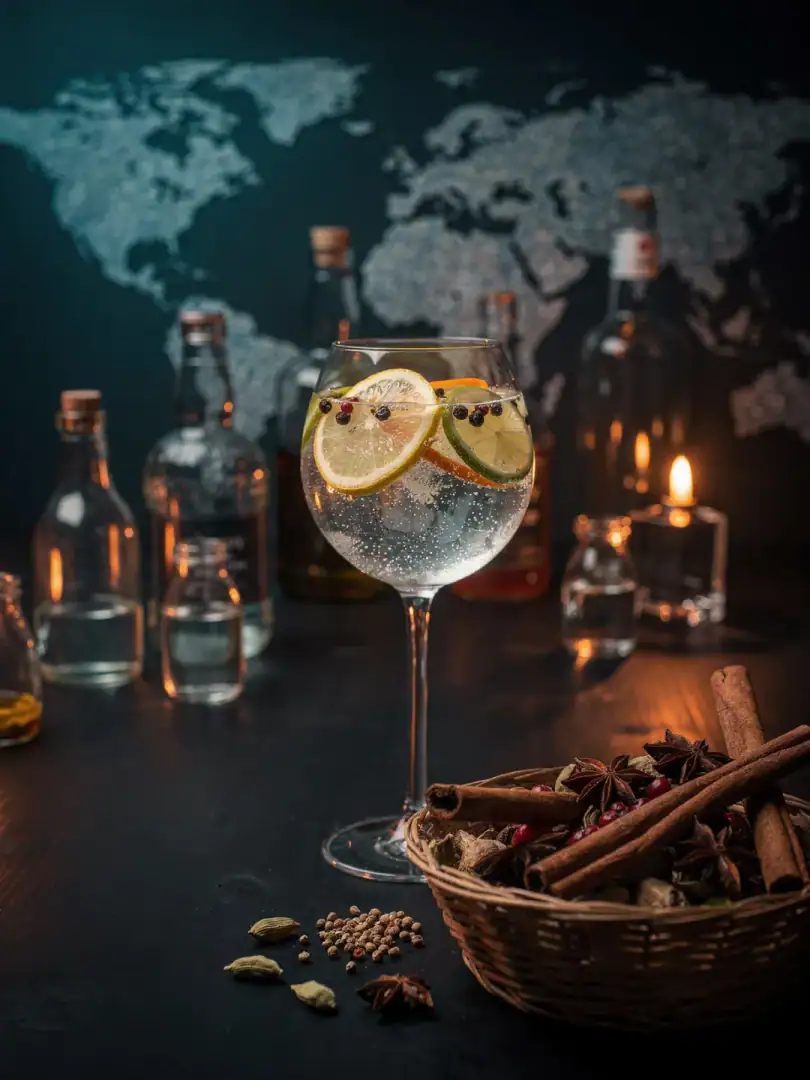
Since the 2000s, Spain has developed its own, highly visible gin and tonic culture that differs markedly from British bar tradition. Instead of a slim highball glass, Spanish bars serve gin and tonic in a large, round-bellied balloon glass. Plenty of ice and an elaborate garnish of herbs and fruit are part of the deal. This presentation became a ritual in its own right. It spread from Spain to many other European countries, including Germany, where it added extra fuel to the gin boom of the 2010s.
Germany itself now ranks among Europe's most notable gin markets. Since the craft wave took hold, hundreds of small distilleries have sprung up across the country, from Black Forest brands to urban distilleries in Berlin or Hamburg. Many work with regional botanicals like spruce tips, elderberry, or native herbs. Germany illustrates how a spirit once seen as purely British-Dutch became a product that virtually every country now reinterprets with its own ingredients.
A drink with two histories
Today, gin represents two very different stories at once. One is about mass-market brands delivering an affordable, reliable drink to millions of people worldwide, as in the Philippines or parts of Eastern Europe. The other is about small craft distilleries courting well-heeled enthusiasts with unusual botanicals, regional provenance, and elaborate presentation. Both stories share the same origin in the bitter juniper medicine of Dutch monasteries, even though today they seem to have almost nothing in common.
This double history explains why gin has remained so adaptable. It was medicine, a poor man's drink, and the status symbol of the gin palaces. It was Royal Navy shipboard ration, a tool of Prohibition, and a drink for the grandparents' generation. Finally, it became the flagship product of a worldwide craft movement, carrying a piece of character forward from each of these phases. A single balloon glass of gin and tonic therefore holds a long history of trade within it: juniper from the Apennines, coriander from Eastern Europe, citrus peel from Spain, and quinine that once came from the Andes. Hardly any other spirit brings together so many corners of the world in a single recipe.