Splendor and Precision
Gin Palaces and London Dry Gin
A century after the misery of the Gin Craze, gin suddenly gleamed behind cut glass and gaslight. New distilling technology made the alcohol cleaner, and magnificent gin palaces invited London's working class to drink in baroque surroundings.
What a Gin Palace Was
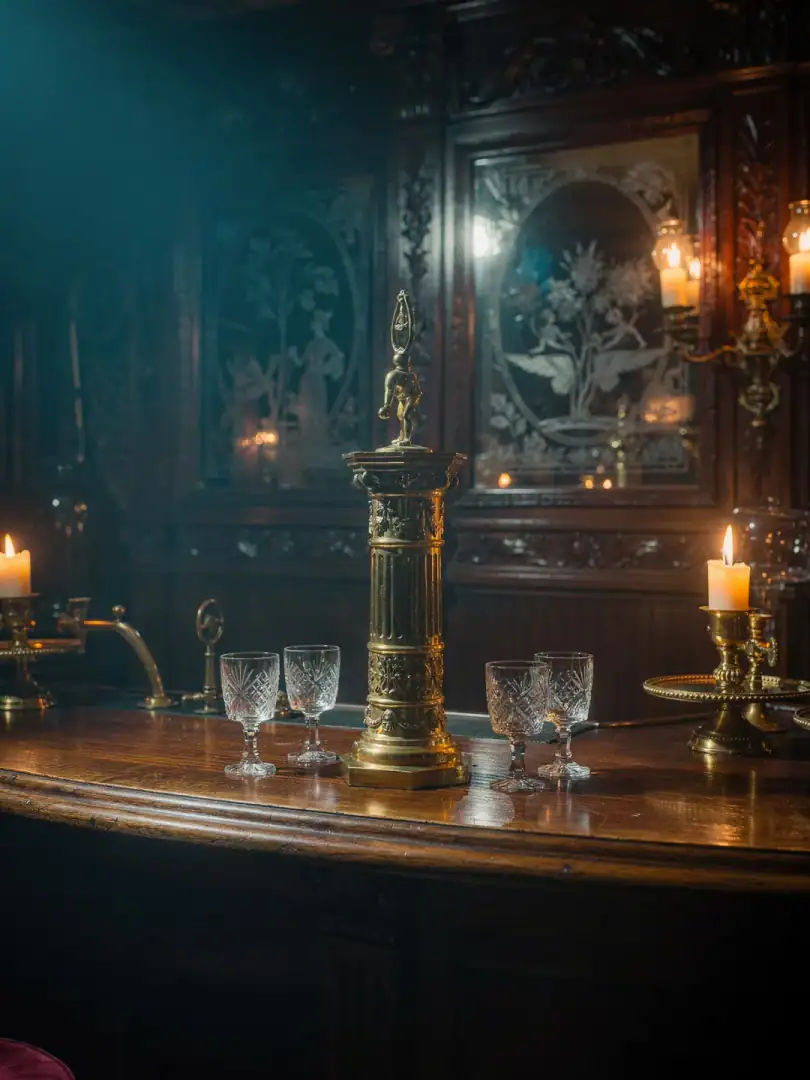
In the 1830s, the English government lowered taxes on spirits. Distilleries began building their own drinking establishments to lure customers away from the many small beer taverns. These venues soon came to be called Gin Palaces, and they relied on glamour rather than cramped spaces. Carved dark wood, enormous mirrors etched with intricate patterns, gleaming brass fittings and bright gaslight made the poorer streets surrounding them look like caves by comparison. Anyone who stepped through the door felt rich for an evening, even if they barely had enough money for a single glass of gin.
Charles Dickens described these halls in 1836 in one of his early sketches. He marveled at the contrast between the splendor of the façades and the poverty of the neighborhoods in which they stood. It was exactly this contrast that made gin palaces a fixture of the Victorian cityscape. They were not an exception, but a business model that spread across London and other industrial cities. The formula was simple: more glamour drew in more paying guests than a plain bar counter ever could.
The Coffey Still Changes the Flavor
Alongside the building boom of the gin palaces, a technical invention changed what was actually in the glass. In 1830, the Irishman Aeneas Coffey patented an improved form of continuous still, known today as the Coffey Still or Patent Still. Unlike the classic copper pot still, which works in individual batches, the Coffey apparatus distills continuously, achieving a significantly higher level of purity. The resulting alcohol was almost flavor-neutral and contained hardly any of the heavy fusel oils that had often made older spirits taste bitter and oily.
For gin, this was a turning point. Distillers could now produce a clean base spirit and no longer needed to soften it with sugar, as had been common with older, rough Genevers and early English juniper spirits. Out of this newfound purity emerged a dry style focused clearly on juniper, which soon came to be known as London Dry Gin. The name does not necessarily denote an origin in London, but rather a method of production: all flavors must arise during distillation. Under today's EU Spirit Drinks Regulation, only water may be added after distilling, and the sugar content must remain below 0.1 grams per liter.
To this day, the name London Dry is not regionally protected, unlike, say, Genever or Vilnius Gin. Even a distillery in Germany or Spain may call its product London Dry Gin, as long as it follows the strict production method. It was precisely this openness that turned the style into a global standard, against which almost every later generation of gin would be measured, from the earliest Scottish brands to today's craft distilleries.
From Palace of Pleasure to a Style of Its Own
London Dry Gin established itself as the preferred style in the second half of the 19th century, in the very gin palaces that had once served sweeter, doctored spirits. Brands such as Gordon's and Tanqueray, founded in 1769 and 1830 respectively, benefited from the new distilling technology and built their reputations on consistent quality. At the same time, Plymouth became established as a second recognized designation of origin, for a somewhat softer, earthier gin style from the port town of the same name in southwest England.
The combination of clean alcohol and a firm set of rules gave gin, for the first time, a reliable brand promise. Anyone buying a bottle of London Dry Gin knew roughly what to expect, whether they bought it in London, Glasgow, or later overseas. This reliability was the very foundation that allowed gin to become the backbone of a drink the world still knows today. Its origin, however, lay not in a bar, but aboard ships of the Royal Navy.