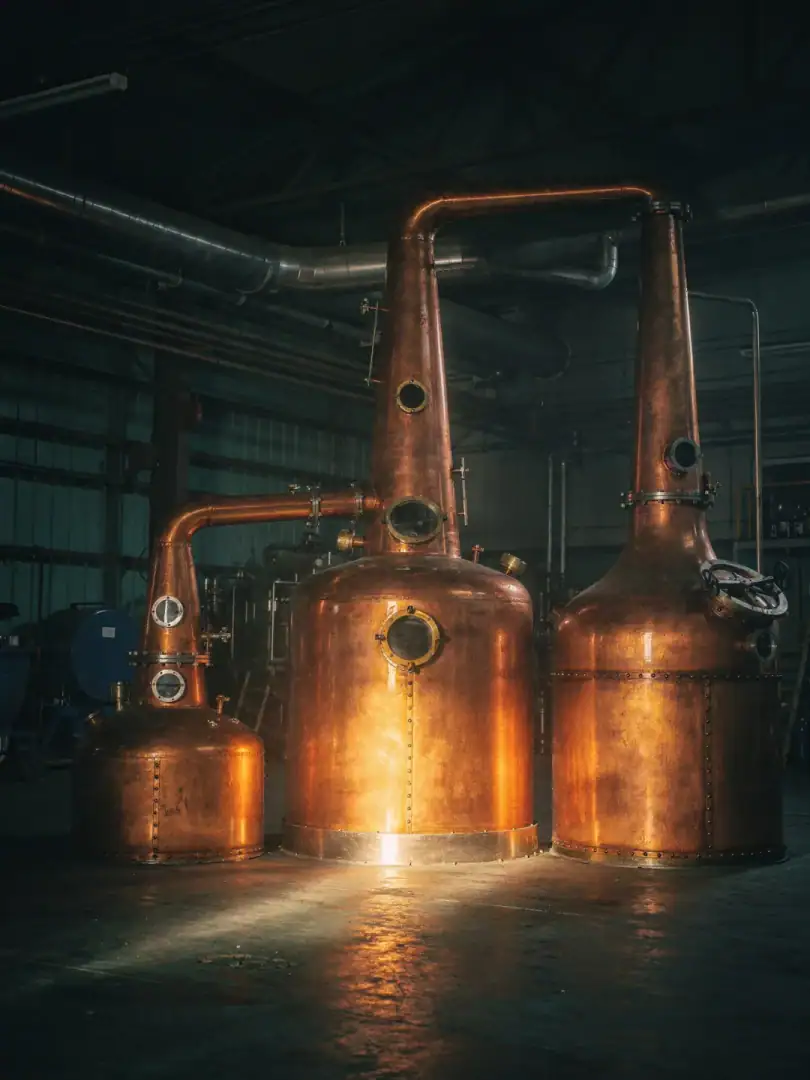
Stills in action
Stills
The still separates aroma from alcohol using heat. Its design and the right cut determine what ultimately ends up in the glass.
Pot still, column, or hybrid: what's the difference?
The classic pot still is a copper vessel with a curved neck that works in individual batches: fill, heat, collect, clean, then start over. Copper binds unwanted sulfur compounds along the way, making the alcohol rounder. This design is considered traditional and often yields particularly characterful, slightly oily distillates.
A column still, by contrast, operates continuously, with multiple plates stacked on top of each other that repeatedly condense and re-vaporize the vapor. It's especially suited for producing very pure, high-proof alcohol, such as the neutral alcohol from the first stage. A hybrid combines both principles: a pot still carries a short column, allowing master distillers to choose between a bolder and a finer character.
What do heads, hearts, and tails mean?
Every distillation run proceeds in three phases, which the master distiller separates by smell, taste, and experience. First comes the heads, rich in methanol and sharp, solvent-like notes, which no one should drink. It's discarded or set aside for the next run.
Next comes the heart, the middle portion of the run, where juniper and the other botanicals come through most purely. Only this portion goes into the finished bottle. At the end comes the tails, heavy, oily, and often slightly bitter, which most distilleries also cut away, though sometimes they bring small amounts back in for added texture.
Why does the cut determine quality?
The transition between phases is gradual, not like flipping a switch. If the master distiller cuts too early from heads to heart, sharp, unpleasant aromas end up in the gin. If they cut too late from heart into tails, the distillate turns heavy and dull.
This cut is considered one of the hardest tasks in the entire production process, since it can barely be measured precisely and requires a great deal of experience. Two distilleries with an identical botanicals list can therefore produce completely different gins, simply because they make the cut differently.
What role does the still's copper play?
Copper reacts chemically with certain sulfur compounds that form during fermentation and distillation and would otherwise smell unpleasant. Contact with the large copper surface of a still binds these compounds and makes the distillate noticeably smoother and rounder in flavor.
The more copper surface the vapor touches on its way through the neck and condenser, the stronger this effect becomes. Some stills therefore feature an especially long, curved neck or additional copper plates, purely to intensify this purifying effect before the alcohol vapor reaches the condenser.
Besides copper, the shape of the still's neck also plays a role in the character of the distillate. A short, wide neck lets more heavy vapor components pass straight through, resulting in a bolder, oilier gin. A long, narrow neck with tight bends, by contrast, forces the vapor into more contact and reflux, so that only the lightest, cleanest components reach the condenser. Master distillers therefore choose their still's design very deliberately, often decades before the first bottle is ever sold, since a still can hardly be fundamentally altered later on. Even small changes to shape or size often require a completely new still, making such decisions among the most expensive and long-term in the entire distillery. Some family-run distilleries therefore still use the same still across several generations and regard it almost as a member of the business in its own right. In some traditional British houses, the old still even carries its own name and is specially honored at every anniversary.