Water Brings It to Drinking Strength
Proofing Down
The alcohol coming out of the still is far too strong. Only proofing it down with water turns it into ready-to-drink gin.
How is gin brought to drinking strength?
Right after distillation, the distillate often sits at sixty to eighty percent alcohol by volume, far higher than what should end up in the glass. The distillery therefore adds water — usually soft, low-mineral water that doesn't bring any distracting flavors of its own — until the desired drinking strength is reached.
EU rules require a minimum strength of 37.5% ABV for gin, and many bottles sit between forty and forty-seven percent. Some brands also offer so-called Navy Strength bottlings at around fifty-seven percent, a nod to historically stronger rations issued to the British Navy.
What does chill filtration do?
Shortly before bottling, some distilleries chill their gin down significantly and then filter it through fine filters. This chill filtration removes fatty acids and essential oils that would otherwise appear as a fine haze at low temperatures or in contact with water and ice.
The advantage is a clear, bright bottle even after weeks in the fridge. Critics counter that some texture and aroma is lost along with the oils, which is why some craft distilleries deliberately skip chill filtration and accept a possible haze as a natural feature.
What is the louche effect?
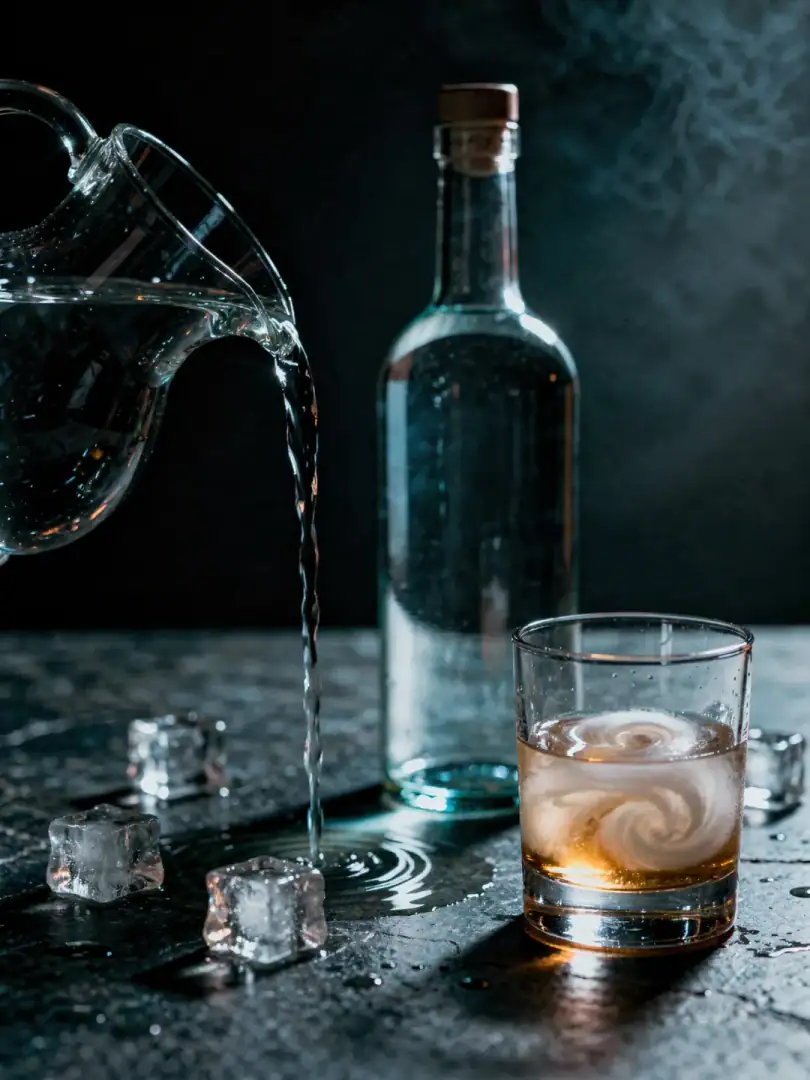
When an unfiltered or lightly filtered gin is diluted with water or ice, the liquid can suddenly turn milky and cloudy. This so-called louche effect occurs because essential oils from citrus peel, anise, or similar botanicals lose their solubility as alcohol content drops, forming fine droplets.
The effect isn't a flaw or a sign of poor quality — it's evidence of real, natural oils in the gin. Anise-forward spirits, such as some Mediterranean styles, show it especially clearly, but classic gins with plenty of coriander or citrus peel can also turn slightly cloudy when diluted.
How much water actually belongs in which gin?
How much a gin is ultimately diluted depends strongly on the intended style. A bold, spicy gin often handles a somewhat higher drinking strength well, since its aromas only fully unfold at higher alcohol levels, while a delicate, floral gin can feel balanced even at lower strengths.
The exact percentage is ultimately decided by the distillery according to its own taste, within the legal minimum. That's why two gins with the exact same botanicals list often taste noticeably different, simply because one is bottled at forty percent and the other at forty-six.
The order of the steps also plays a role: some distilleries proof their gin down to target strength only shortly before chill filtration, while others filter at a higher concentration and dilute further afterward. Both approaches affect how many oils ultimately get removed from the gin, since the solubility of aroma compounds changes with alcohol content. Anyone diluting an unfiltered gin at home with water or tonic can often observe this effect directly: depending on the brand, a single ice cube is enough to reveal a slight haze, while other bottles stay crystal clear even when heavily diluted. Knowing this difference means you can watch for it deliberately while tasting, and read a slight haze not as a flaw but as a clue about how the gin was made. This detail almost never appears on the bottle itself, which is why only your own observation in the glass really provides clarity. With a bit of practice, the haze quickly becomes a familiar signal that reveals more about the gin than any claim on the label.