Cold Instead of Hot
Vacuum Distillation
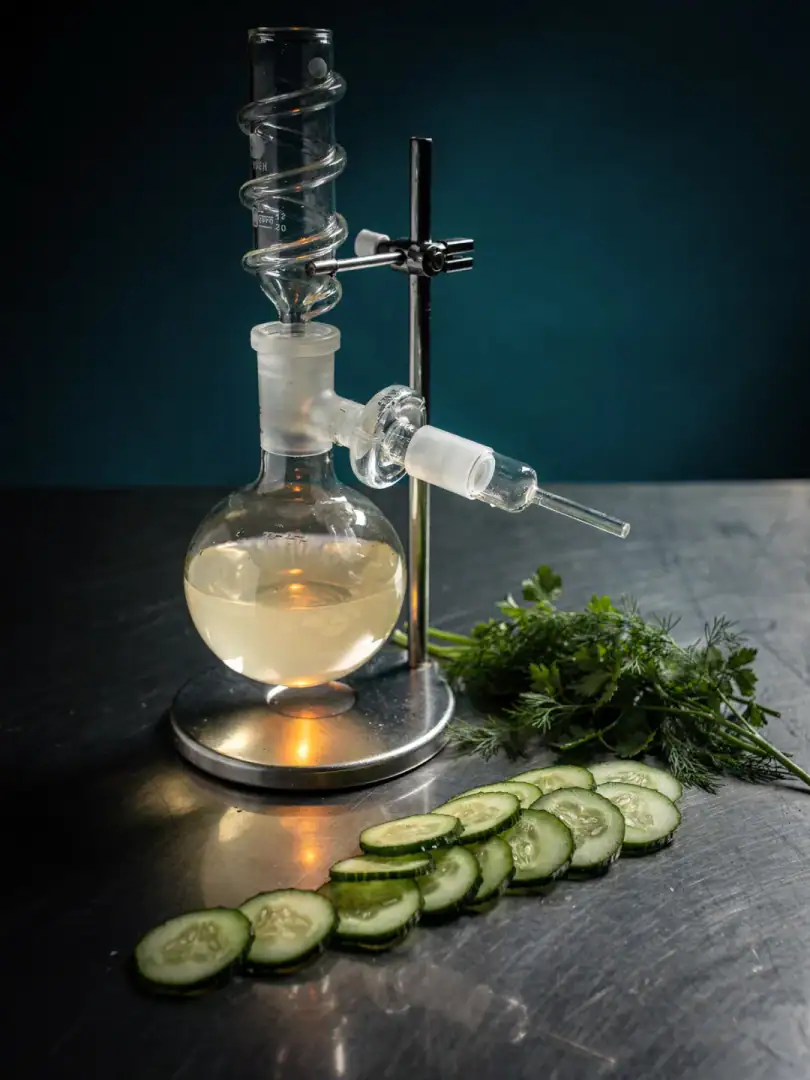
Some botanicals can't handle intense heat. For these, distilleries lower the pressure inside the still and distill at a much lower temperature.
How does cold distillation work?
Alcohol evaporates through heat, but also when air pressure drops. If a still reduces the pressure inside to a fraction of normal atmospheric pressure, the alcohol evaporates at temperatures of around thirty to fifty degrees Celsius instead of the usual eighty to ninety.
This technique is called vacuum distillation, and it changes the result significantly. Botanicals that lose their finest aromas — or even scorch slightly — under normal heat release their essential oils much more gently at these low temperatures. The escaping vapor is cooled as usual and condenses back into liquid, aromatized alcohol.
Why does the freshness stay better preserved?
Many delicate aromas, such as those from cucumber, fresh herbs, or citrus peel, consist of volatile compounds that break down or change under high heat. Under vacuum, these very compounds evaporate at low temperatures and make their way into the finished gin almost unchanged.
Many tasters describe the result as especially green, fresh, and close to the raw starting ingredient, almost as if the botanicals had just been chopped. Classical distillation at high heat, by contrast, essentially cooks some of these delicate notes away and replaces them with heavier, roasted-tasting aromas.
Which distilleries use this method?
On a small scale, some craft distilleries work with rotary evaporators — compact lab devices that distill under vacuum and are especially well suited to test batches or limited editions. Larger operations use purpose-built vacuum stills that apply the same physics on an industrial scale.
Vacuum distillation doesn't fully replace the classic pot still — it complements it, particularly for delicate ingredients. Many modern gins therefore combine both approaches: juniper and robust botanicals run through the classic still, while delicate fresh ingredients go through the vacuum unit, before both distillates are combined into the finished gin.
Where are the limits of vacuum distillation?
Not every botanical benefits from low temperature. Some aromas only emerge because of heat, such as the roasted or caramel-like notes from certain roots, which barely appear under vacuum at all. Anyone aiming for a bold, warm gin therefore usually turns to the classic pot still rather than a vacuum unit.
Technical complexity also limits how widespread the method is: vacuum stills are more expensive to buy and maintain than a simple pot still, and they require trained staff to operate. For small craft distilleries, the investment is often still worthwhile, though, since it lets them work with botanicals that would yield barely usable aromas via the classic route.
Another advantage of vacuum distillation shows up in energy consumption: because the alcohol evaporates at a lower temperature, the equipment overall requires less heating power than a classic pot still working at atmospheric pressure. For large production volumes, this can noticeably affect operating costs over time, even though the equipment itself costs more to buy. Some distilleries therefore treat the technology as a deliberate investment in more efficient operations over many years. Tasters who try both variants side by side often describe the difference with a simple image: classically distilled gins feel like cooked vegetables, while vacuum-distilled ones feel more like raw-harvested produce. For botanicals with robust, heat-stable aromas, such as dried roots or roasted spices, vacuum technology brings hardly any advantage, which is why many distilleries ultimately run a mixed calculation using both methods. It's not uncommon, then, for a single distillery to use both techniques in parallel, depending on which botanical is up next in the recipe. This flexibility allows very different styles to be produced with the same basic setup, from a bold classic to a particularly delicate special edition.