Preparation
- Rub the chicken all over with a handful of salt, remove any loose skin, rinse thoroughly inside and out and pat dry. Trim off the excess fat and set it aside for the rice.
- Season the chicken on the outside with salt and fill the cavity with the ginger slices and spring onions.
- Place the chicken in a large pot, cover with cold water by just under 2 cm and add salt. Bring to the boil over high heat, then immediately turn to the lowest heat and let it steep, covered, for about 30 minutes, until the core temperature reaches 75 °C. Take the pot off the heat.
- Remove the chicken, keep the stock and put the chicken in iced water for 5 minutes so it stops cooking and the skin stays taut. Discard the ginger and spring onions.
- Pat the chicken dry and rub sesame oil all over it so it does not dry out.
- For the rice, heat the toasted sesame oil in a wok or large frying pan over medium-high heat. Add the chopped chicken fat, garlic, ginger and salt and fry until it smells strongly fragrant.
- Take off a quarter of the fried garlic and ginger mixture for the soy sauce. Add the rice to the rest and fry for 3 minutes, stirring.
- Put the rice and the measured stock in a rice cooker, or in a pot with a lid, bring to the boil once and cook over the lowest heat for about 17 minutes, then leave to rest, unopened, for 10 minutes.
- Meanwhile, mix the chilli sauce (sambal, sriracha, sugar, garlic, ginger, lime juice, stock), the ginger-garlic sauce (mix the ingredients, add salt) and the soy sauce (the set-aside garlic and ginger mixture with oyster sauce, both soy sauces and stock) separately.
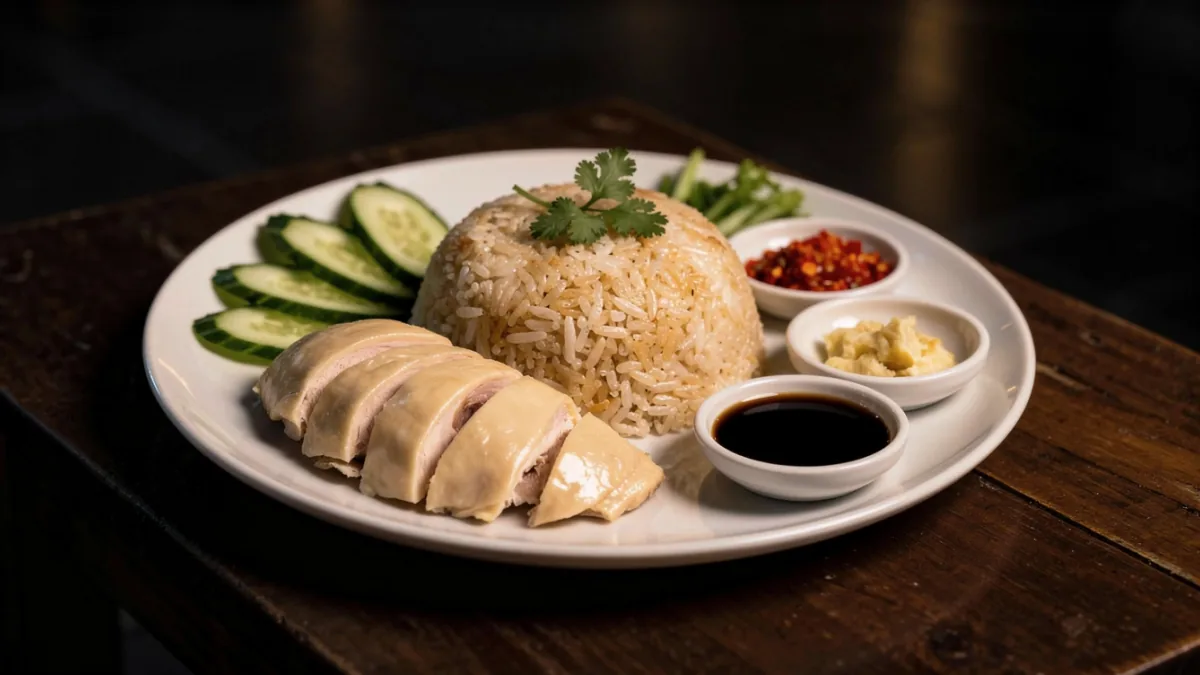
- Cut the chicken into pieces and serve with the rice, the three sauces, cucumber slices and coriander.
Drink with it
Pale lager · excellent match
Light lager or Pils, ice-cold
This is how it is drunk at the hawker stalls of Singapore: carbonation cuts through the chicken fat in the rice and refreshes between the sauces.
Pils or Helles: What's the Difference?White wine · excellent match
Grüner Veltliner or off-dry Riesling Kabinett
Fresh acidity and a peppery note go with the ginger and spring onion, and a little residual sugar stands up to the chilli and soy sauces.
Which wine pairs with food? A simple approach to choosingJunmai sake · good match
Junmai, cool
The soft rice note mirrors the stock-cooked rice, and the mild acidity gets along with ginger and soy sauce.
Junmai, Ginjo, Daiginjo: What do these mean for sake?Sparkling wine · good match
Sekt or Crémant brut
Bubbles and acidity loosen the chicken fat and keep the ginger and garlic fresh.
Sparkling wine, Champagne, and Prosecco: what's the difference?