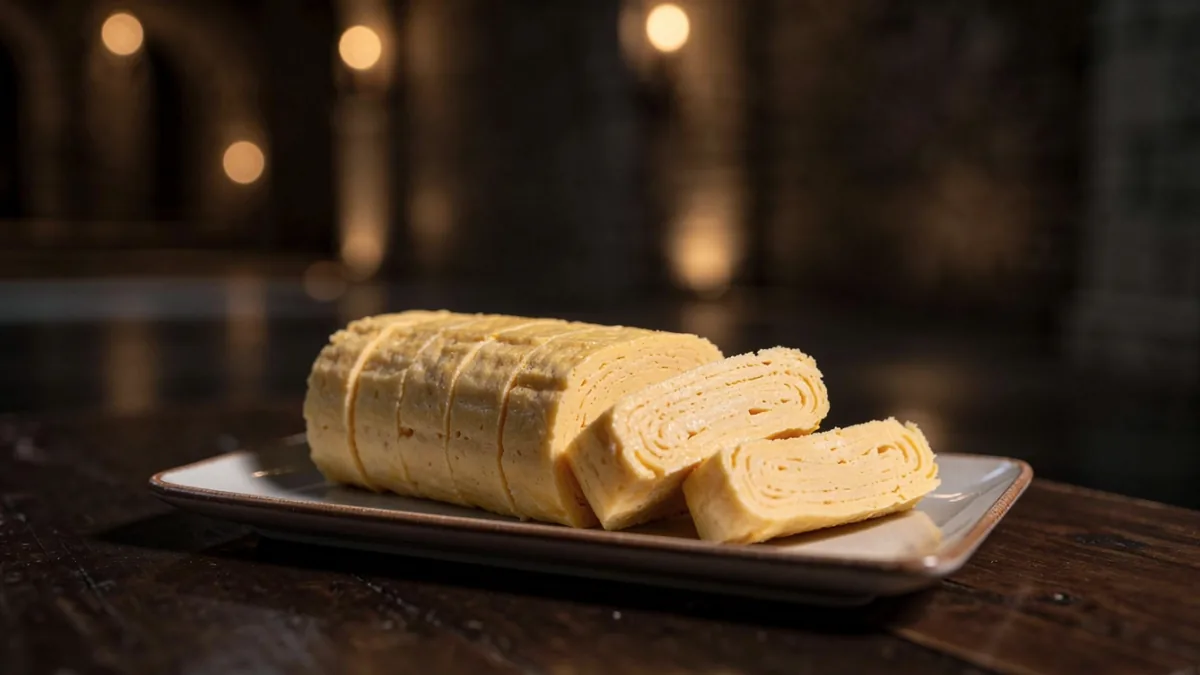
Preparation
- Stir the water, dashi powder, sugar, soy sauce, mirin and salt until everything has dissolved.
- Beat the eggs in a bowl with chopsticks or a fork in a zigzag motion, without whisking them until frothy. Stir in the seasoning mixture and pour the mixture into a jug with a spout.
- Heat a tamagoyaki pan or small frying pan over a medium heat and wipe it thinly with oil, ideally with oiled kitchen paper. A drop of egg mixture should sizzle when it hits the pan.
- Pour a third of the egg mixture into the pan and tilt it so the base is covered; prick any air bubbles. As soon as the egg is set underneath but still moist on top, roll it up loosely from one side towards the middle and push the roll to the edge of the pan.
- Oil the now empty part of the pan and the area under the roll again, pour in the next thin layer of egg mixture, let it run under the roll too, and roll up again, this time towards the opposite side. Continue until the mixture is used up.
- Remove the omelette from the pan while hot, shape it firmly in a bamboo mat if you like and leave to rest for 5 minutes. Cut into slices about 1 cm thick, served warm or cooled. In a round pan, fold in the edges before each roll or trim the finished omelette straight.
Drink with it
Ginjo sake · excellent match
Ginjo, chilled (8 to 10 °C)
The soft, lightly sweet egg with dashi leaves room for the delicate fruit of the ginjo; sake and mirin share rice as a bridge.
Junmai, Ginjo, Daiginjo: What do these mean for sake?Junmai sake · excellent match
Junmai, lightly warmed (about 40 °C)
Dashimaki tamago is a standard bite in the izakaya: warmed, the junmai emphasises its rice character, which connects with the dashi umami and the mirin sweetness of the egg.
Sparkling wine · good match
Crémant or sparkling wine, brut
Bubbles and acidity refresh after the soft, lightly sweet egg.
Sparkling wine, Champagne, and Prosecco: what's the difference?Pale lager · good match
Japanese lager, cool
A slim body and carbonation accompany the delicate omelette without covering it.
Pils or Helles: What's the Difference?