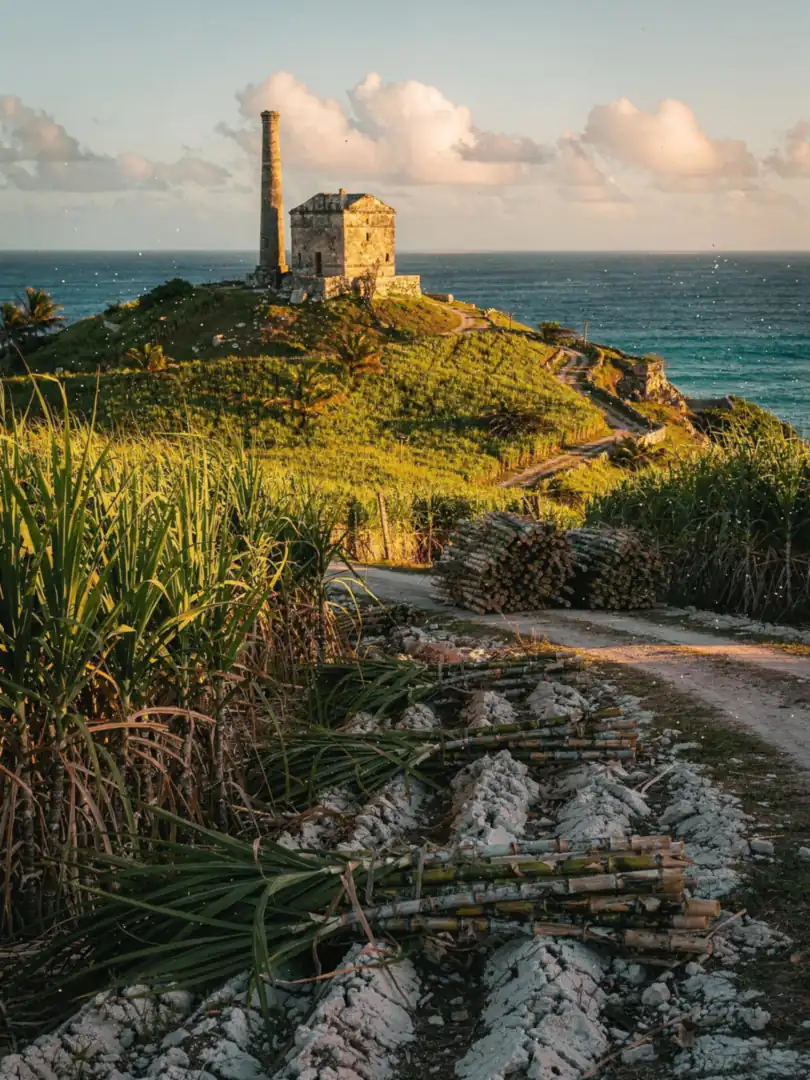
Cane on Coral Limestone
Sugarcane & Molasses
From Speightstown, the land rises gently to the east, and the higher you climb, the more cane fields line the road. The island's foundation is coral limestone, a porous rock that lets rainwater pass through like a sieve, leaving only a thin layer of soil on which sugarcane nonetheless thrives. At the same time, the limestone filters the groundwater. Mount Gay points to a historic well on its own grounds as its water source.
Just how dense the sugar economy once was is shown by a survey from 1717 to 1721: it lists 870 estates and 320 windmills for sugar production on Barbados. Ships loaded with sugar sailed from Speightstown directly to London and Bristol, which is why the port was also known as 'Little Bristol.' The cane is harvested in the first half of the year, and the island still celebrates the end of the harvest today with the Crop Over festival.
Three raw materials emerge from the cane, each giving rum a different character later on. Molasses is the dark, viscous residue left over once the crystallizable sugar has been extracted from the juice. Mount Gay distills from molasses. Cane juice is the freshly pressed juice, which begins fermenting quickly. Syrup is thickened juice, shelf-stable and workable year-round.
St Nicholas Abbey takes the shorter route. On the roughly 160-hectare estate, around 90 hectares of sugarcane are grown, according to the house, which is pressed by its own steam mill and processed into syrup. Here, sugar factory and distillery aren't opposites but a single working estate, much as plantations were in the 18th century, minus the forced labor.