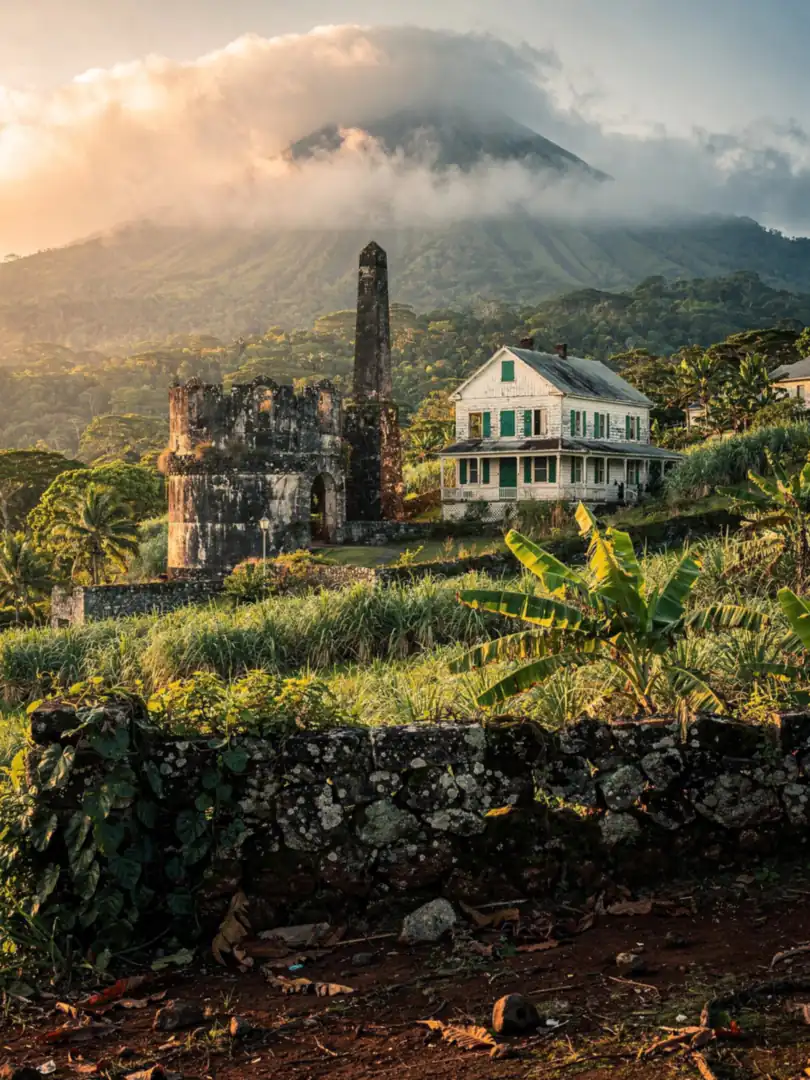
Volcano and Cane
Region & History
Anyone wanting to understand what makes Guadeloupe rum distinctive should look to Basse-Terre, the mountainous western half of the island. Here the La Soufrière volcano rises nearly 1,500 meters, rainfall is heavy, and sugarcane and bananas grow side by side on the slopes. Rhum de la Guadeloupe carries a protected geographical indication, but not an AOC.
Sugarcane arrived in the Caribbean with the Europeans in the 15th century, and in 1635 the French began settling Guadeloupe. On the plantations, enslaved people from Africa planted, cut, and processed the cane under coercion. When Napoleon reintroduced slavery in 1802, the officer Louis Delgrès led an armed resistance and died with his followers at Matouba, not far from Basse-Terre. Slavery was finally abolished in 1848.
The Bologne distillery in Rivière des Pères near Basse-Terre traces its estate back to 1654, according to the house. In 1830 it was bought by Jean-Antoine Amé Noël, considered the first man of color among the island's major landowners. It was not until 1887 that the sugar plantation became a rum distillery. Today it belongs to the fourth generation of the Sargenton-Callard family.
In Capesterre-Belle-Eau, Henri Longueteau turned an old sugar factory into a distillery for cane juice rum in 1895, according to the house. In 1916, the Reimonenq distillery followed in Sainte-Rose. Montebello in Petit-Bourg has operated under Grégory Marsolle since 2016, and the Karukera brand was revived by Grégoire Hayot in 2005. Together, these five names form the backbone of Basse-Terre: four distilleries and one finishing house that does not distill itself.
Since 1989, the name Rhum de la Guadeloupe has been listed in the EU register as a protected geographical indication. It allows the additional designations "agricole" and "de sucrerie," depending on whether juice or molasses goes into the still. An AOC, as exists only on Martinique, is unknown on the island.