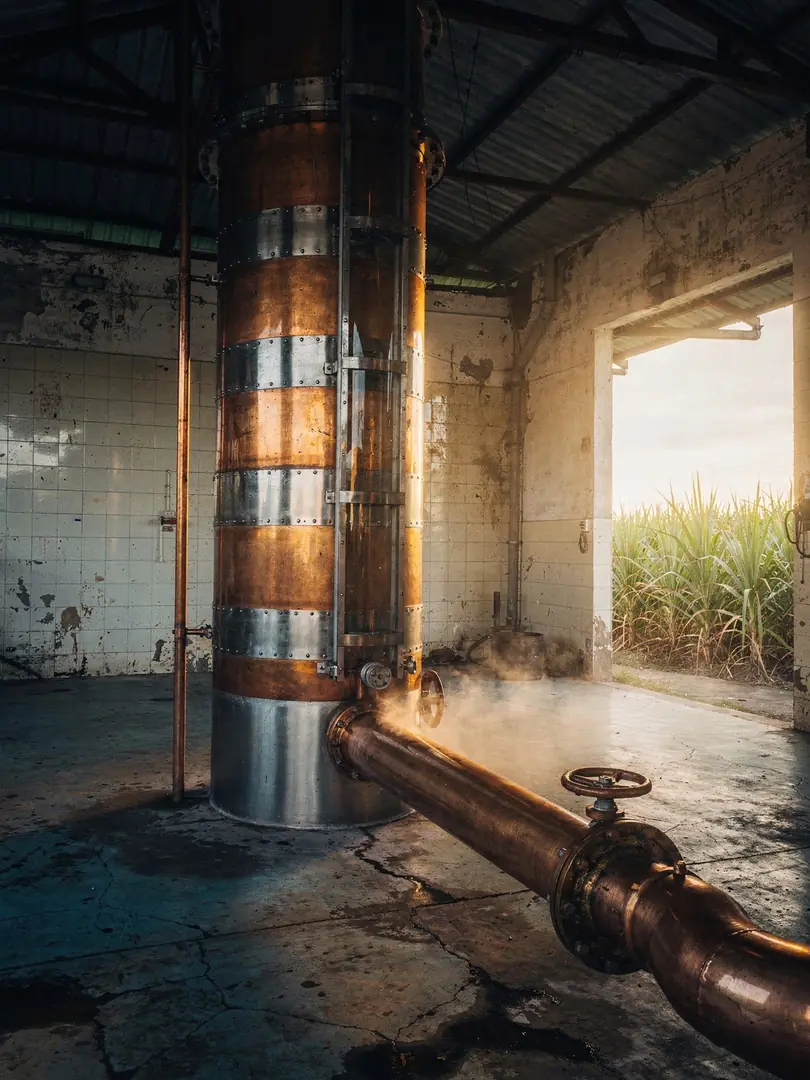
Column and pot still head
Distillation
Two types of stills are permitted to distill Rhum de la Guadeloupe. One is the column still, a tall tower with plates through which the vapor rises. The other is a pot still fitted with a column head, whose kettle may hold no more than 30 hectoliters. Both qualify for the designation of origin.
The column still works without pause: alcohol flows out at the top while fresh mash is continuously fed in at the bottom. On each plate, the liquid evaporates and condenses anew, and the alcohol content rises with every plate. The result is a clean, lighter distillate in which the cane-juice aroma remains clearly present.
The classic pot still, a copper kettle without a tower, is filled batch by batch instead. It yields a heavier, oilier distillate with more congeners. On Grande-Terre, it is not the dominant style. According to available information, Damoiseau distills in a continuous column still.
The distillate comes off the still at a much higher strength than what eventually ends up in the glass. Distillers dilute it with water to bottling strength. For Damoiseau's Blanc, that means 40, 50, and 55 percent alcohol, as stated by the distillery and retailers. The Ambré sits at 40 percent, and the Rhum vieux VSOP at 42 percent.
Copper also plays a role in the column still, as it binds unwanted sulfur compounds from the vapor. How much copper a given still contains depends on the producer. On Grande-Terre, the division of labor is clear: the Gardel sugar factory supplies sugar and molasses, while the Damoiseau distillery presses its own cane for the Rhum agricole.