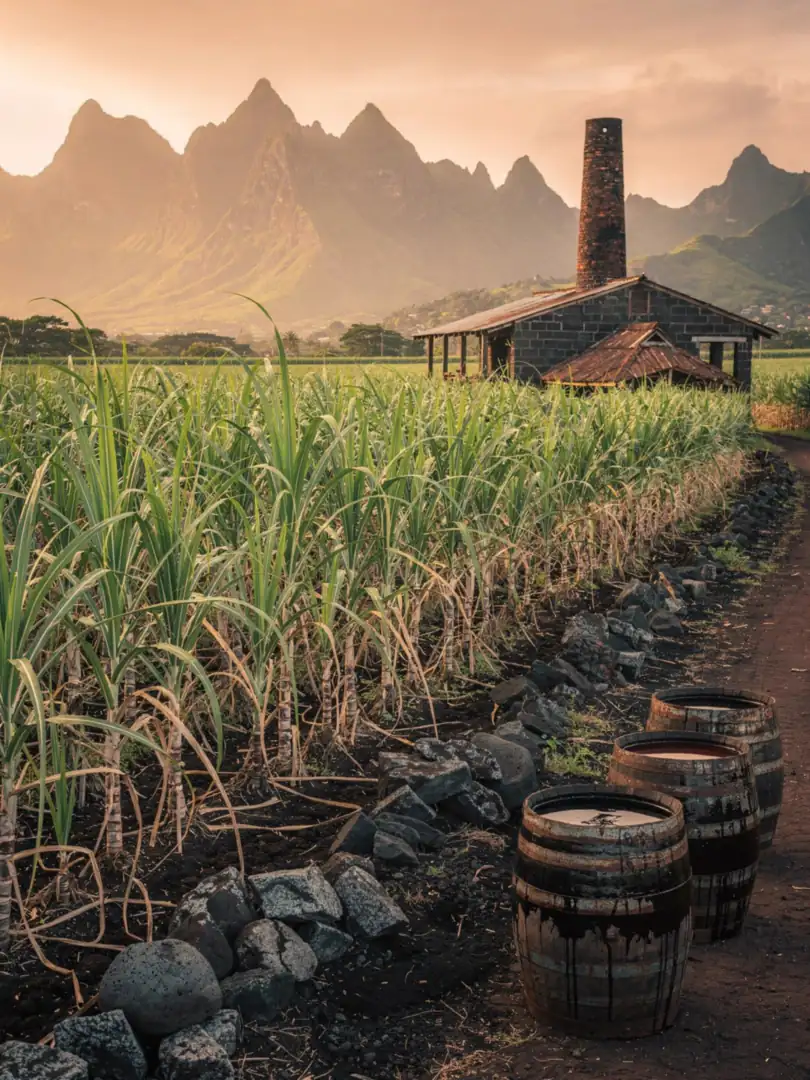
What's Left of the Sugar Factory
Sugar Cane & Molasses
Anyone wanting to know where molasses rum comes from needs to look inside the sugar factory. There, pressed cane juice is boiled down until sugar crystals form. What remains after the crystals are spun off is molasses: a black-brown, sticky mass still containing plenty of sugar that the factory can no longer extract. Yeasts, however, can still make use of it.
Harvesting on Mauritius runs from June to December, and the cane regrows in the months that follow. In 2023, according to the sugar industry, around 2.45 million tonnes of cane came from just over 35,000 hectares, yielding nearly 239,000 tonnes of sugar. Over the course of the last century there were around a hundred mills; today, three large companies process the cane: Terra, Omnicane and Alteo.
The fields lie on volcanic soil, and some plots are so stony that the stones have been piled up into heaps and walls at the edges. On flat ground, machines help with the harvest; on slopes and among the stones, cutting is still done by hand. The climate is tropical, with warm, humid summers and milder, drier winters.
Molasses has an advantage that juice doesn't: it keeps. A distillery can store it and process it year-round, while juice begins to ferment within just a few hours. Syrup, thickened cane juice, can also be stored. Trade statistics for Mauritius cite around 88,000 tonnes of molasses for 2023.
The origin shows in the glass. Molasses brings dark sweetness, caramel and a hint of licorice, while juice tastes more of grass and green fruit. For Grays' rum, molasses is the base. The EU permits it as a raw material alongside syrup and juice; beet sugar or honey, on the other hand, never lead to rum.