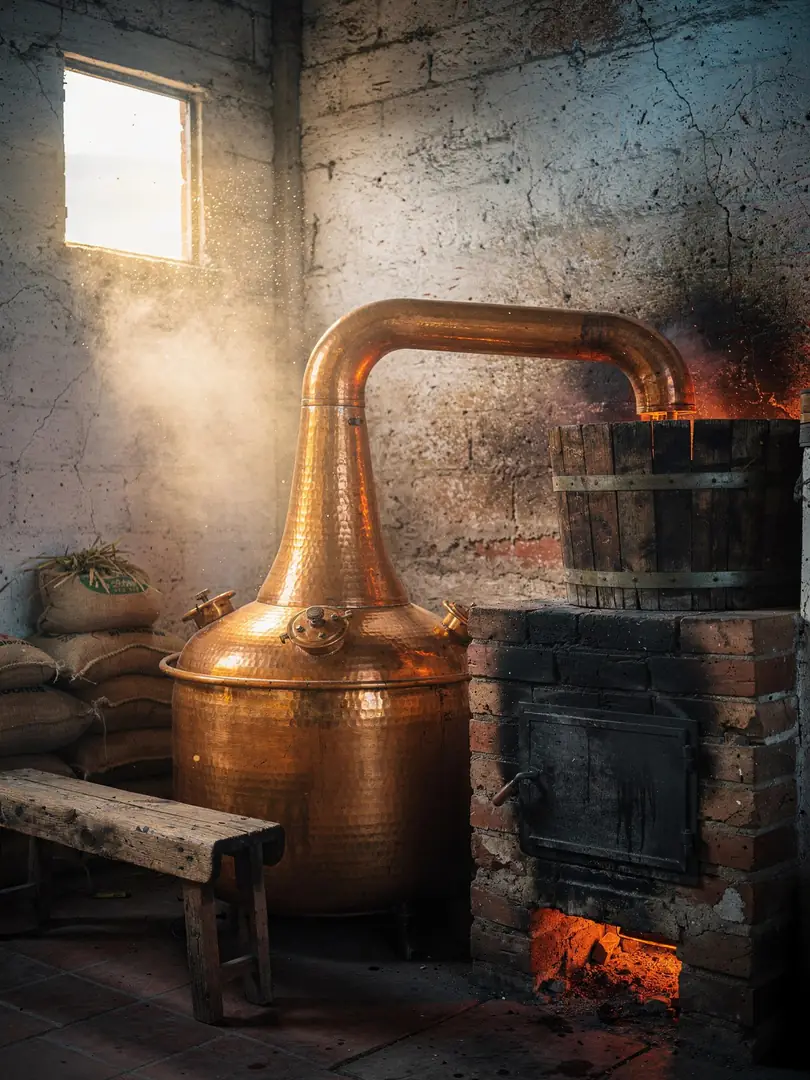
Copper and Tradition
Distillation
According to Mexican trade media, Charanda is distilled in copper alambiques, the Spanish term for stills. Whether a house prefers column or pot stills is up to each producer; the protection decree refers to the standard NOM-144-SCFI-2000 for all details.
During distillation, the distiller separates the heads, which smell sharp and solvent-like, keeps the heart with its clean sugarcane character, and discards the tails. The more precisely this is done, the smoother the spirit becomes. This matters especially for a juice-based spirit like Charanda, since it lacks heavy esters behind which flaws could hide.
Trade media cite a bottling strength range of 38 to about 54 percent ABV. The lower figure sits just above the EU minimum for rum of 37.5 percent. A Charanda at the upper end tastes more powerful and feels sharper in the glass, while one at 40 percent reads as smooth.
On the label, the name Charanda is what counts. It is a Mexican designation of origin protected by the state, and it is not a subtitle of rum, any more than Cachaça is. The term rum itself is regulated in the EU by Regulation 2019/787, and these rules apply to anything bearing that name in Europe.
There is no fixed brand list for the region. The names most often cited are Tarasco, with its Blanco, Reposado, and Añejo bottlings, and Uruapan, with Blanco, Plata, and the aged Real de Uruapan line. The house of Sol Tarasco states that it distills from sugarcane it grows itself. These are producer claims.
Charanda remains a niche product in Europe, and the region's distilleries are few. The spirit emerges from a landscape where sugarcane fields, avocado orchards, and volcanic cones lie close together.