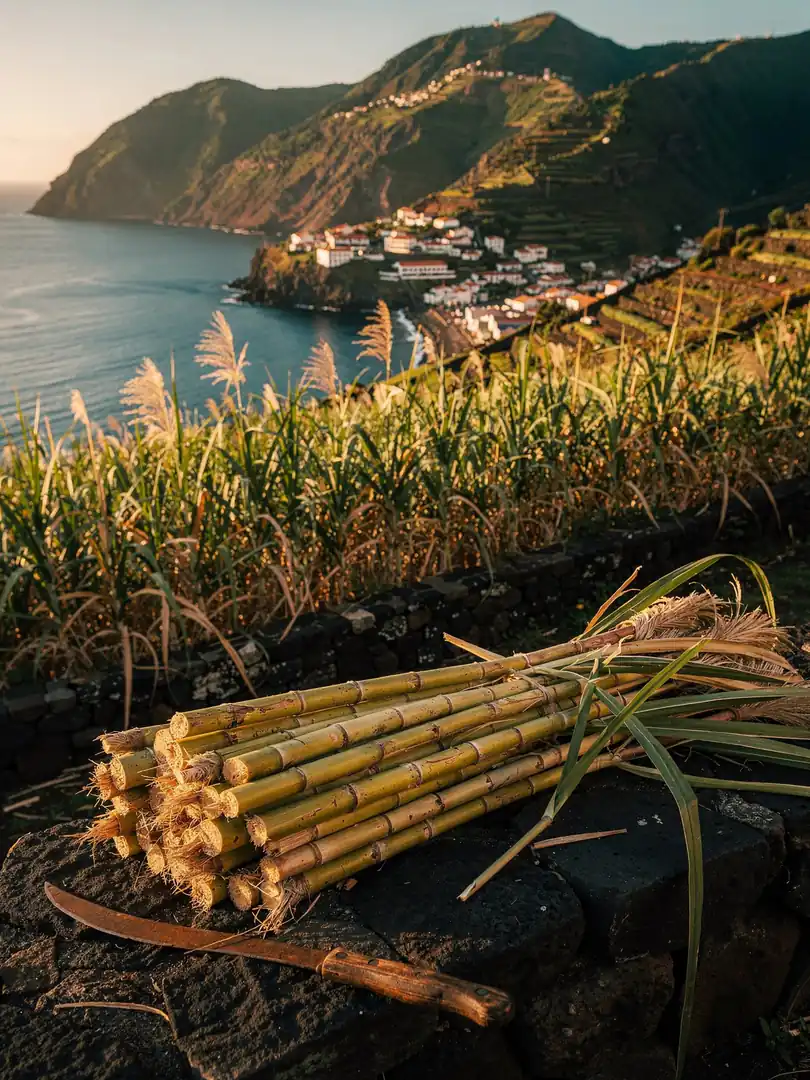
Cane on the Terraces
Sugarcane & Molasses
Today sugarcane grows on Madeira across just around 125 hectares, yielding roughly 5,800 tonnes a year. That's a fraction of the output from the days of white gold, but still enough to supply several distilleries. The leading growing areas are Calheta, Machico (including Porto da Cruz), and Ponta do Sol, followed by Ribeira Brava.
The fields sit on narrow terraces, the poios, clinging to steep slopes. Machinery can barely reach them, so the cane is cut by hand. According to the island's tourist board, visitors to Porto da Cruz can watch the cane being pressed into juice between March and May.
Common varieties include POJ 2725, whose code traces back to the Dutch research station Proefstation Oost-Java, alongside the old "caiana" cane. Regulations require that the cane be grown on the island and reach an average of at least 15 degrees Brix, roughly 15 grams of sugar per 100 grams of juice.
Several products come from Madeira's sugarcane. Sugarcane juice is the freshly pressed, cloudy liquid used to make Rum da Madeira. Molasses is the dark residue left after sugar crystallizes out of the juice; elsewhere it's the base for rum, but not here. Sugarcane honey, called "mel de cana" on Madeira, is a dark syrup used for baking and sweetening.
Making this rum requires no crystal-sugar factory: the juice goes straight from the mill into fermentation. That's why the old engenhos, once sugar mills, were able to become distilleries once the great sugar trade had run its course.