Cane, Mill, Molasses
Sugarcane & Molasses
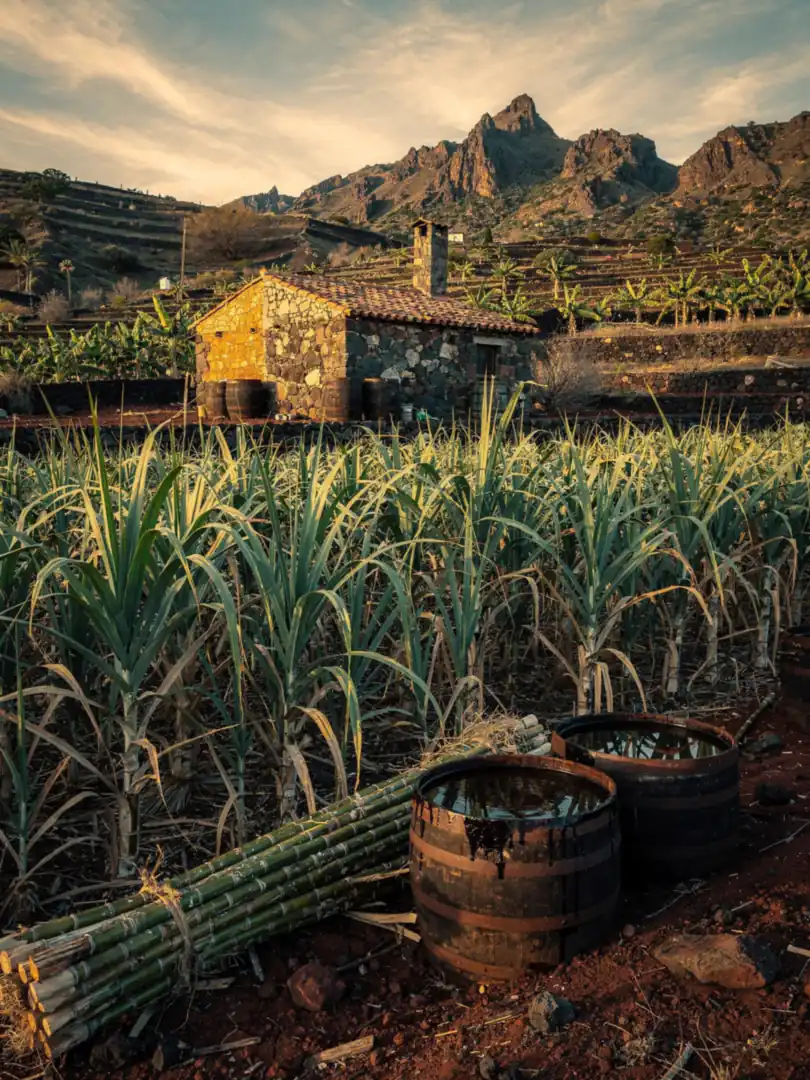
The archipelago lies between 27 and 29 degrees north latitude, roughly level with Florida. Sugarcane demands warmth, sun, and plenty of water, and the islands' coasts provide that warmth nearly year-round. Water, however, is scarce, as the Canaries are comparatively dry. Arucas in northern Gran Canaria was, alongside Telde, Bañaderos, and Guía, one of the places where sugarcane was grown and processed.
The mill presses juice from the cane, which is then thickened into sugar. As it crystallizes, molasses remains behind—a dark, viscous syrup that still contains sugar. This was the basis for the 19th-century transformation: many of the islands' sugar factories extracted brandy from the molasses, and some turned entirely into rum factories. Fábrica San Pedro in Arucas also milled cane; according to the company, the first harvest in 1885 amounted to 5,619,540 kilograms.
Ron Aldea on La Palma works differently. The distillery in Los Sauces on the east coast reportedly uses fresh sugarcane juice rather than molasses, receiving more than 8,000 kilograms of cane daily from growers on the island. The brand was founded in 1936 by Manuel Quevedo Alemán on Gran Canaria; the family later moved to La Palma, where sugarcane cultivation was still underdeveloped.
The choice of raw material matters more to the glass than one might think. Molasses delivers a rounded, often caramel-like base note, while fresh juice leans toward grassy, vegetal notes. Under EU law, both may be called rum, but the term "agricole" is reserved for juice-based rum from the French overseas departments and Madeira; a juice rum from La Palma cannot claim that name. Madeira and Andalusia's Motril, where cane also grew, have their own regions in this journey.