Molasses and the Vega
Sugar Cane & Molasses
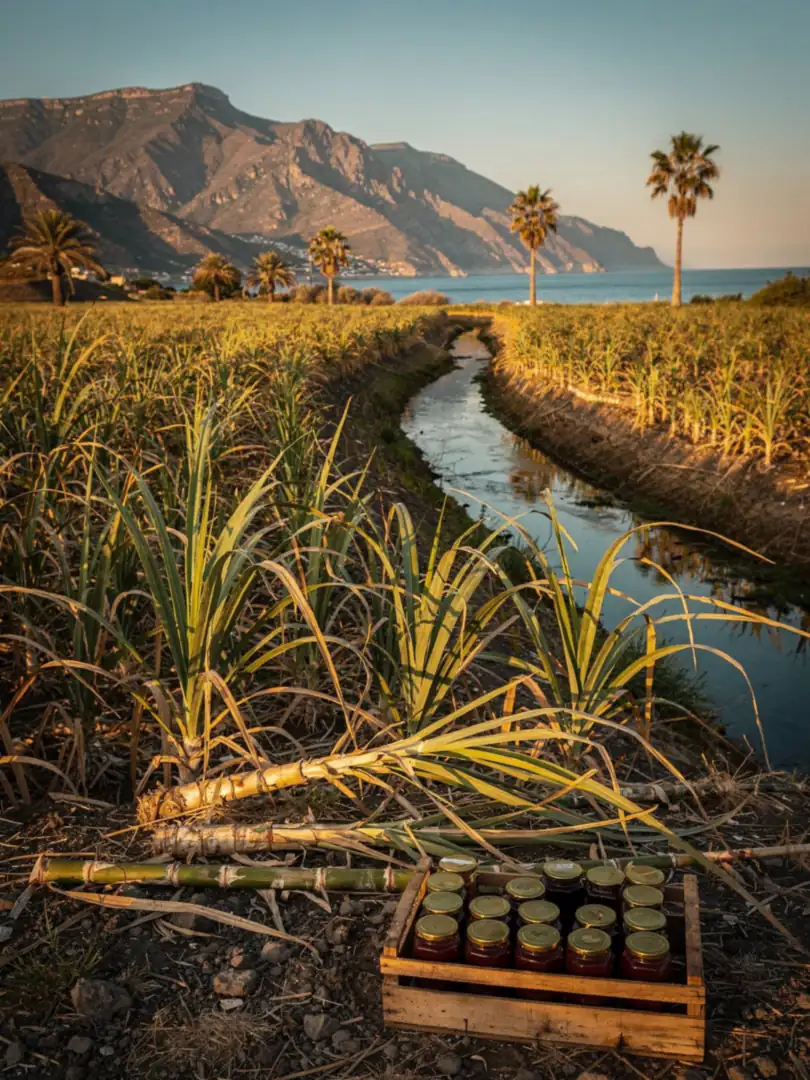
Why did sugar cane grow here of all places? The plant is a grass that can reach several meters in height, and it demands warmth, plenty of water, and a winter without frost. The coast of Motril offers all of this: a mild climate without harsh winters, abundant water from the Sierra Nevada, and fertile alluvial soil in the Vega del Guadalfeo.
Harvesting takes place during a campaign, called zafra in Spanish. The cut cane must reach the mill quickly, as the juice in the stalk otherwise loses sugar. At the factory in La Caleta, the juice was pressed, boiled down, and processed into crystallized sugar. According to the Junta de Andalucía's heritage records, the byproducts were molasses, bagasse, and alcohol.
What is molasses? It's the thick, brown residue left over once sugar has crystallized out of the boiled-down juice. It still contains plenty of fermentable sugar, making it a classic raw material for rum. Bagasse is the pressed fiber of the cane left over after pressing.
Three raw materials should be kept distinct. Sugar cane juice is the freshly pressed juice, syrup is the boiled-down juice, and molasses is what remains after sugar extraction. Within the EU, rum made from juice may only be called "agricole" in the French overseas departments and on Madeira; Madeira has its own region in this journey devoted to that. Ron Montero, by contrast, works with molasses.
When the factory closed in 2006, large-scale cane cultivation in the Vega came to an end. Today, the Costa Tropical mainly grows avocado, mango, and cherimoya. According to the house, the Montero family continues to grow its own cane and obtains the molasses for its rum from it.