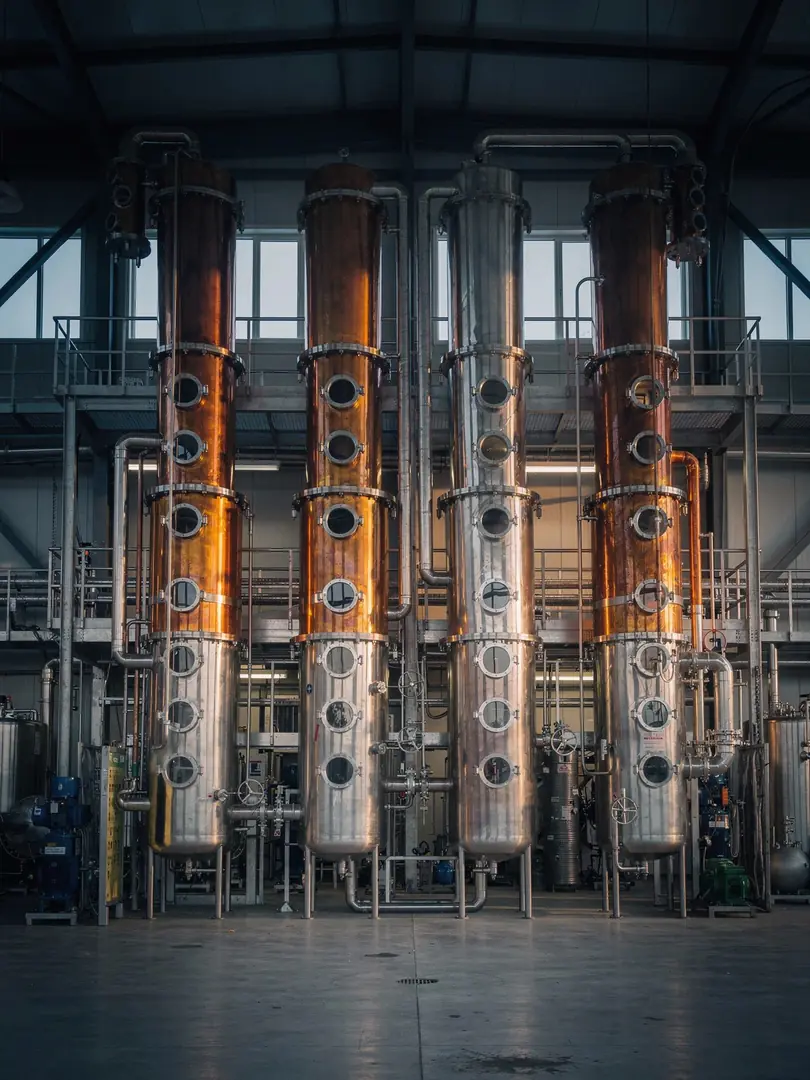
Column Distillation
Coffey, Savalle, Multi-Column: How Light Rum Is Made
Light rum is produced in column stills that distill continuously and can push the distillate above 90 percent. The path was paved by the Coffey Still of 1830, with its two columns. Today, large distilleries work with multiple columns, separating flavor compounds almost at will.
What Is a Coffey Still?
In 1830, the Irishman Aeneas Coffey patented a still that fundamentally changed distillation. It consists of two columns. In the first, the analyzer, wash trickles down over perforated plates while steam rises from below, extracting the alcohol. In the second, the rectifier, alcohol-rich vapor is further concentrated and purified across many additional plates.
The advantage was clear. The still runs without interruption, uses less fuel, and produces a stronger, more consistent distillate than a pot still. Because the process was patented, it's still known today as the patent still. It's as much at home in Scottish grain whisky distilleries as in the world of rum. In Guyana, a Coffey still is still operating, with columns built entirely of wood.
Savalle Columns: French Technology for Molasses
In the 19th century, the Parisian industrialist Désiré Savalle built distillation columns that he explicitly marketed for overseas molasses. In 1876 he published a work on new distillation apparatus, and in 1880 he received a French patent for a system to rectify—that is, to purify and strengthen—alcohol. Savalle columns found their way to the sugar colonies. In Guadeloupe, according to the trade magazine Rumporter, one was already operating at the Bologne distillery before 1876.
The most famous example stands in Guyana today. Demerara Distillers operates a four-column Savalle still at Diamond, originally sourced from the now-closed Uitvlugt distillery. Depending on where along the column and at what strength the distillate is drawn off, this setup can produce light to medium-bodied rums. This flexibility makes multi-column plants valuable to large houses that need a wide range of rums for their blends.
How Does a Modern Multi-Column Plant Work?
Many large rum distilleries today operate with three to five columns, each assigned its own task. The first strips alcohol from the wash. Additional columns purify and rectify. One separates highly volatile compounds from the top, another draws off heavy fusel oils (higher alcohols) from the side, and the last brings the distillate to its final strength. This allows distillates to be produced at nearly 96 percent.
This is the threshold set by EU law for rum. Rum must be distilled to less than 96 percent so that the distillate still perceptibly tastes of rum. At 96 percent and above, the law classifies it as neutral alcohol, the kind used for vodka or liqueurs. A distillate at 94 or 95 percent is therefore legally rum, but it tastes light, clean, and restrained. Its character then comes mainly from cask, filtration, and blending.
Light Rum in the Spanish Style
Most rums from Cuba, Puerto Rico, the Dominican Republic, Venezuela, or Panama come from column stills. Bacardí distills the bulk of its rum in Cataño, Puerto Rico, where the main distillery opened in 1958. The Cuban designation of origin, for which Cuba has applied for EU protection, explicitly requires continuous columns. A pot still is practically absent from this style.
Cuba's two-distillate process is revealing. The aguardiente at 74 to 76 percent brings aroma and matures alone in the cask first. It is then blended with an activated-carbon-filtered distillate under 96 percent and water to create the Ron Base, which continues to mature. This way, a house combines spice and lightness, all without a pot still. Light doesn't mean inferior here, but deliberately chosen: light rums carry many classic cocktails.