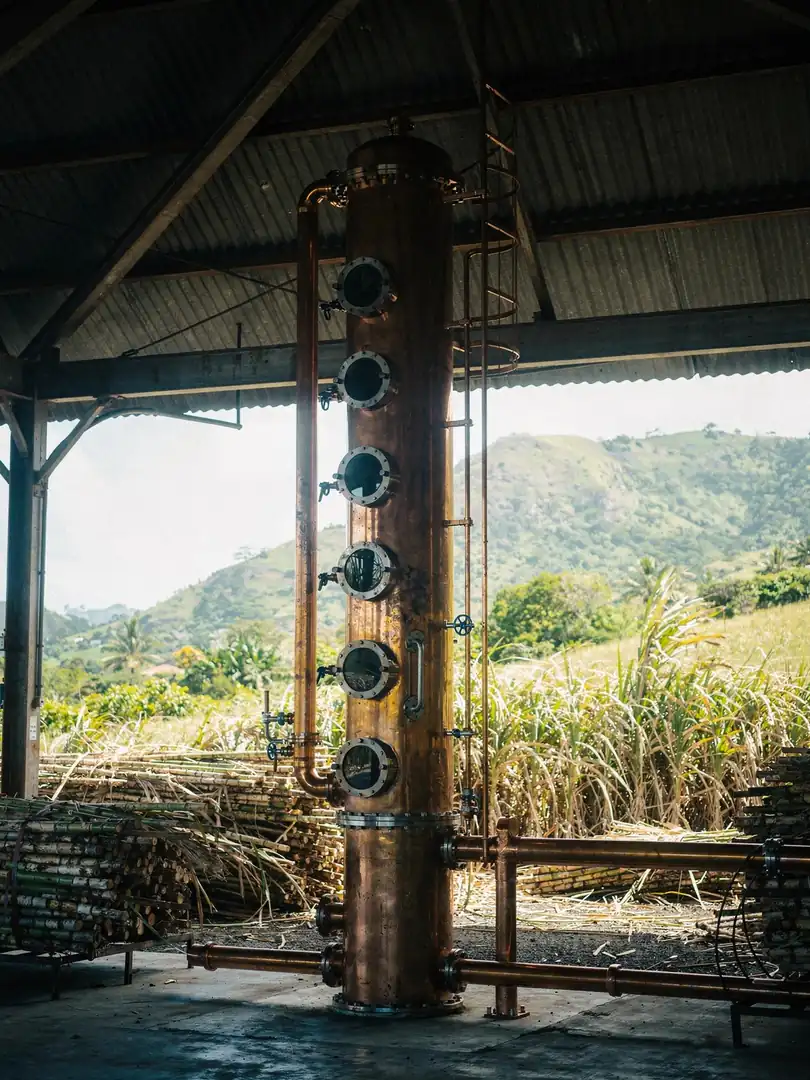
Colonne Créole
The Creole Column: How Rhum Agricole Is Distilled
Rhum agricole is distilled in the creole column, a single, continuously operating still. In Martinique, the AOC mandates its specifications: at least 15 plates for stripping, 5 to 9 copper plates for rectifying, and a distillate of 65 to 75 percent alcohol.
What Is a Creole Column?
Visit a rum distillery in Martinique and you won't find bulbous kettles, but tall, often gleaming copper towers. This is the colonne créole, the creole column. According to the specifications of the AOC Rhum de la Martinique, it's derived from the technique used in France to distill alcohol from sugar beets. In the Antilles, it was adapted for fresh sugarcane juice and continues to shape the region's style to this day.
Unlike the pot still, it runs without pause. The fermented juice, called vesou, flows in continuously, steam rises to meet it from below, and distillate drips out just as continuously. Distillation takes place during harvest season. The AOC permits distillation from January 2 to September 5. The reason lies in the raw material: sugarcane juice cannot be stored and spoils within a short time.
How Does the Creole Column Work?
The column has two sections stacked on top of each other. At the bottom sits the stripping section, with at least 15 plates made of stainless steel or copper. Here, alcohol is extracted from the trickling wash until only stillage, called vinasse in French, drains from the bottom. Heating comes from directly injected steam or via a boiler, where steam heats the stillage through a tube heat exchanger. The column diameter, per the AOC, ranges between 0.7 and 2 meters.
Above this sits the rectifying section, made entirely of copper according to the AOC, with just 5 to 9 plates. On each plate, steam bubbles through a thin layer of liquid, and with each stage the alcohol content rises. Few plates mean limited rectification, so the vapor arrives at the top rich in aroma. A preheater, where the cold wash cools the hot vapor, and a water condenser then turn it back into liquid.
Why 65 to 75 Percent Preserves the Agricole Flavor
The AOC requires that a day's distillate, collected in the receiving vessel, fall between 65 and 75 percent alcohol. For a column still, this is remarkably low. Modern multi-column plants push their distillate above 90 percent. The lower the proof, the more congeners are preserved. These very compounds carry the grassy, peppery, and floral notes associated with fresh sugarcane.
The law also measures this richness chemically. A white rhum agricole under the AOC must contain at least 225 grams of volatile compounds per hectoliter of pure alcohol, and a vieux at least 325. This places it clearly above a neutral column-distilled rum. After distillation, the blanc rests in tank for at least six weeks before bottling. During this time, the young spirit rounds out and the sharpest edges mellow.
Creole Column in Guadeloupe, Marie-Galante, and Beyond
Martinique is strict; its neighbors are somewhat more relaxed. The geographical indication Rhum de la Guadeloupe, which includes Marie-Galante, allows pot stills with a column attachment in addition to columns, with kettles limited to a maximum of 30 hectoliters. Réunion distills most of its rum from molasses. The still type alone, then, doesn't determine whether a rum qualifies as agricole—the raw material does, namely fresh sugarcane juice.
Juice-based rum is also distilled elsewhere, including in Mauritius and Haiti, sometimes also in columns. The word agricole, however, cannot appear on bottles for the EU market in these cases, as it's reserved for the French overseas departments and Madeira. How rhum agricole tastes, which distilleries produce it, and how to drink it are explained in greater detail in the encyclopedia entry. Here, the focus is on the column that makes its fresh character possible in the first place.