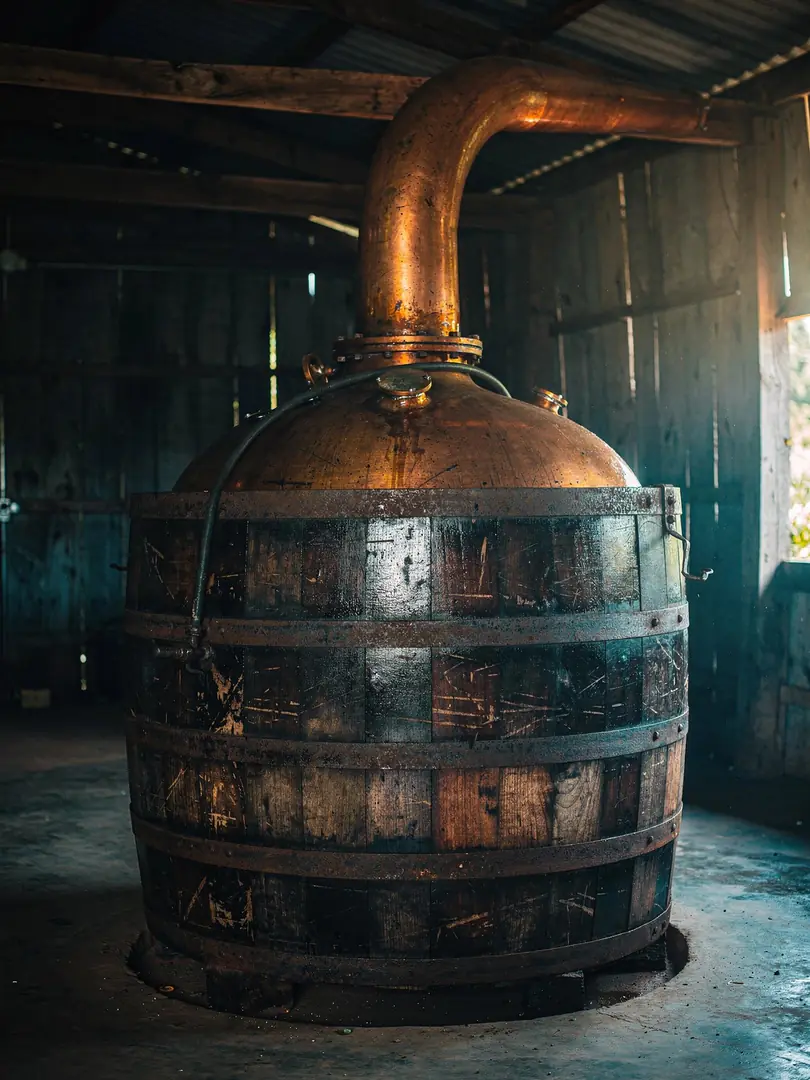
Guyana's wooden stills
Wooden pot stills made of greenheart: Port Mourant, Versailles, Enmore
In Guyana, the world's last wooden distilling apparatuses are still at work: the double pot still Port Mourant, the single pot still Versailles, and the wooden Coffey still from Enmore. Their bodies are made of greenheart, an extremely dense tropical hardwood, and each apparatus produces its own unmistakable rum.
Why does Guyana have wooden stills?
A commonly cited explanation is practical. Copper had to be shipped across the Atlantic to the colonies, while wood grew right on the doorstep. Greenheart, a hardwood from the forests of northern South America, is so dense and durable that it is prized in hydraulic engineering for lock gates and harbor structures. Distilleries along the Demerara coast built the bodies of their stills from it and connected them with necks and pipes made of copper.
Such stills once stood on many sugar plantations. As the plantations declined, most distilleries closed. The surviving stills moved from site to site until they were brought together at Diamond, on the east bank of the Demerara River. Since the Uitvlugt distillery closed around the turn of the millennium, Diamond has been Guyana's only rum distillery. It belongs to Demerara Distillers, known for the El Dorado brand.
Port Mourant and Versailles: wooden pot stills
Port Mourant is a double pot still made of two wooden kettles connected in series. According to El Dorado, it comes from a distillery founded in 1732; it is the only one of its kind still operating. Its rum is considered especially heavy and spicy. Tasters often describe it with notes of anise, licorice, dark fruit and wood. Independent bottlers love to release it as a single-still rum.
Versailles is a single wooden pot still with a copper swan neck and a retort attachment. According to El Dorado, it is over 250 years old. It moved to Enmore in 1977, to Uitvlugt in 1993, and finally to Diamond. Its rum is leaner than that from Port Mourant, with wood, dried fruit and spice. The Demerara GI classifies heavy rum with more than 300 grams of congeners per hectoliter of pure alcohol as coming precisely from such single and double pot stills.
Enmore: the last wooden Coffey still
The Enmore still works on the principle devised by Aeneas Coffey, but its columns are made of greenheart. According to El Dorado, it was built on the Enmore plantation in 1880 and moved to Diamond after the plantation closed. It is considered the last working wooden column still in the world. Because it distills continuously, it produces a medium-bodied rum: stronger than a distillate from multi-column stills, but rounder and less powerful than rum from the pot stills.
Among rum enthusiasts, Enmore is known for notes of wood, licorice and coffee. Such descriptions are subjective, but they show that the wood is more than just a component. For comparison, the Savalle still with four columns stands at the same site, producing light to medium rums. Under one roof, Diamond thus brings together tools for almost every weight a Demerara rum can have.
What the wood does to the flavor
Copper binds sulfur compounds that smell unpleasantly of rotten eggs or rubber. A wooden body gives the vapor less contact with copper. Experts cite this as the reason for the heavy, sometimes slightly sulfurous or meaty character of young rums from wooden stills. On top of that, wood conducts heat differently than metal and, over the years, absorbs and releases substances of its own. Reliable measurements on this are rare, and much of it remains experiential knowledge.
For buyers, one thing matters: the name of a wooden still on the label is a production detail, not a rule of origin. The Demerara GI permits stills made of greenheart, copper or steel and prohibits blending with foreign rum. Abbreviations such as PM, VSG or EHP on independent bottlings refer to the still the rum came from: Port Mourant, Versailles and Enmore.