Jamaica's Ester Classes
High-Ester Rum: From Common Clean to DOK
High-ester rum is rum with an unusually high ester content, in Jamaica up to 1,600 grams per hectoliter of pure alcohol. The old trade classes range from Common Clean at 80 to 150, through Plummer and Wedderburn, up to Continental Flavoured at 700 to 1,600; at the very top sits Hampden's mark, DOK.
What does High Ester mean in rum?
In the trade, High Ester refers to a rum whose fermentation is deliberately designed to maximize ester formation. It is not a legal category. Neither the EU nor Jamaica's geographical indication recognizes a class by that name. The term comes from the practice of Jamaican distilleries, which for a long time sold their rum mainly in large casks to merchants.
These merchants ordered not by color or age, but by aroma intensity. Each distillery therefore produced several so-called marks or marques. These are recipes with their own designation and a fixed ester range, differing in fermentation, additives, and distillation method. This way, a merchant knew exactly what he was getting without having to taste every single cask.
The ester values arise mainly during fermentation and distillation, as described in the previous entries. Long fermentations, dunder, and for the highest marks, muck, followed by a pot still that carries through heavier compounds.
The Ester Classes: Common Clean, Plummer, Wedderburn, Continental
Jamaica's historical trade classes rank rum by grams of ester per hectoliter of pure alcohol. Common Clean ranges from 80 to 150, Plummer from 150 to 200, Wedderburn from 200 to 300. After that comes a big jump to Continental Flavoured at 700 to 1,600. Between these classes, further gradations exist depending on the distillery, sometimes called Light or Medium, though these aren't defined consistently.
At the very top is Hampden's mark DOK, with 1,500 to 1,600 g/hl p.a. According to trade press, 1,600 is the highest value permitted under Jamaica's export regulations. There is no official standard for the classes themselves. They are a form of trade language that has evolved over time, comparable to terms agreed upon among merchants and distilleries.
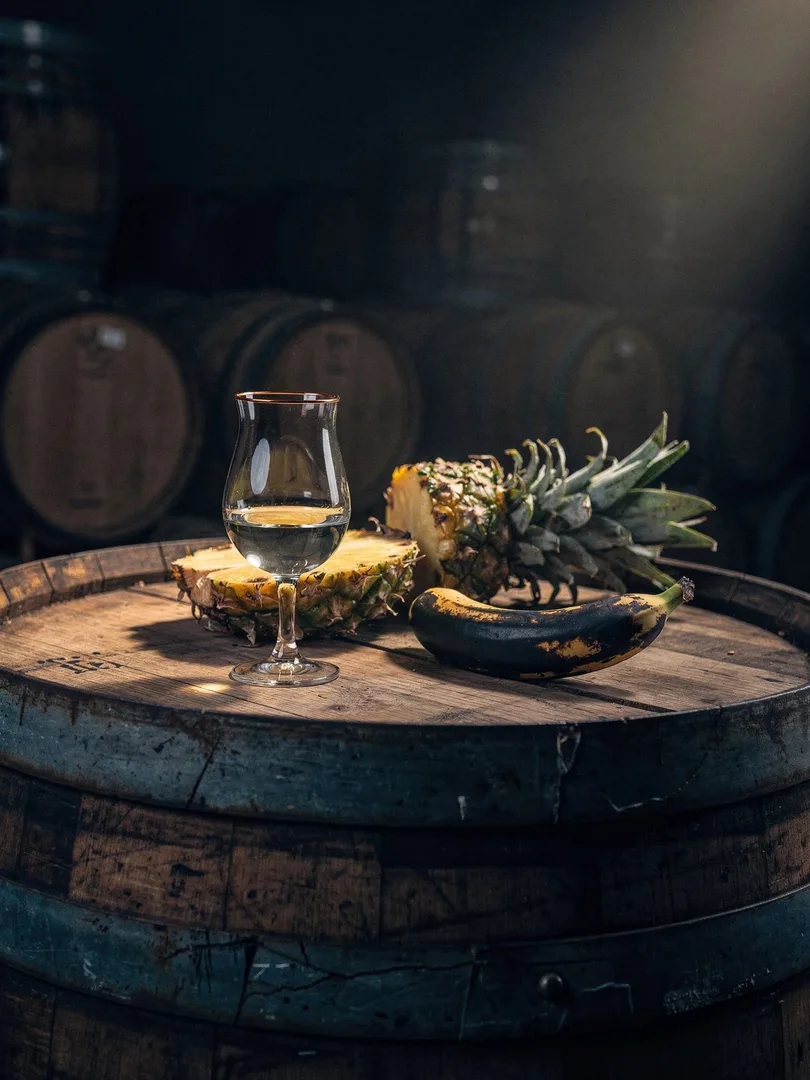
Important to understand: a value of 1,600 is about ten times higher than that of a Common Clean. At this concentration, the aroma no longer resembles friendly fruit but rather glue, solvent, and fermented pineapple in a density that's hardly pleasant to drink neat.
What High-Ester Rum Is Used For
The name Continental Flavoured reveals the buyer. It refers to the European continent, where such rums were used mainly for blending. A small portion gives a large quantity of lighter rum or neutral alcohol a noticeable rum character. This also extends to baked goods and confectionery, where a strong aroma needs to remain detectable even after baking.
In Germany, this fits with Rum-Verschnitt, a distinct spirit category in which at least five percent of the alcohol must come from rum, with the rest being neutral alcohol. A high-aroma rum is particularly well-suited to such blends because a small amount carries a lot of flavor. Legally, though, Rum-Verschnitt remains a spirit, not a rum.
More Esters, Better Rum? A Common Misconception
In rum circles, high ester values are sometimes seen as a mark of quality. This is a misunderstanding. High-ester marks are primarily tools for blending. A sipping rum, even a very bold one from Jamaica, usually falls well below these levels. Even a Common Clean already brings more fruit than many light Spanish-style rums.
These days, distilleries and independent bottlers are also releasing higher marks as standalone bottlings, often at cask strength and with the ester number printed on the label. Among others, Hampden sells the Hampden Estate and Rum Fire marks. Such bottlings are fascinating for the curious who want to understand how far fermentation can push an aroma. Still, the number itself is no measure of quality. What matters is whether fruit, acidity, wood, and alcohol are in balance.
Those wanting to work their way in should start with an aged blend and progress toward bolder bottlings. A few drops of water will open up the fruit and tame the solvent edge.