French High-Aroma Rum
Grand arôme: High-Aroma Rum from Réunion and Martinique
Grand arôme is a legally defined category for highly aromatic molasses rum from Réunion and the Le Galion sugar factory in Martinique. It requires at least 800 g of volatile congeners per hectoliter of pure alcohol; the molasses ferments for a long time together with dunder.
What does Grand arôme mean in rum?
Literally, Grand arôme means "great aroma." Unlike Jamaica's ester classes, the term is legally established, specifically within two geographical indications. One is "Rhum de la Réunion," the other "Rhum de sucrerie de la Baie du Galion," a molasses rum from the Le Galion sugar factory in La Trinité, Martinique.
Both require at least 800 g of volatile congeners per hectoliter of pure alcohol. Le Galion additionally requires at least 500 g of esters. For comparison: a white Rhum agricole from AOC Martinique needs 225, a vieux needs 325. Grand arôme thus sits well above everything else required of French rums.
The raw material matters here. Grand arôme is always molasses rum; on the French islands it's also called Rhum de sucrerie, meaning rum from the sugar factory. It has little in common with Rhum agricole made from fresh cane juice, even though both can come from the same islands.
How Grand arôme Ferments: Molasses, Vinasse, and Lots of Time
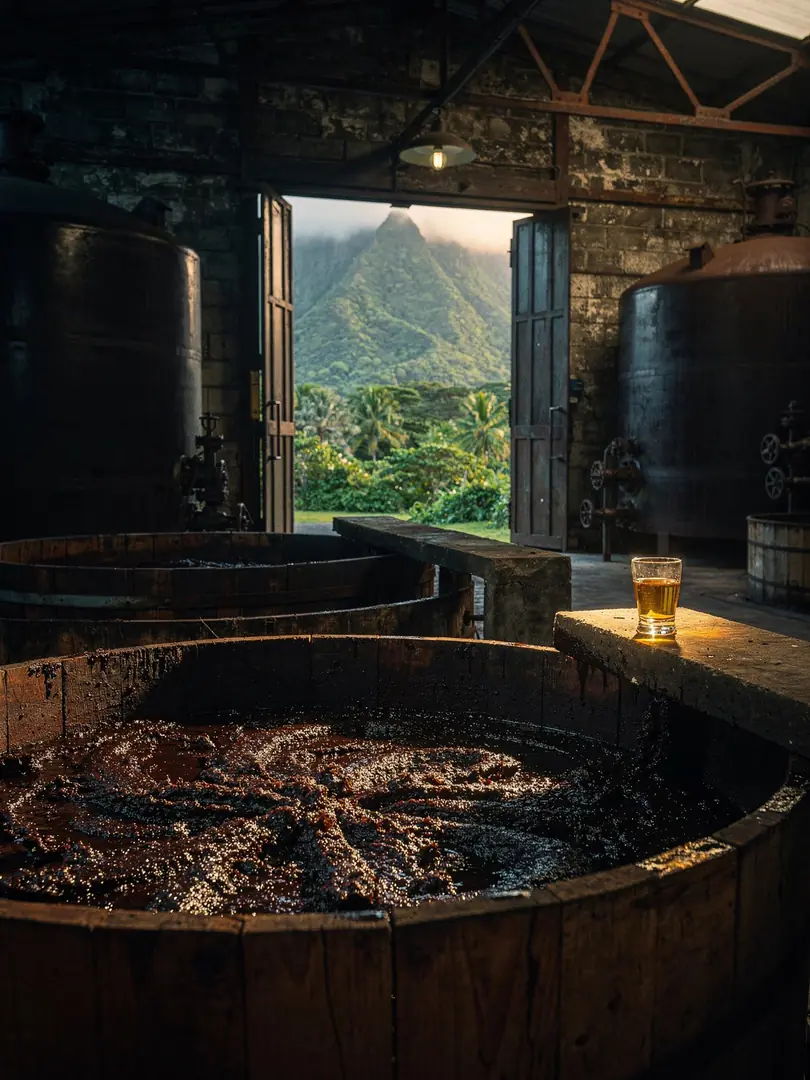
According to the Réunion specification, the wash for Grand arôme is prepared from molasses, vinasse from previous distillation runs, and water. Vinasse is the French term for dunder, i.e., the residue left in the still. It brings acids, nutrients, and microbes, similar to dunder in Jamaica.
For Le Galion, the geographical indication specifies open wooden vats and a molasses blended with more heavily exhausted molasses. "Exhausted" means that more sugar has already been extracted from it at the sugar factory. As a result, it contains less sugar and more minerals and other congeners, which feed the long fermentation.
The exact fermentation time is not specified by the regulations. Trade and producer information for individual bottlings from the Savanna distillery cite fermentation times ranging from six to fifteen days. That's many times longer than Cuba's short fermentations and comparable to Jamaica's long fermentations.
Réunion and Savanna: The Island of Molasses Rum
Réunion lies in the Indian Ocean and, as an overseas department, belongs to France. Unlike Martinique, most of the island's rum is made from molasses. Besides "agricole," the geographical indication also recognizes "traditionnel" for molasses rum, plus the categories blanc, vieux, and Grand arôme itself.
The best-known producer of Grand arôme is the Savanna distillery. Also active are Isautier in Saint-Pierre and Rivière du Mât. Since 1972, the three houses have jointly marketed the Charrette brand, an everyday rum on the island. For a long time, Grand arôme itself was mainly a blending and confectionery rum. Only in recent years have pure bottlings aimed at rum enthusiasts become more common.
Le Galion: Grand arôme from the Sugar Factory in Martinique
The geographical indication "Rhum de sucrerie de la Baie du Galion" has been protected in the EU register since February 13, 2008. It refers to the Le Galion sugar factory, which, being a sugar factory, produces its own molasses anyway. Whether distillation still takes place there continuously today is a point on which sources disagree.
The contrast on the same island is striking. Martinique is known for Rhum agricole, with short fermentation of fresh cane juice and the only AOC for rum. Le Galion represents the other end of the spectrum: molasses, wooden vats, dunder, long fermentation. Anyone tasting both side by side quickly notices how strongly raw material and fermentation shape character, even under similar climates.
In the glass, Grand arôme often shows heavy fruit notes, solvent, olive tapenade, or leather, depending on the house. Neat, this is too intense for many. In desserts, punch, or in small amounts within a cocktail, it shows its strength.